Online activity now moves faster than the tools built to secure it. Across banking, fintech and eCommerce, businesses have to verify who sits behind every interaction without slowing legitimate users down. Behavioral biometrics answers that problem by analyzing how people type, move and navigate, then building a real-time behavioral profile from those signals. This guide explains what the technology is, how it works and where it stops fraud.
quick summary
What is Behavioral Biometrics?
Behavioral biometrics is a fraud prevention technology that identifies users based on how they interact with digital environments rather than what they know (passwords) or have (devices). Monitoring real-time patterns like how a person types, moves their mouse or swipes on a touchscreen builds a digital fingerprint that is extremely difficult to spoof.
The technology is best understood as digital body language. Just as physical mannerisms like walking gait or vocal tone identify a person offline, distinctive digital behaviors identify them online. Unlike static methods, behavioral biometrics enables continuous authentication, validating identity throughout a session rather than only at login. That makes it effective against account takeover attempts, bot activity and fraudulent intent, even when credentials appear valid.
How Does Behavioral Biometrics Work?
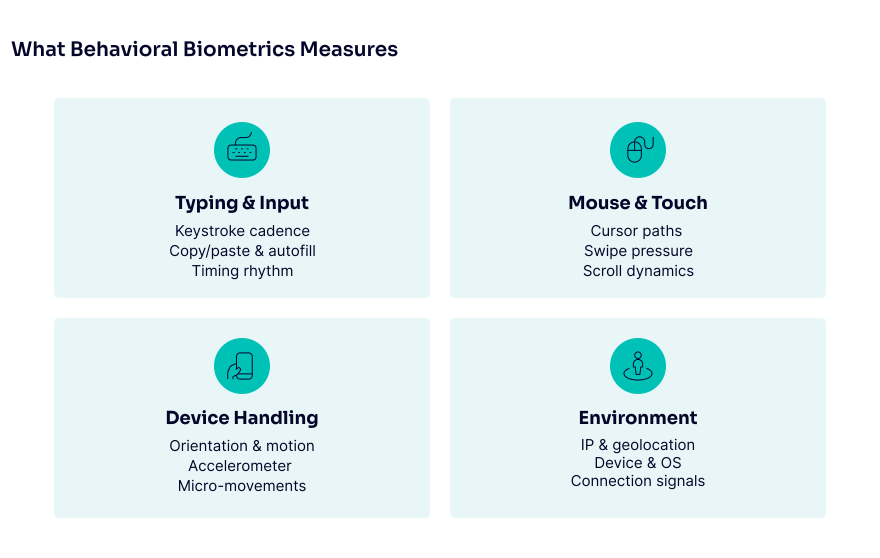
Behavioral biometric systems passively collect data during user sessions, then analyze it with machine learning (ML) to spot unusual patterns. Rather than focus on one behavior, they look at a composite of small, distinctive signals to build a real-time risk assessment. The system asks whether current behavior matches a known user profile or resembles a potential threat.
Here are the key elements behavioral biometrics typically evaluates:
- Typing behavior: measures cadence, speed and timing to flag unusual keystroke patterns.
- Mouse or cursor movement: tracks how a user moves, clicks and navigates across a screen.
- Touchscreen activity: detects pressure, swipe gestures and interaction speed on mobile devices.
- Device handling: analyzes movement and orientation using built-in sensors like accelerometers and gyroscopes.
- Input methods: identifies copy/paste or autofill use that may suggest automation or credential stuffing.
- Environmental cues: considers contextual data like IP address, location and device type to strengthen risk scoring.
These systems establish a behavioral baseline for each user during routine activity, then continuously compare live sessions against it. Because the profile draws on dozens of parameters at once, it is remarkably resistant to replication. Advanced ML separates natural variation from suspicious deviation: a slight change in typing speed reads as normal, while a dramatic shift in navigation or rhythm triggers a risk alert.
Device intelligence adds another layer of context. Alongside behavioral patterns, these systems weigh device type, operating system, browser configuration and connection parameters, then factor in geolocation to check whether the current location fits the user’s history. Combining these data points enables real-time fraud detection without interrupting the customer journey.
From Static to Dynamic Authentication
Traditional authentication relies on static credentials like passwords, security questions and even fingerprints that verify identity at a single point in time rather than continuously. That binary check leaves gaps, and those gaps widen as transactions grow faster and span more channels and devices.
The weakness is clearest during account takeover (ATO) attacks, where criminals use stolen credentials to hijack legitimate accounts. These attacks have grown more sophisticated with artificial intelligence (AI), combining credential stuffing, phishing and social engineering to bypass traditional defenses, plus SIM swaps to defeat two-factor authentication (2FA). Static tools struggle here because they cannot separate a real user from a skilled impostor holding the right credentials.
Behavioral biometrics closes that gap during account creation. It can tell whether an account is opened by hand or by a bot, whether card details are typed or pasted, and whether a cursor travels from one point to another in a suspiciously straight line. With bots opening accounts at scale, distinguishing human from automated behavior through strong signals makes a decisive difference to fraud outcomes.
“Behavioral biometrics is essentially digital body language. Users leave behind distinctive patterns in how they type, move and hold their devices, and those patterns are nearly impossible for fraudsters to replicate. That is what lets us turn authentication from a one-time gate into a continuous, invisible layer of defense.”
Tamás Kadár, CEO & Co-Founder, SEON
Why Is Behavioral Biometrics Important?
Cybercriminals no longer need to guess passwords or hack devices because they can buy everything they need on the dark web. Personal data is cheap and accessible, and static tools like one-time passcodes, device IDs and login credentials are routinely bypassed through phishing, malware and social engineering.
Behavioral biometrics steps into that gap with real-time, context-aware detection based on how people behave, not just what they know or hold. It provides strong, continuous authentication without the challenge-response friction that frustrates customers and drives drop-offs. Working quietly in the background, it picks up subtle signs of risk such as robotic copy-pasting, erratic touchscreen gestures and unusual session lengths. In a landscape where attackers often look legitimate on the surface, that dimension of defense is essential to maintaining digital trust at scale.
7 Types of Behavioral Biometrics
Behavioral biometrics isn’t limited to how people type or move a mouse. It captures a wide array of human behaviors across web and mobile environments — many of which are difficult to replicate with automation or social engineering. Here are seven distinct types that provide a deeper behavioral fingerprint for detecting fraud:
- Navigation Flow Patterns: This refers to the path users take through an application or website. Behavioral systems evaluate how users progress through steps, pages and screens — including backtracking, skipping or hesitating on specific actions. Fraudsters often move with unnatural precision or speed compared to legitimate users who follow more organic, varied flows.
- Field Focus Behavior: The system observes how users interact with individual form fields — including how often they click in and out, pause before typing or revisit specific fields. Real users display hesitation, re-typing and second-guessing. Bots or scripted tools, in contrast, show rigid, highly repeatable field behavior.
- Scroll Dynamics: Human scroll behavior tends to be inconsistent. Behavioral systems monitor scrolling speed, frequency and direction — all of which can reflect user intent or comfort level. Uniform scroll behavior, erratic speed changes or scripted jumps are red flags associated with automation or spoofing attempts.
- Gesture Recognition in Mobile Apps: On mobile, behavioral biometrics captures multi-touch gestures like pinch-to-zoom, directional swipes or tap pressure variations. These actions reflect physical muscle memory and are difficult to fake remotely. A lack of natural gestures or overly robotic touch patterns can expose fraudulent sessions.
- Tab Switching and Multi-Tasking Behavior: Legitimate users often toggle between browser tabs or apps, especially when cross-referencing information. Behavioral systems detect patterns like idle time, context switching and window focus changes — behaviors typically absent in bot or synthetic sessions, which tend to be linear and uninterrupted.
- Inertia and Micro-Movements: Behavioral systems can detect subtle, involuntary device movements using data from motion sensors (like gyroscopes and accelerometers). These micro-movements—even while a device appears still—are unique to each user and nearly impossible to reproduce using emulators, bots or remote desktop tools.
- Correction Patterns and Input Revisions: How a user corrects mistakes says a lot about their authenticity. Whether they delete characters mid-word, re-enter fields multiple times or make spelling corrections, these actions create behavioral depth. Automation and credential stuffing tools rarely show this imperfection, making input revision behavior a powerful fraud signal.
How Behavioral Biometrics Powers Dynamic Friction
Dynamic friction is one of the most valuable applications of the technology. Traditional security applies the same verification to everyone, adding needless friction for genuine customers while still leaving room for skilled fraudsters. A smarter approach scales security to each interaction’s risk level, using behavioral analysis to decide when extra verification is warranted.
Continuous monitoring makes this possible. A long-standing customer logging in from a recognized device and location, with expected behavior, meets minimal verification. If that same profile suddenly attempts a high-value transfer from an unfamiliar device, types erratically or shows signs of remote access tool (RAT) usage, the system escalates — prompting multifactor authentication, liveness checks or a temporary account freeze.
Social engineering scams sharpen the need for this. Fraudsters often coerce victims into installing RATs, then take control of the device to push transactions through. Paired with device intelligence, behavioral biometrics flags anomalies like unusual device control, screen-sharing activity or abrupt shifts in interaction, so teams can block the transaction or require voice verification in real time.
The payoff extends beyond security. Organizations using these adaptive strategies report meaningful reductions in false positives, the legitimate transactions wrongly flagged as fraud that inflate operating costs and erode customer relationships. Separating normal variation from genuine risk keeps real users moving while high-risk activity gets caught fast.
Use Cases for Behavioral Biometrics
Behavioral biometrics shines in scenarios where traditional authentication falls short — especially when users appear legitimate on the surface, including:
- Account Takeover Prevention: Behavioral biometrics flags inconsistencies between a known user’s behavior and that of an imposter — even if credentials are correct. Real-time session analysis helps block fraudulent transfers and protect customer accounts.
- New Account Fraud Detection: Fraudsters using automation to open fake accounts leave behind unnatural behavior patterns. Behavioral signals can detect this activity early in the funnel, reducing risk without delaying onboarding.
- Social Engineering Scam Intervention: Behavioral biometrics can detect stress signals like fragmented typing or unusual session timing and trigger step-up authentication even when a legitimate user is coerced- such as during an authorized push payment scam.
- Mule Account Detection: Behavioral patterns reveal repeated suspicious activity linked to money mule operations, such as high-volume transfers, consistent use of automation or behavior inconsistent with legitimate users.
How Behavioral Biometrics Enhances Fraud Prevention
Traditional fraud prevention methods like 2FA, device checks and static biometrics verify identity at isolated points, which makes them reactive and easy to bypass at scale. Behavioral biometrics monitors the whole session instead. It does not ask “is this the right device?” but “is this the right person, behaving as expected?”
That shift delivers three advantages:
- One connected layer. It replaces stitched-together point solutions with continuous, in-session insight, improving accuracy while reducing false positives and speeding up response.
- Real-time intent profiling. It analyzes thousands of micro-patterns to build a baseline that is nearly impossible to fake, catching account takeover even when the password is correct.
- Threat adaptation. It flags bot-driven signups and users acting under duress, adapting to new tactics instead of relying on static rules or hardcoded thresholds.
Best Practices for Implementing a Behavioral Biometric Solution
Deploying behavioral biometrics effectively requires more than just enabling a new data stream — it’s about embedding behavioral intelligence into the right moments across the user journey. A well-implemented solution should minimize friction for trusted users while providing real-time defense against increasingly subtle and complex fraud tactics.
The following best practices can help organizations unlock the full value of behavioral biometrics while ensuring privacy, accuracy and operational efficiency:
- Start with High-Risk Flows: To immediately reduce exposure to fraud, begin implementation where the impact is highest—such as account creation, login and transaction authorization.
- Prioritize Passive Monitoring: Behavioral biometrics should enhance, not disrupt, the user experience. Ensure the solution operates invisibly in the background, applying friction only when risk is detected.
- Integrate with Existing Tools: A behavioral biometric solution should complement your current fraud stack. For maximum visibility, connect it to your scoring engine, rules-based systems or orchestration layer.
- Customize Your Risk Profile: Tune behavioral models to your specific user base and threat landscape. Fraud in fintech may look different than in iGaming or eCommerce — your signals should reflect that.
- Monitor Data Privacy & Compliance: Collect only the behavioral data you need. Ensure all data is encrypted, stored securely and used exclusively for fraud prevention, not marketing or profiling.
- Test & Refine Continuously: Use A/B testing and retrospective analysis to calibrate your risk thresholds, validate performance and refine behavioral indicators for accuracy over time.
- Educate Internal Teams: Ensure the fraud, risk and customer experience teams understand how behavioral data is used and how to act on insights. The cross-team collaboration will maximize ROI.
Building Trust Through Smarter Fraud Prevention
As fraud becomes more complex and digital interactions grow more personal, businesses need security strategies that evolve alongside user behavior. Behavioral biometrics offers that evolution — providing continuous, invisible authentication that strengthens fraud prevention without introducing unnecessary friction.
By adopting behavioral biometric solutions, companies can stay ahead of attackers, reduce false positives and deliver seamless, secure user journeys. Whether you’re fighting bots, stopping account takeover or safeguarding digital onboarding, behavioral biometrics helps transform real-time behavioral signals into smarter fraud decisions.
Frequently Asked Questions
How does behavioral biometric fraud detection work?
It continuously monitors how users interact with digital platforms — analyzing inputs like typing rhythm, mouse movement and screen behavior — to build a behavioral profile. When current behavior deviates from a known pattern or resembles automation or coercion, the system flags it as suspicious in real time.
What fraud types can behavioral biometrics detect?
Behavioral biometrics can detect a wide range of fraud, including account takeovers (ATOs), new account fraud, bot and automation attacks, money mule behavior and social engineering scams. It’s especially effective at identifying threats that bypass traditional checks but leave behind abnormal behavioral signals.
How do businesses use behavioral biometrics for fraud prevention?
Businesses integrate behavioral biometrics into their fraud prevention stack to monitor user sessions, assign risk scores, trigger dynamic friction (like step-up authentication) and block or flag suspicious activities. It helps differentiate real users from fraudsters without disrupting the experience for trusted customers.
What is a behavioral biometric solution?
It’s a technology platform or SDK that captures and analyzes real-time behavioral signals during digital interactions. These solutions can be deployed on web and mobile applications and are often used alongside device intelligence, scoring engines or orchestration tools to detect fraud and minimize user friction.