quick summary
List of KYC Software & Tools
What Is KYC Software?
KYC software helps organizations verify customer identities to comply with global regulations and prevent financial crime. As a core component of Customer Due Diligence (CDD), this technology automates the collection and validation of personal data, such as government-issued IDs and biometrics, so every user is real and legally identifiable.
KYC Software and Tools Compared
The table below summarizes how each provider covers the core pillars of a KYC program: identity verification, AML screening and ongoing monitoring.
| Provider | Document + biometric / liveness | AML / sanctions & watchlist screening | Ongoing / continuous monitoring |
|---|---|---|---|
| SEON | Yes | Yes | Yes |
| Sumsub | Yes | Yes | Yes |
| iDenfy | Yes | Yes | Not stated* |
| Entrust IDV (formerly Onfido) | Yes | Partial | Not stated* |
| Alessa | Partial | Yes | Yes |
| Trulioo | Partial | Yes | Not stated* |
| Ondato | Yes | Yes | Yes |
| Jumio | Yes | Partial | Yes |
| Shufti | Yes | Yes | Not stated* |
“Not stated” means the capability is not described in this comparison’s sourced vendor materials, not that it is unavailable. Capabilities change often, so confirm current scope with each provider before relying on it.
List of KYC Software & Tools
Disclaimer: All information in this article is based on publicly available sources gathered through online research. We haven’t tested each tool directly. The content was last updated on September 2026. If you spot anything outdated or would like to suggest an update, feel free to get in touch here.
SEON
SEON is a fraud prevention and AML compliance platform that pairs identity verification with real-time risk signals. Rather than relying only on document uploads or biometrics, it analyzes a user’s digital footprint (email, phone, IP), device intelligence and behavioral data from the first interaction, so teams can assess risk before running full KYC checks.
The platform brings pre-KYC risk filtering, document and liveness verification, real-time risk scoring across 1,100+ signals, AML and watchlist screening and configurable no-code workflows into one system. Because identity verification, risk signals and AML screening sit on a single platform, teams can flag high-risk users earlier and reduce manual reviews without adding friction for legitimate customers.
Key capabilities include: pre-KYC digital footprint analysis, device intelligence, document, proof of address and liveness verification, AML and watchlist screening, and no-code workflow rules. Read SEON reviews on G2.
Sumsub
Sumsub is an identity verification and compliance platform that supports onboarding and ongoing checks across multiple markets. It offers a broad set of modules, including ID verification, liveness, proof of address, business verification (KYB), AML screening and ongoing re-screening, with configuration options for different risk levels and jurisdictions.
It covers multiple verification and compliance steps within one platform, with configurable workflows and coverage across several geographic regions.
Key capabilities include: ID verification, liveness, proof of address, KYB, AML screening and ongoing monitoring.
iDenfy
iDenfy is an identity verification and compliance platform covering KYC, Know Your Business (KYB) and AML workflows across global markets. It supports a wide range of government-issued IDs, includes liveness checks, and offers sanctions and Politically Exposed Person (PEP) screening.
It combines automated verification with 24/7 human review for cases that need manual assessment, and integrates via API.
Key capabilities include: document verification, liveness, KYC and KYB, sanctions and PEP screening, and hybrid automated plus human review.
Onfido
Entrust IDV, formerly Onfido, is an identity verification product that uses document checks, biometrics and liveness detection to support onboarding across many countries and ID types. Onfido was acquired by Entrust in April 2024 and is now marketed as Entrust IDV, so buyers evaluating older “Onfido” material should confirm current product naming and roadmap.
Integration is available via API and capture SDKs, with options to customize workflows. Its focus is document and biometric verification with liveness detection, backed by manual review for edge cases.
Key capabilities include: document verification, biometrics, liveness detection, API and capture SDK integration, and configurable workflows.
Alessa
Alessa is an AML compliance platform that includes identity verification and KYC tooling, combining screening and ongoing monitoring in one workflow. It integrates with data providers such as Refinitiv World-Check and Dow Jones for sanctions, PEP and adverse media checks, and identity results feed into transaction monitoring, risk scoring, case management and reporting.
Key capabilities include: sanctions, PEP and adverse media screening, transaction monitoring, risk scoring, case management and reporting.
Trulioo
Trulioo is an identity verification platform that supports KYC, KYB and AML checks across global markets. It provides access to a large network of data sources and document types, covering individuals and businesses in many jurisdictions. The platform offers modular verification services, configurable workflows and API-based integration to support onboarding and compliance needs.
It covers individuals and businesses across many jurisdictions and is oriented toward organizations operating in multiple regions.
Key capabilities include: KYC and KYB verification, a large network of data sources and document types, AML checks, modular services and API integration.
Ondato
Ondato is a Lithuania-based compliance platform that provides KYC, KYB and AML tools for identity verification and onboarding. Features include biometric face matching, video checks, age verification and AML screening. Ondato supports verification in 192 countries and offers automation and configurable workflows. It also includes customer data management, due diligence features and partner-based support for transaction monitoring, with use cases across fintech, crypto, telecom and marketplace platforms.
Key capabilities include: biometric face matching, video checks, age verification, AML screening, customer data management and configurable workflows.
Jumio
Jumio is a digital identity verification and identity assurance platform that offers KYC identity verification through a combination of document checks, biometric authentication, liveness detection and database validation. It verifies users in real time and supports thousands of ID types across more than 200 countries and territories.
Beyond initial verification, Jumio incorporates ongoing risk assessment through behavioral signals and identity reputation analysis. Its platform includes an analytics dashboard that centralizes monitoring, transaction review and rule management.
Key capabilities include: document checks, biometric authentication, liveness detection, database validation, ongoing risk assessment and an analytics dashboard.
Shufti Pro
Shufti offers KYC software covering identity verification, fraud prevention and global compliance. Its solutions include electronic KYC (eKYC), KYB, Know Your Investor (KYI) and biometric authentication, with coverage across 240+ countries and support for 150+ languages.
It supports onboarding, transaction verification and AML and Combating the Financing of Terrorism (CFT) checks, and is used across industries such as fintech, crypto, gaming and e-commerce.
Key capabilities include: eKYC, KYB, KYI, biometric authentication, and broad geographic and language coverage.
Top Features to Look For in KYC Software
Most tools cover ID checks and AML screening, but the best setups also add risk signals early to reduce fraud and onboarding friction.
- KYC orchestration and adaptive workflows: Apply the right checks based on real-time risk. This allows low-risk users to move through onboarding faster while automatically escalating high-risk cases for review.
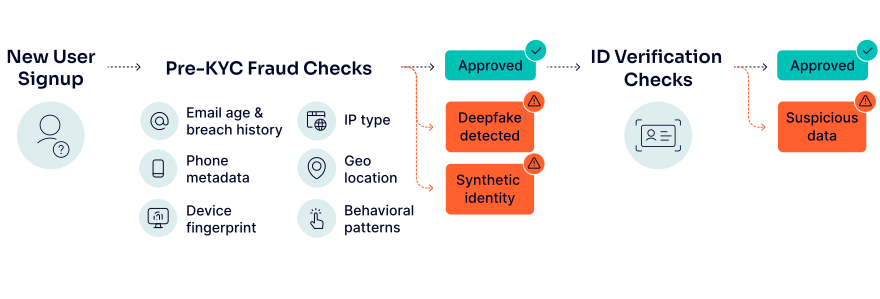
- Early risk signals before document upload (pre-KYC): Identify high-risk users early using digital footprint, device, and behavioral signals. This filters out bad actors before requesting ID documents, reducing friction and failed verifications.
- Digital footprint analysis (email, phone, IP): Assess user legitimacy by evaluating email age, phone reputation, IP history, and geolocation patterns to ensure the digital identity matches the physical one.
- Device intelligence and environment checks: Detect VPNs, emulators, spoofed environments and linked devices to uncover sophisticated fraud attempts that slip past basic identity checks.
- Behavioral signals and bot detection: Monitor how users interact with forms to flag automation, bots, and abnormal behavior that is inconsistent with legitimate human usage.
- Document, liveness and proof-of-address verification: Verify government-issued documents, confirm a real human is present via liveness detection, and validate address information where required.
- AML screening and ongoing monitoring: Screen verified users against sanctions, PEP, and watchlists, and continuously monitor them for risk profile changes over time.
- Cross-session identity and account linking: Detect repeated or coordinated activity by linking identities, devices, and behaviors across different sessions and accounts.
The 5 Steps of the KYC Process
While regulatory requirements vary globally — shaped by frameworks like the USA PATRIOT Act in the US and AML Directives in Europe — the core workflow remains consistent. A robust KYC process is not just about collecting ID cards; it is a structured framework for identifying, assessing, and responding to risk.
Here are the five essential stages of a modern KYC process:
Customer Identification Program (CIP)
This is the foundational stage where you collect PII (Personally Identifiable Information) to establish a reasonable belief that the user is who they claim to be. Financial institutions must gather core data points like name, date of birth, address, and identification numbers. However, in a digital-first world, simply collecting this data is rarely enough to guarantee trustworthiness, as fraudsters easily use real or synthetic identities to get past basic checks.
Pre-KYC Filtering (The SEON Approach)
Before paying for expensive document verification, modern teams apply a “Pre-KYC” filter to control spend and catch bad actors early. By analyzing a user’s digital footprint—email history, phone reputation, and device intelligence—you can identify high-risk users immediately at signup. This allows you to block obvious fraudsters before they ever reach the costly ID verification stage, ensuring your budget is spent only on legitimate customers.
Customer Due Diligence (CDD)
Once the user passes initial screening, CDD assesses their actual risk profile. This involves validating their identity documents and screening them against global sanctions, watchlists, and PEPs (Politically Exposed Persons). Effective CDD goes beyond just ticking boxes; it evaluates whether a customer’s behavior and intended activity align with legitimate use, helping you distinguish between a good user and a bad actor with a stolen ID.
Enhanced Due Diligence (EDD)
For higher-risk scenarios, such as users from high-risk jurisdictions or those flagging as PEPs, the process escalates to Enhanced Due Diligence. This stage requires deeper investigation, including verifying sources of funds and checking for adverse media. Crucially, a flexible KYC workflow applies this friction dynamically—letting low-risk users pass quickly while reserving these intensive (and expensive) checks only for the sessions that truly warrant them.
Ongoing Monitoring
Risk is not static, so verification cannot be a one-time event. You must continuously monitor customer activity for changes in behavior, such as sudden spikes in transaction volume, unusual cross-border payments, or new sanctions listings. If a user’s risk profile shifts, the system should trigger an immediate review or file a Suspicious Activity Report (SAR), ensuring you remain compliant throughout the entire customer lifecycle.
How to Choose the Right KYC Software
With so many tools on the market, finding the right KYC software can be difficult. The right solution should detect fraud early, keep legitimate customers moving and scale with the business without forcing teams to bolt together separate tools.
Here are the key factors to consider when evaluating options:
Fraud Detection Signals
ID and document checks aren’t enough. Strong KYC software uses digital footprint analysis, device intelligence and behavioral signals to find high-risk users before they even reach the verification stage.
Risk-based Workflows
The best software lets you adjust the strictness of your checks based on the situation. Low-risk users should move through with minimal friction while suspicious cases trigger additional checks automatically. Configurable workflows that balance conversion with compliance, without requiring engineering resources to adjust, are a key differentiator.
Liveness and Deepfake Detection
Make sure the provider can prove a real person is actually behind the screen. Strong liveness detection should go beyond static selfie checks to effectively catch spoofing attempts, replay attacks and deepfakes.
AML Screening
KYC and AML don’t have to live in separate systems. Integrated sanctions, PEP and adverse media screening means verified identity data feeds directly into compliance checks — reducing false positives and manual review volume.
Your software should have built-in checks for sanctions, PEPs and global watchlists. This helps you follow the law in different countries while reducing the number of false alarms your team has to review manually.
Integration and Customization
The ideal software should fit into the existing stack, not the other way around. Well-documented APIs or SDKs, flexible UI options and the ability to customize rules and workflows to match specific risk appetites all make integration easier.
Scalability
Teams operating across multiple regions need a platform built for global coverage. That means broad document support, multilanguage flows and the ability to handle volume spikes without degrading performance or requiring a full rebuild.
Pricing
Transparent pricing matters, but so does what’s included. Whether the vendor charges per verification, per approved user or on a flat model, the cost of manual reviews, false positives and integration overhead should factor into the comparison. A lower sticker price can get expensive fast if accuracy is poor.
Frequently Asked Questions
Why do you need to invest in KYC software?
KYC software is one of the most convenient solutions for automating Know Your Customer checks. These are legal requirements in a growing number of industries, including finance, iGaming, and crypto exchanges. KYC software can help you avoid compliance fines and accelerate customer verification to onboard more new customers without spending additional resources.
How do KYC tools reduce onboarding abandonment without increasing fraud risk?
Risk-based workflows apply friction proportionally. Low-risk users — those with low-risk profiles based on device, IP and behavioral signals,— can move through quickly while high-risk users trigger additional verification steps.
How should KYC be handled for businesses with multiple products or regions?
Use policy segmentation so verification depth adapts by geography, product risk level and customer profile. A business onboarding retail consumers in a low-risk jurisdiction requires different verification depth than one onboarding high-value financial services customers in a high-risk market.
What regulatory frameworks govern KYC requirements for fintechs and iGaming operators?
Requirements vary significantly. US fintechs fall under FinCEN’s Customer Due Diligence Rule and the Bank Secrecy Act. UK-regulated firms follow FCA guidelines informed by the Money Laundering Regulations. iGaming operators are governed by their licensing jurisdiction, with MGA, UKGC, Gibraltar and others each carrying specific player verification standards. Global alignment draws on FATF Recommendations.
What are the best integrated KYC and fraud detection platforms that can streamline player onboarding?
The strongest platforms combine identity verification, real-time fraud detection and AML screening in a single workflow rather than requiring separate tools for each function. A unified platform reduces handoffs between systems, lowers manual review volume and shortens time-to-approval — all of which directly impact onboarding completion rates.