
Rules & AI Risk Decisioning
Catch More Fraud With Logic You Control
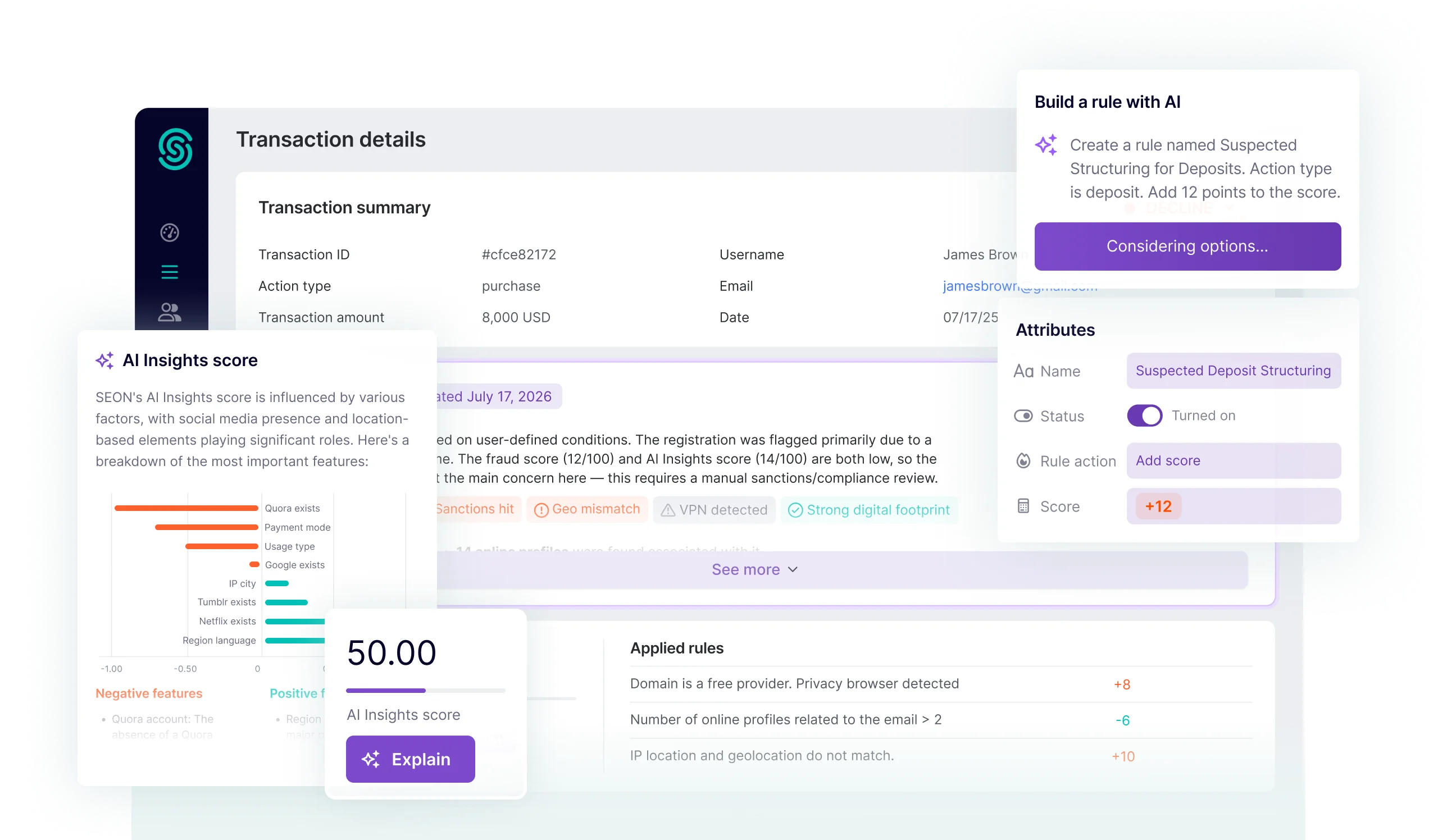
Build fraud and AML decision logic using SEON’s 1,100+ risk signals plus your own data and transaction history. Use rules, AI risk scoring or both, see the evidence behind every score and test any change against real history before it touches a live decision.
Trusted by the World’s Most Ambitious Companies


Rules & AI Risk Scoring
Turn Unique Signals Into Decisions You Can Explain
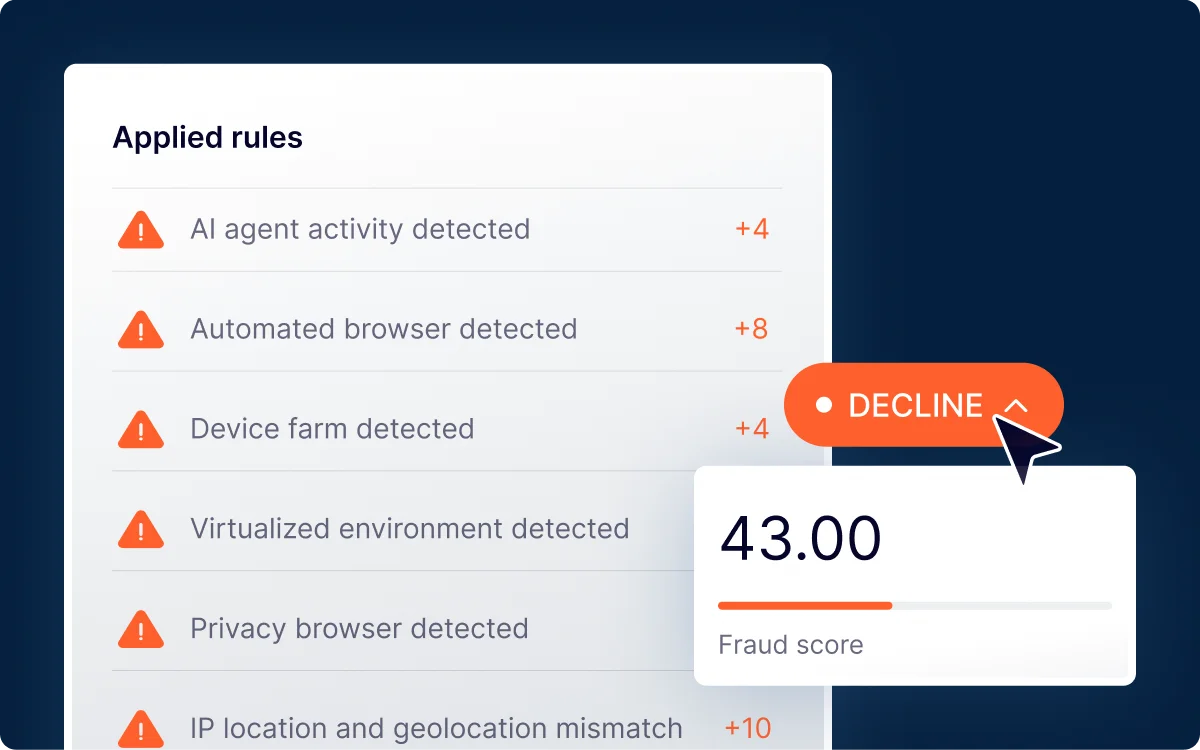
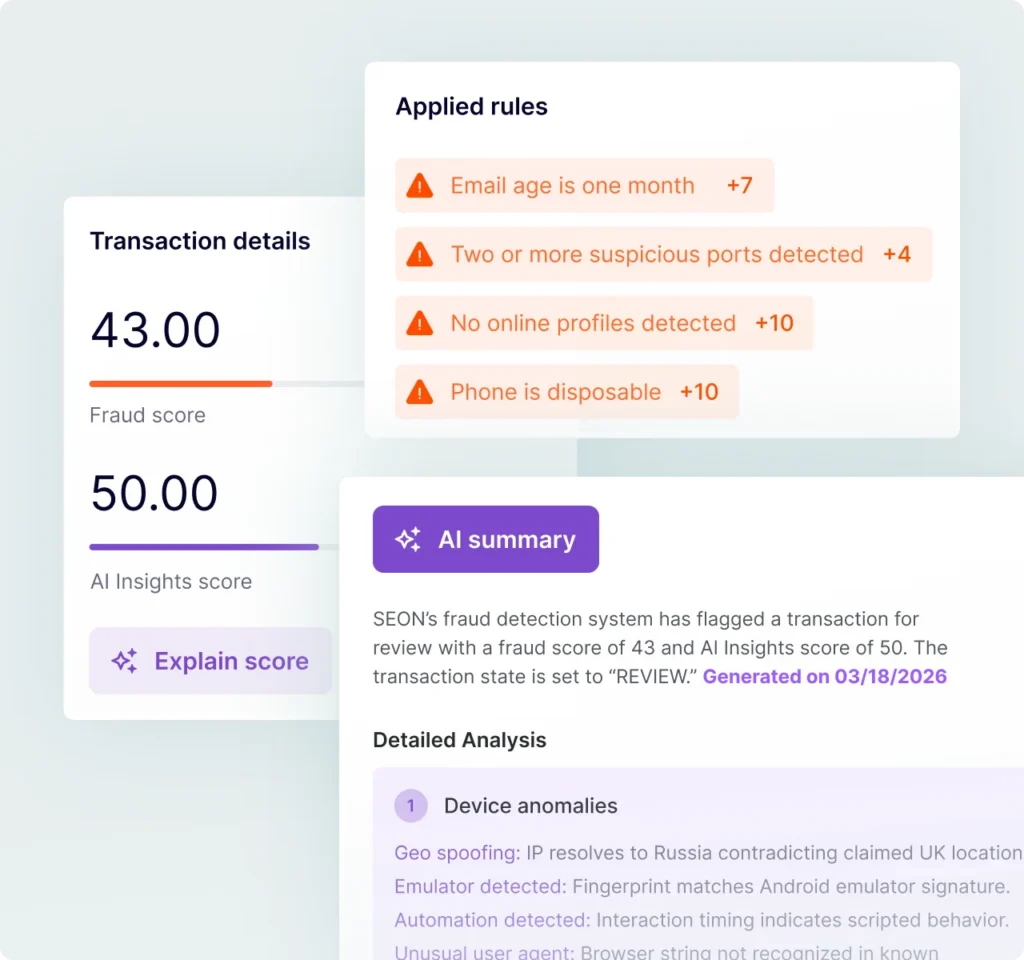
Legacy tools feed third-party data into opaque models and hand you a verdict. SEON gathers every signal first-hand, in real time, and shows its work, so an analyst can act on a score in seconds and back up their decision with hard evidence.
Fraud Score
Build Rules to Stop the Fraud You Anticipate
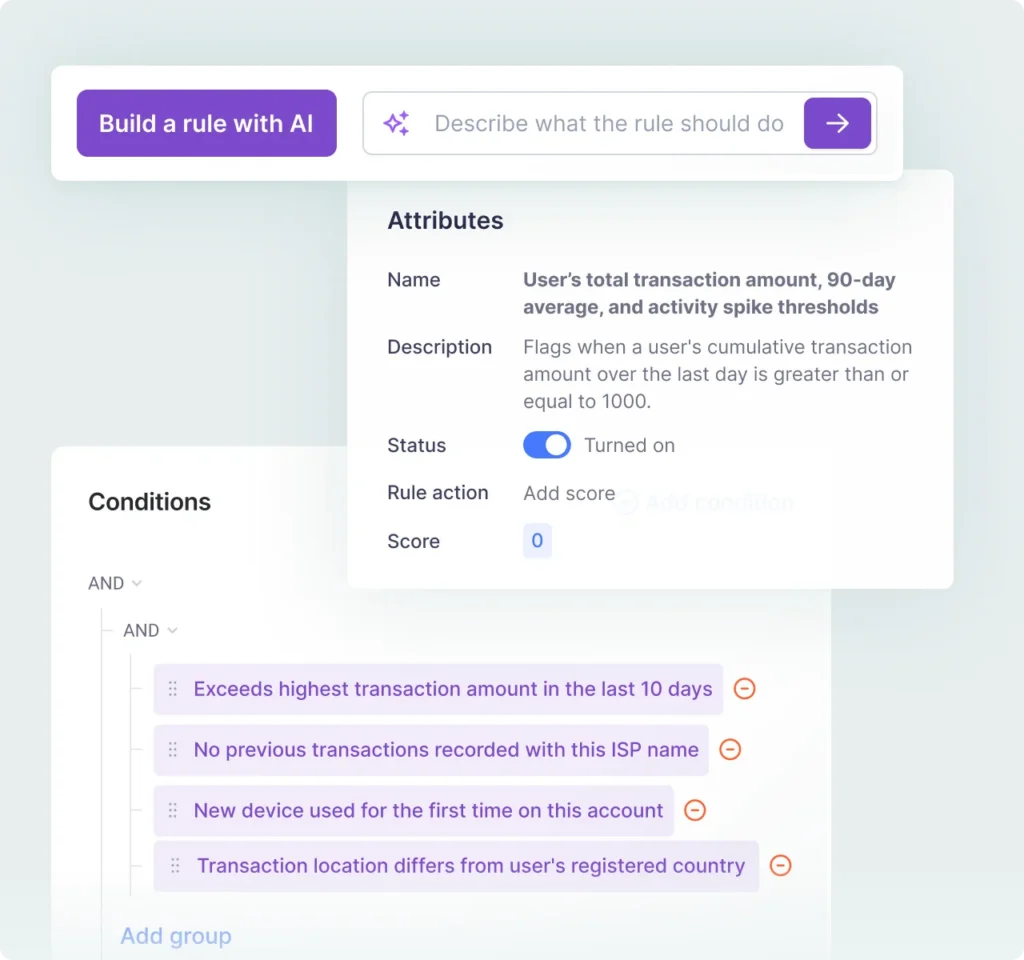
Set conditions that add to or reduce the fraud score, or directly approve, review or decline an event. You control the rule values and thresholds so they reflect your risk appetite rather than vendor defaults.
AI INSIGHTS SCORE
Let AI Spot Fraud Patterns Your Rules Miss
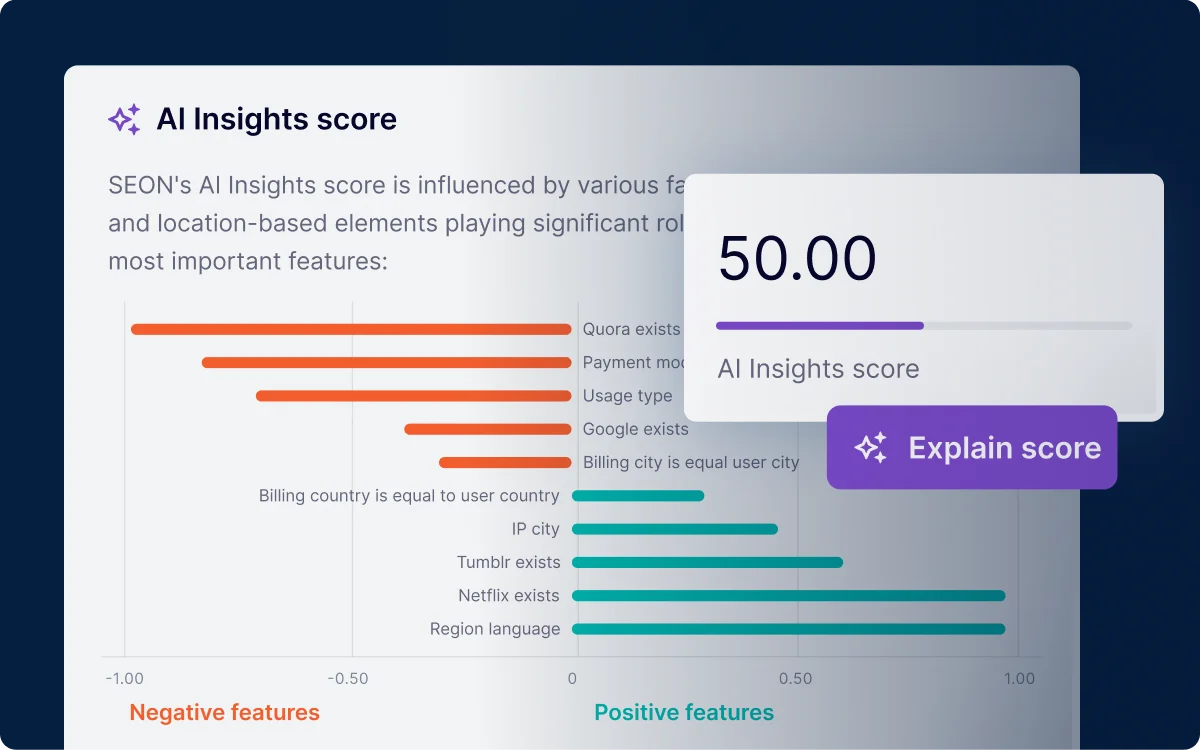
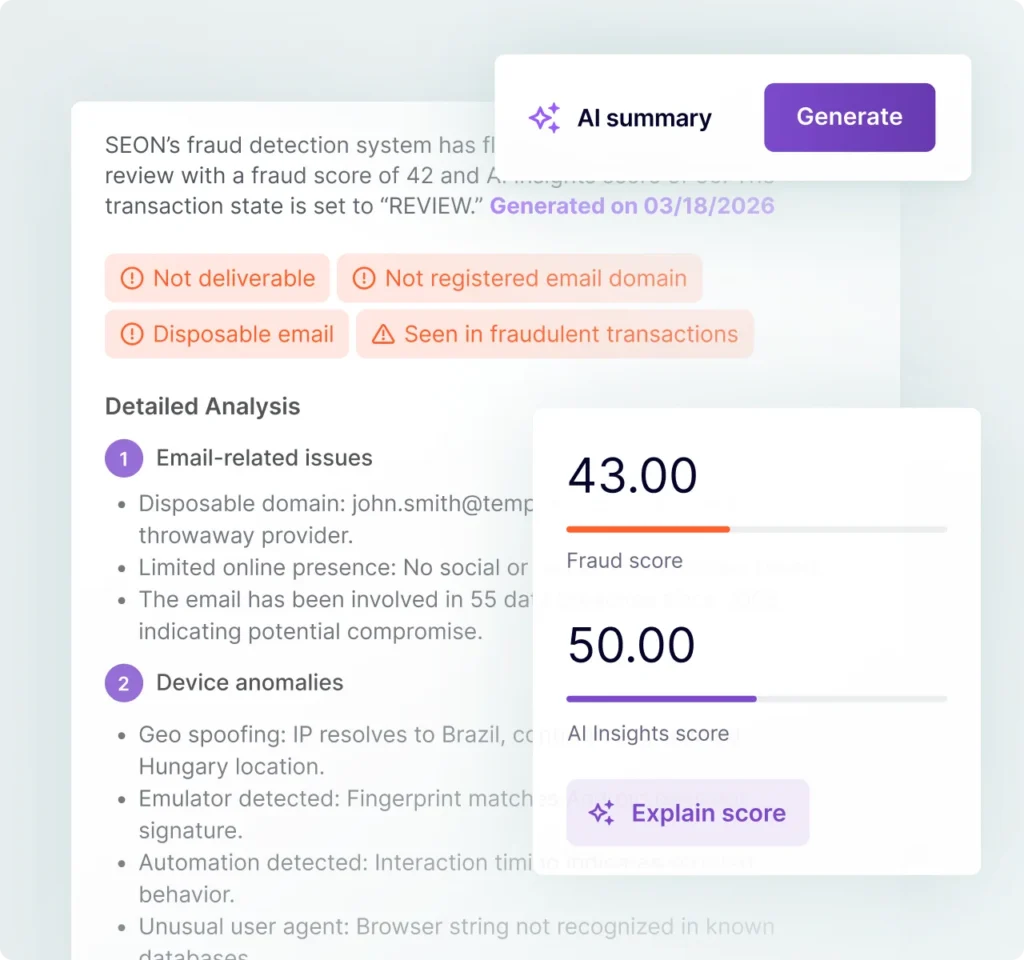
Your own personalized AI Insights Score analyzes patterns across all of SEON’s unique signals and returns a fraud probability score from 0 to 100, calculated separately from your rule-based fraud score.
Put Your Risk Strategy Into Action
Build and test rules, train AI on confirmed outcomes and automate the work that follows a decision.
Build or Edit Rules With AI
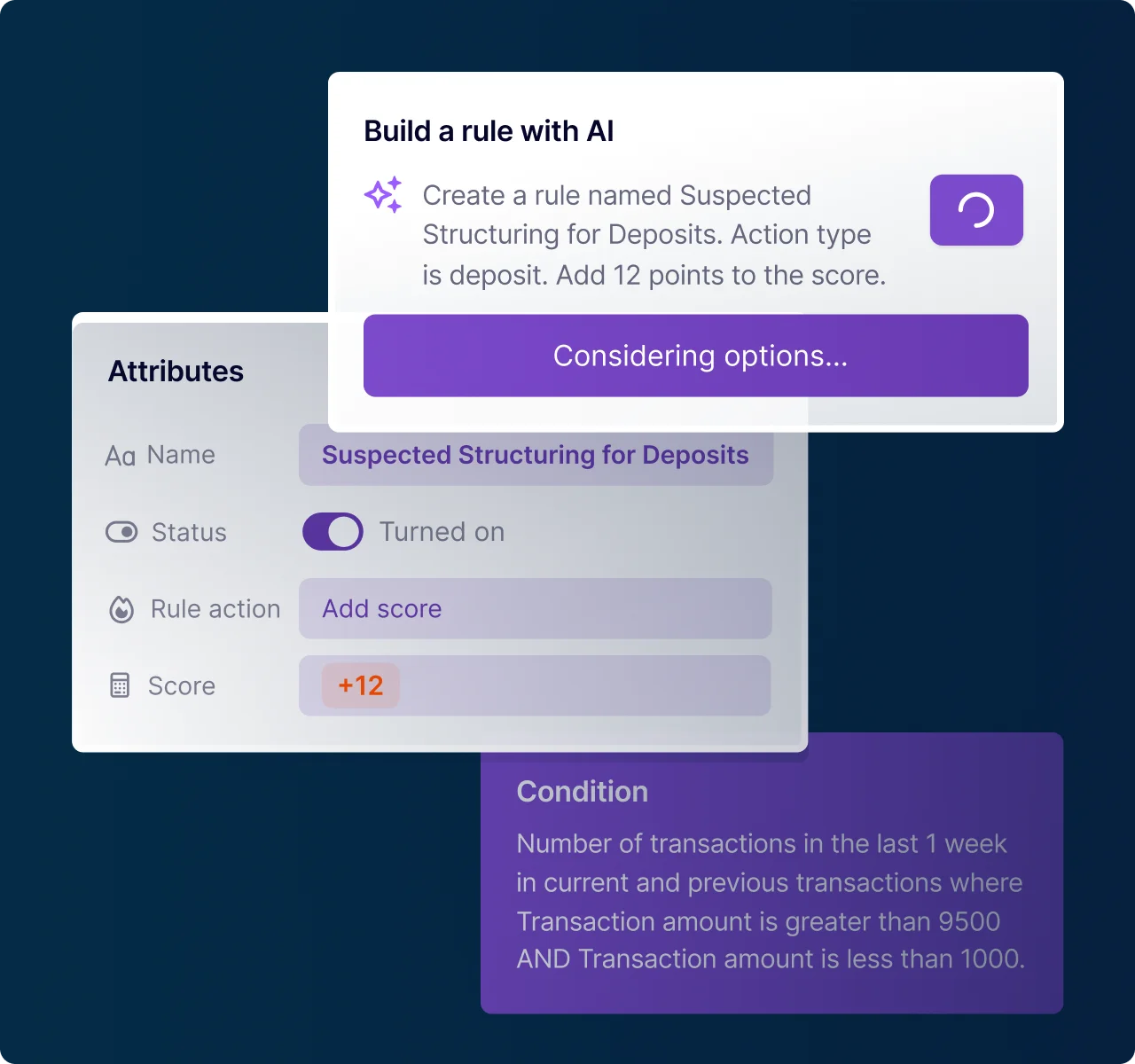
Describe what you want to detect and let AI turn it into rule logic. Create new rules or update existing ones, refine the result with follow-up prompts or manual edits, and review the conditions before enabling the rule.
Spot New Patterns With AI Rule Suggestions
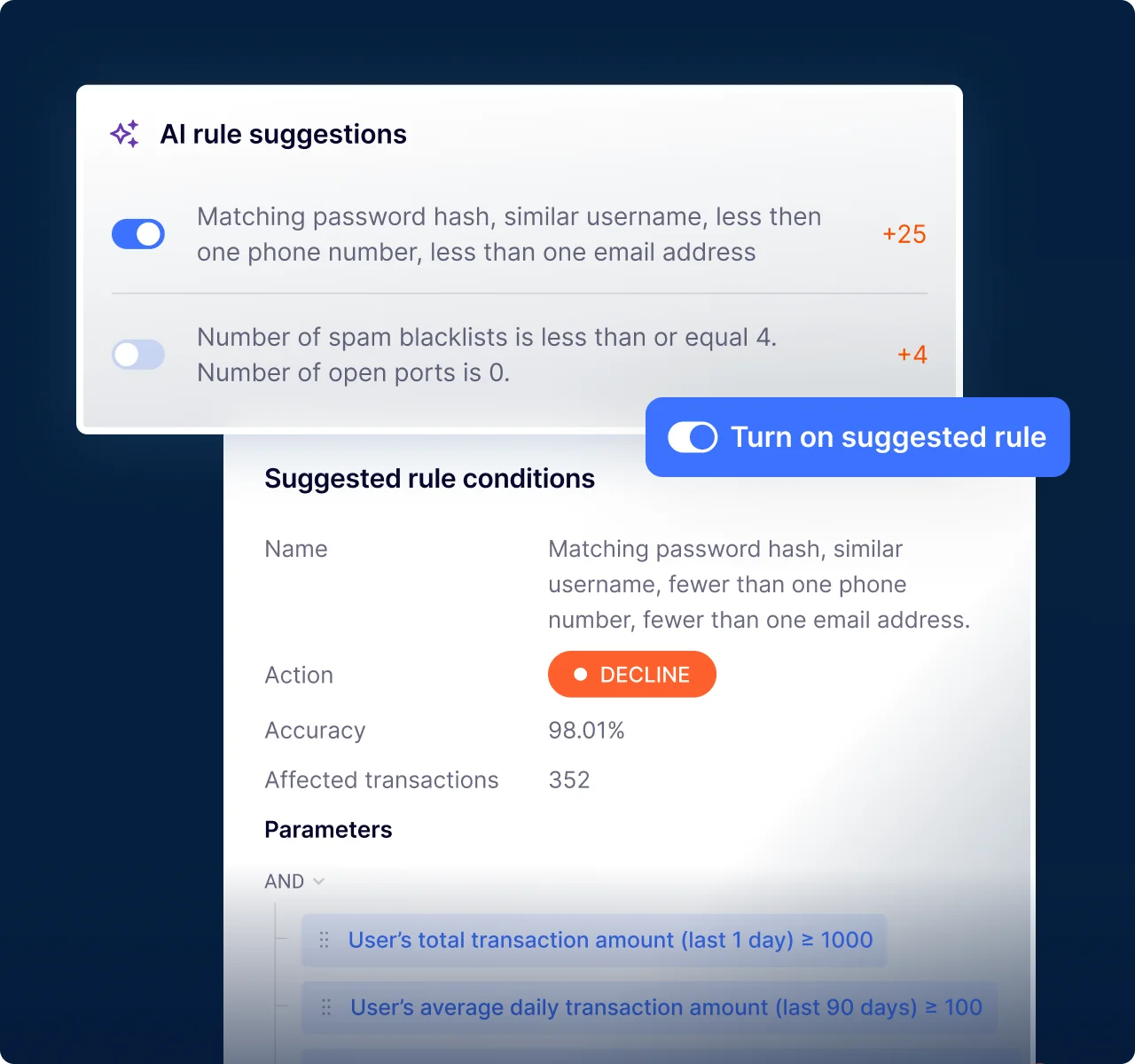
Identify new risk patterns as they emerge. AI analyzes your historical transactions to recommend rules for patterns your existing rules may miss. Review each suggestion and its estimated accuracy before deciding whether to turn it on.
Organize Rules by Policy
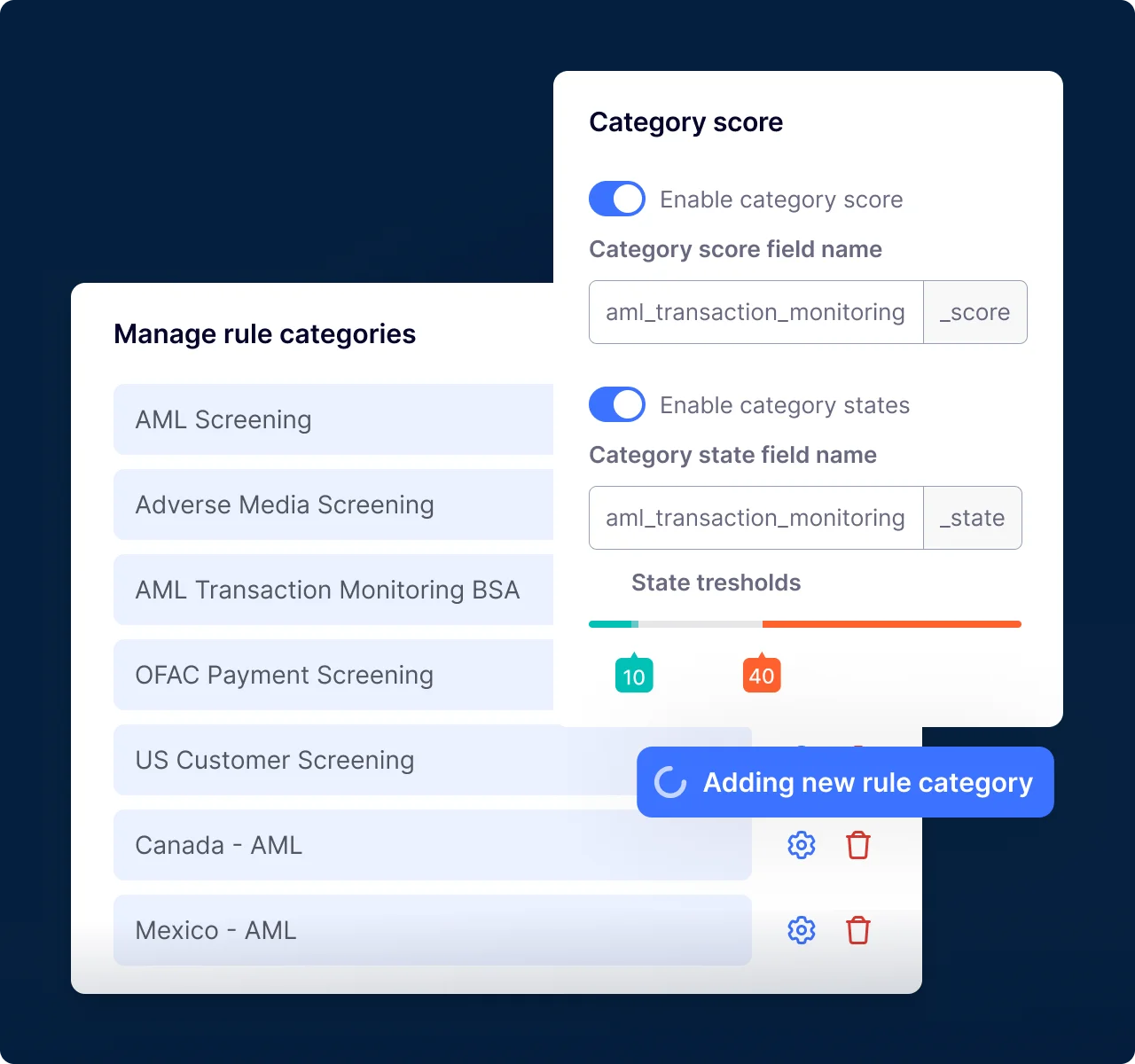
See which policies relate to flagged activity, instead of tracking rules in a spreadsheet. Rule categories carry their own scores and states for an added layer of decisioning.
Test Rules Before They Impact Customers
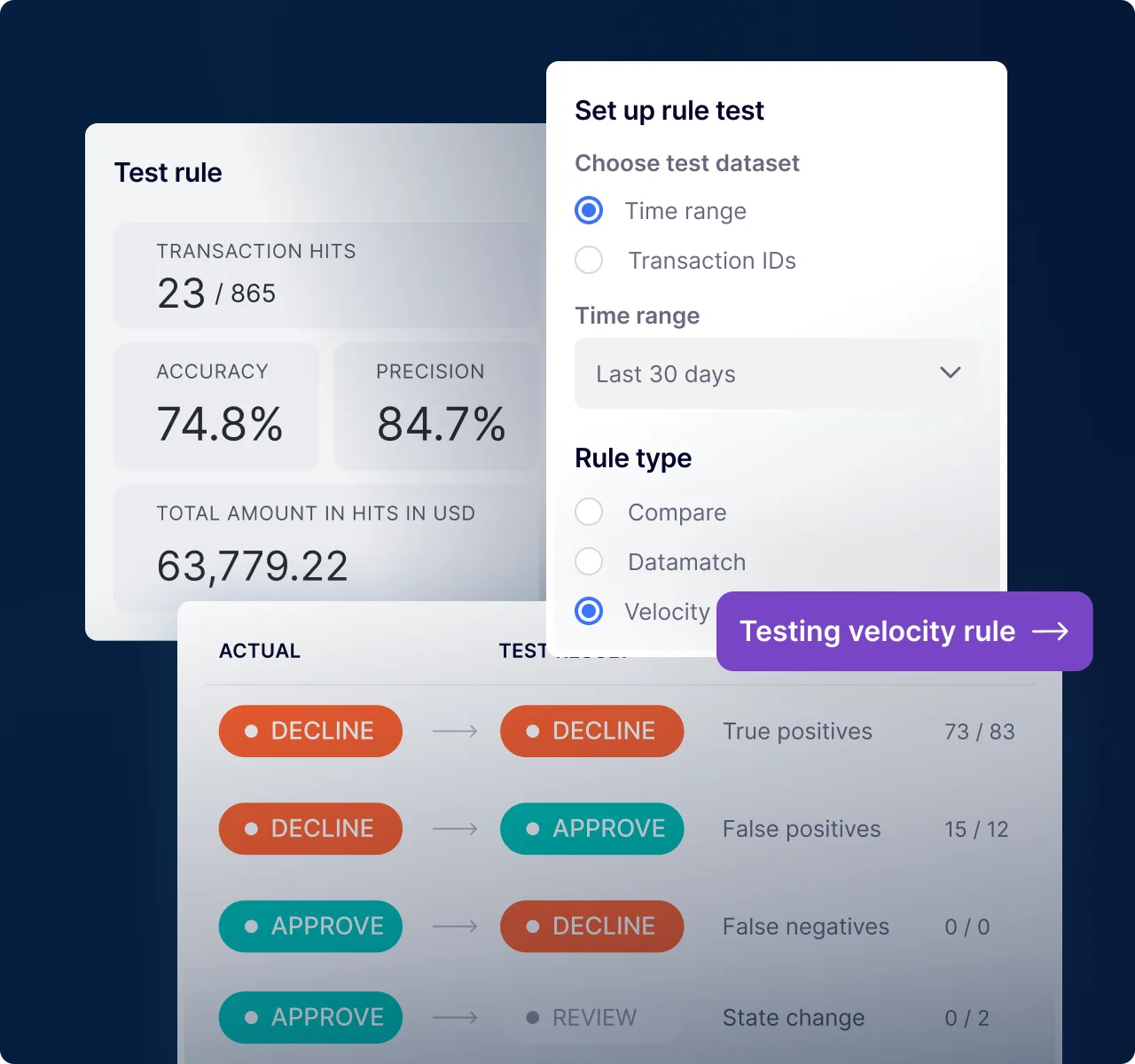
Evaluate the outcome of custom rule changes against historical transactions. See exactly which outcomes would change and the transaction value affected before you apply new rules or updates.
Train AI on Confirmed Outcomes
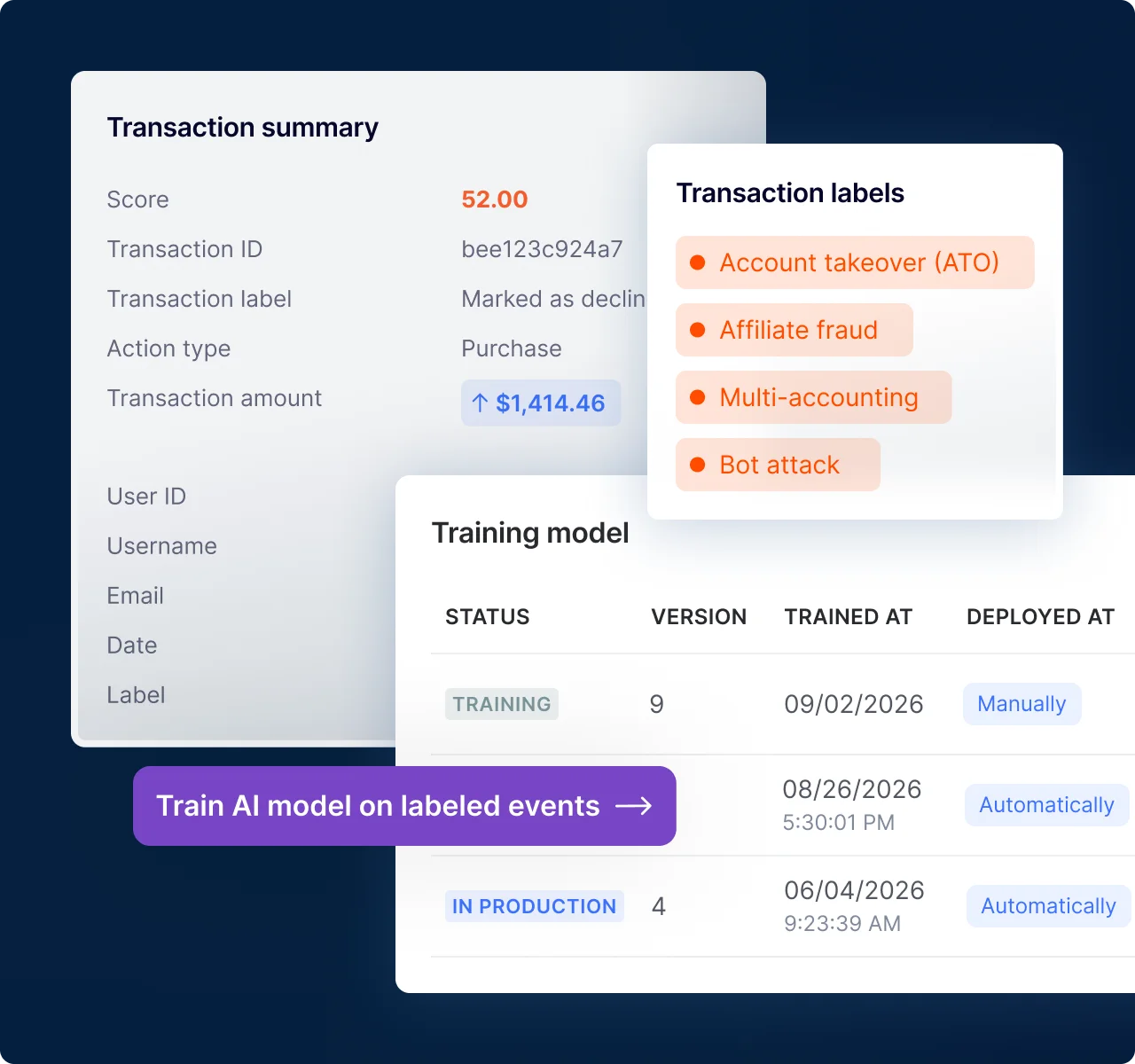
Every confirmed fraud and legitimate interaction sharpens your risk decisioning. Feed your AI model the verified outcome to sharpen your business’s detection logic and train a new model.
Automate Follow-Up Actions
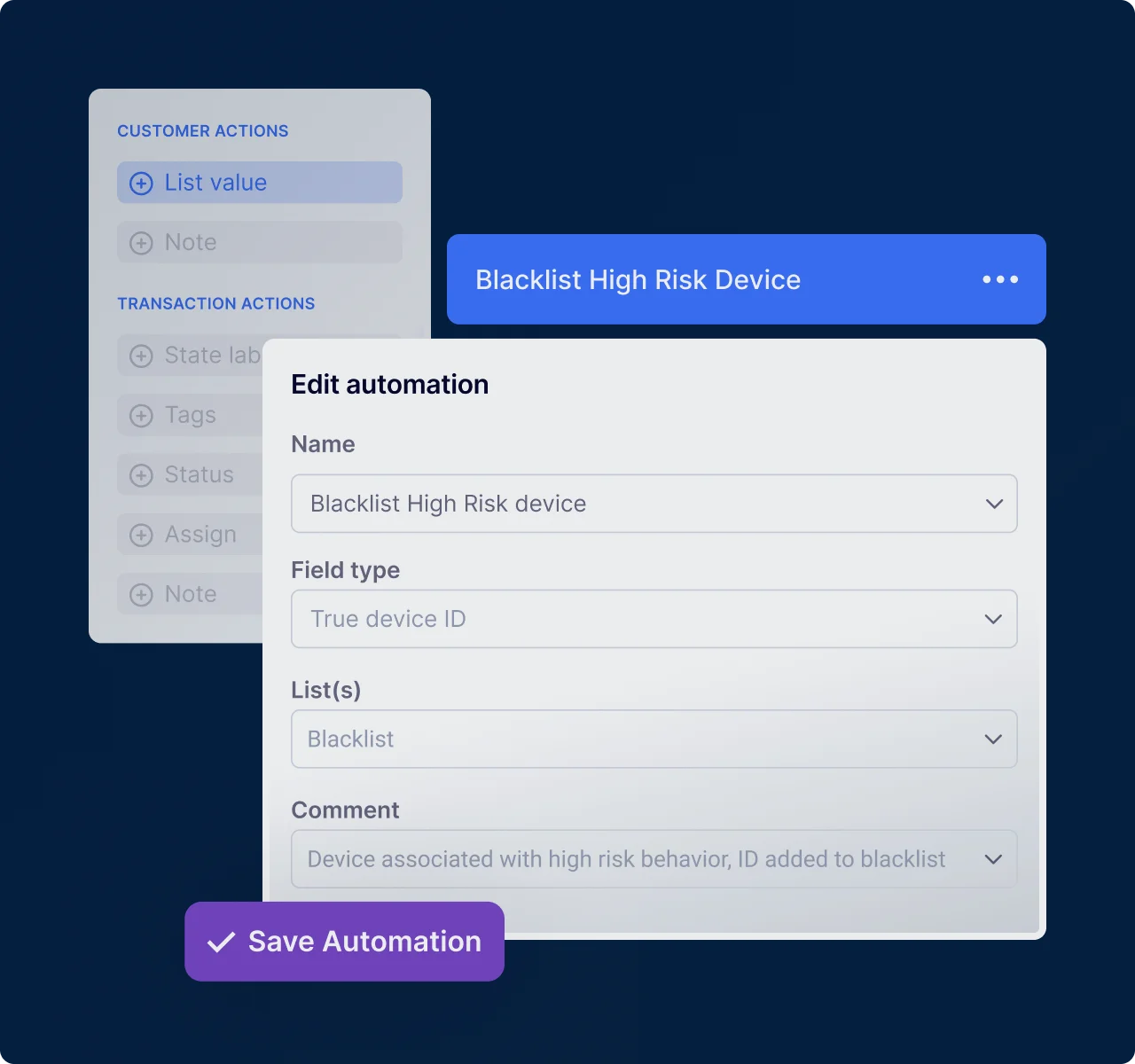
Save time by combining follow-up tasks in a reusable automation. Add risky identifiers to lists, label events, update statuses or assign work across customers or transactions. Review the outcome of each action to see what succeeded.
THE SEON ADVANTAGE
Put Your Team in Control of Risk Decisions
Start detecting risk with AI scoring built on 1,100+ unique signals. Adapt rules to your fraud and AML policies, and explain decisions with the signals and rule results behind them.
Get Started in Days, Not Months
Create Rules Without Limits
Defend Every Decision With Evidence
What Fraud Teams Say

“SEON’s incredibly flexible rule writing and ease of launch allow us to respond quickly to emerging fraud threats.”
Ryan Hunter
Director of Identity & Fraud Strategy, Bilt

“Thanks to SEON, we have confidence in each fraud score and a clear understanding of how it’s determined. Creating rules is now effortless, giving us greater flexibility.”
Eric Taylor
Manager of Trust and Safety, TurboTenant


Integration
Choose How to Integrate with SEON
The choice is up to you: integrate directly with SEON’s APIs or through the AWS Marketplace.
Learn More About Rules & AI Risk Decisioning
-
Rules-based fraud detection identifies fraud based on a set of unusual attributes.
-
We don’t know what AI will look like one year from today. The technology is advancing so rapidly that it’s…
-
How AI-led fraud and risk teams unify defenses with horizontal intelligence to outpace modern financial crime.
-
Discover why explainable AI in fraud and compliance builds trust, meets regulatory demands, and powers audit-ready risk management decisions.
-
Discover how SEON’s intelligence-led approach predicts and prevents fraud by shifting defenses upstream with adaptive AI. Download the guide.
-
For the past two years, organizations have raced to integrate generative models and machine learning capabilities into their environments, driven…






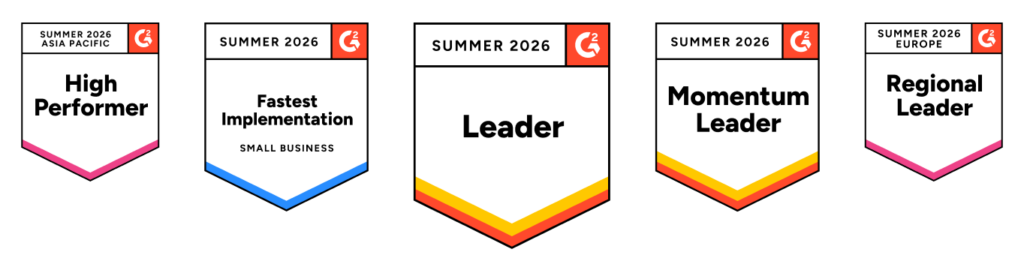
The #1 AI Platform for Fraud Prevention & AML Compliance
With over 380 reviews, SEON is the market leader and G2’s best fraud prevention platform.
Frequently Asked Questions
What is risk decisioning?
Risk decisioning is how a business turns data about a customer or transaction into an automated outcome. In SEON, each event is enriched with 1,100+ first-party signals, evaluated against your rules, lists and the AI insights score, then returned with a fraud score from 0 to 100 and a state of APPROVE, REVIEW or DECLINE. The same API response identifies which rules fired by their IDs, so you can trace what contributed to the decision.
Should I use rules or AI to detect fraud?
Both. Rules are transparent and tunable, but a rule only fires on a condition someone already thought to write. An AI model reads correlations across every signal, including ones too subtle to encode, but most models cannot tell you why. SEON’s AI insights score can: open any score to see which signals contributed to the score and by how much. Run both together, and use the score as a condition inside your own rules.
What kinds of velocity rules can I build?
Velocity rules count, total, average or take the minimum or maximum of any field over a time window, either rolling from the current transaction or anchored to real calendar periods in your own timezone. You can compare one aggregate against another, compare two timeframes in the same rule and use ‘Where’ conditions to control which historical transactions are included in the calculation.
Can I build rules on my own data, not just SEON’s signals?
Yes. Custom fields let you send any data point SEON does not collect by default, from KYC status to account tenure to anything specific to your product. Those fields are then available in custom rules, velocity conditions and custom lists alongside SEON’s 1,100+ first-party signals, so you can recreate decision logic you already run elsewhere rather than rebuilding your strategy around someone else’s data model.
How do I keep track of hundreds of rules?
Rule categories let you group rules by product, jurisdiction, risk type or compliance framework, so an investigator looking at a flagged transaction can see which policy it relates to without opening a spreadsheet. Categories can carry their own scores and states, which gives you a second layer of decisioning on top of individual rules.
Can I test a rule before it affects customers?
Yes. You can run a new or modified rule against your historical transactions while the published version keeps evaluating live traffic. The test returns a confusion matrix, accuracy, precision, recall and the state changes the rule would have caused, and you can drill into the individual transactions behind any result before applying the change.
What controls do I have in place for the AI risk score?
The AI insights score is an input, not a verdict. You choose whether to use it in a rule or an alert trigger and at what threshold. You decide what the model trains on, including which periods, merchants, brands and action types. Every training run produces an evaluation report comparing the candidate to the model in production, and models are held for your approval by default. Every change is written to the audit log.
How long does it take to change a rule?
Minutes, and it does not require engineering. Rules are built and edited in the SEON UI by the fraud team that owns them, either by hand or by describing the logic you want to the AI Rule Builder. You can test the change against historical traffic first, and SEON’s performance checks validate that the rule runs efficiently before it reaches production.
Build Risk Decision Logic That Reflects Your Strategy
“SEON significantly enhanced our fraud prevention efficiency, freeing up time and resources to create better policies, procedures and rules.”
Chief Compliance Officer, Soft2Bet
Trusted by 5,000+ global organizations:


*Based on SEON proprietary research in 2025. Potential benefits listed herein are illustrative only. Outcomes are not guaranteed and vary by customer and configuration.
Speak With a Risk Expert
Just like you, we hate spam. We won’t call you and we may only send you relevant emails, which you can opt out of at any time. By submitting this form, you agree to our Terms Of Service and acknowledge that you have read and accept our Privacy Policy.