Fraud follows growth. Every new campaign, market and bonus program expands the surface it feeds on, and when the losses start eating into margins, the first instinct is to do two things at once: launch more campaigns to address the losses and hire more analysts to handle the larger workload. That instinct feeds the problem. You cannot outrun losses that scale with your growth. Knowing that this self-feeding loop exists is one thing. Understanding whether you’re stuck in it is another.
Our latest Betting & Gaming Fraud Report found that 57% of operators say fraud losses are now growing faster than revenue, and the urge to double down is stronger than ever. The growth trap loop — where growth scales fraud faster than the operation can absorb it (full breakdown here) — has specific, observable symptoms inside a fraud operation. If you know what to look for, you can tell whether this is already happening inside your own operation.
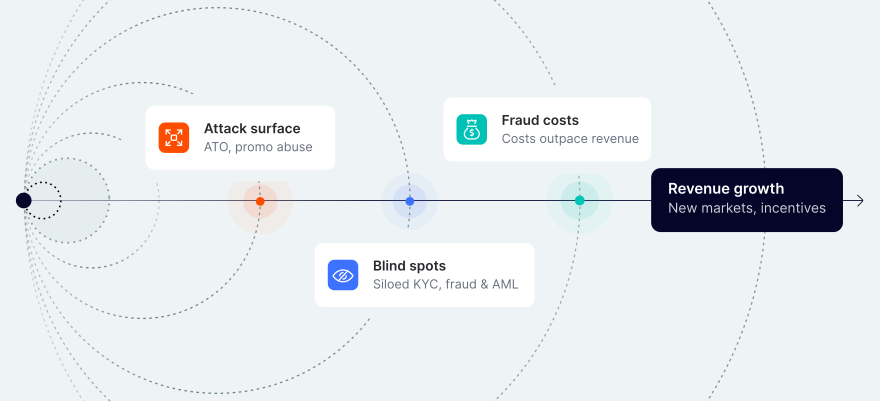
How the Growth Trap Loop Hides in Your Operation
This isn’t a quiz with a final score. It’s a diagnostic checklist that follows the six stages of the loop. Every question is answerable from what you already see week to week, without any data pulls. Read each stage and count how often you catch yourself nodding.
Stage 1: Aggressive growth
Every operator plans for fraud when entering a new market or launching a new product. That’s table stakes. What often gets missed is how quickly the fraud surface compounds when multiple growth moves happen at once. A new jurisdiction, a revamped loyalty tier and an aggressive reload bonus campaign might each carry manageable risk individually, but layered together they create entry points that fraud teams haven’t had time to build controls around. The questions below aren’t about whether you’re growing. They’re about whether you’ve outpaced your own fraud coverage in the process.
- Have you launched a new product or entered a new jurisdiction in the past 12 months?
- Have you added or restructured retention bonus offers (reload bonuses, loyalty milestones, VIP tier resets) within the past six months?
- Can a returning player claim a retention bonus while facing less scrutiny than a new player would at registration?
Stage 2: Fraud scales with growth
Every promotional offer you launch invites fraud that eats into the margin it was meant to grow. Fraud scales with growth, and it scales toward the categories that hurt most. Account takeover, promotion abuse and loyalty fraud now account for 68% of combined losses across the industry, and all three feed directly off growth activity. The telling signal here is a shift in your fraud mix: not just more fraud overall, but a larger share of it concentrated in the abuse types that attach themselves to your revenue drivers.
- Of all the fraud you handle, is a larger percentage now tied to account takeover, promotion abuse and loyalty fraud?
- Does promotion-related fraud usually surface only after a campaign ends, once the results come in lower than expected?
- When you trace your fraud cases back, do they cluster around your promotional windows and market launches?
Stage 3: Fragmented tools create blind spots
Ask a fraud manager whether they have the tools to catch abuse, and the answer is almost always yes. Ask whether those tools talk to each other, and the conversation changes. KYC sits on one platform, transaction monitoring on another, AML on a third, and no single system sees the full player lifecycle. Patterns that would be obvious in a unified view (the same device fingerprint appearing across three accounts, a bonus claim tied to a previously flagged email) go unnoticed because the signals live in separate queues, reviewed by separate teams, on separate timelines. Operators are nearly four times more likely than peers in other industries to call unified data “extremely challenging,” which suggests the problem isn’t a lack of investment in tooling but a lack of connection between the tools already in place.
- Do your KYC, fraud detection and AML systems operate on separate platforms that don’t share data in real time?
- Have you ever closed a fraud case, only to identify the same actor weeks later in a different system?
- When a fraud pattern is identified, does confirming it require pulling data from more than two separate tools or queues?
Stage 4: Headcount fills the gaps
When review backlogs grow and false-positive rates climb, hiring more analysts is the most intuitive fix: more hands, faster clearance. On a short timeline it works. But if the underlying architecture hasn’t changed, additional analysts process more noise at the same rate. The backlog doesn’t shrink; it gets divided among more people. 47% of operators are prioritizing headcount in their 2026 fraud budgets, 12 percentage points above other industries. That gap is wide enough to suggest the response has become a default rather than a strategy, and defaults tend to persist even after they stop delivering results.
- Is headcount your primary planned investment in fraud prevention for 2026?
- Has your analyst headcount grown in the past 12 months without a proportional reduction in review backlogs?
- Despite adding analysts, are your case closure times staying flat or getting worse?
Stage 5: Costs outpace revenue
By this stage the math stops being abstract. Fraud losses as a share of revenue keep climbing even through strong growth periods, and the operational cost of fighting fraud grows alongside it. The revenue that expansion generates gets consumed by the cost of protecting it, and the margin pressure becomes harder to explain away as a growth-phase trade-off. Finance notices before the fraud team does, usually in the form of budget conversations that frame fraud operations as a line item to contain rather than a function to invest in.
- Have your fraud losses, as a share of revenue, kept climbing even through strong growth?
- Are your retention bonus costs climbing faster than the player value they generate?
- Is finance or leadership pushing you to cut fraud headcount or tool spend even as fraud volumes rise?
Stage 6: Operators double down on growth
When margins tighten, the playbook almost always calls for more aggressive expansion to offset the losses: new markets, bigger campaigns, higher bonus thresholds. That response feeds stage one again, and the loop is now complete. Fraud prevention, still structured as a cost center with no seat at the table when campaigns launch, absorbs the consequences of decisions it had no input into. The cycle repeats at a larger scale and with a thinner margin, and each rotation makes it harder to distinguish between a growth strategy and a recovery strategy.
- When margins tighten, does the plan usually call for more aggressive growth to make up the difference?
- Is fraud prevention structured as a cost center rather than a function with input into product or growth decisions?
- Are new promotional campaigns designed without a fraud impact assessment built into the process?
What Your Answers Mean
If you found yourself nodding through three or more stages, you are likely in the loop. The loop is designed to outrun you: it scales fraud with the same growth that funds your business, faster than any operation built on fragmented tools can keep pace with. Every quarter, the structure stays in place, the gap widens.
That is not a verdict on your team. Operators in the loop usually have analysts clearing more cases than ever; the caseload simply grows faster than they can. The problem is not the team, but the architecture, and no amount of effort inside a fragmented system can produce the connected view this fraud requires.
Breaking the Loop
It’s tempting to accept fraud and revenue loss as the industry’s yin and yang, so intertwined that operators treat the pairing as inherent to the cost of doing business. It isn’t. The loop can be broken; you just need to know how.
That’s exactly what we’ll cover at the SBC webinar on August 19: how operators escape the loop without slowing growth.