Players weren’t the only ones making bets during the 2026 World Cup. Betting and gaming operators and platforms across the globe eased registration controls to compete for customers, and many expected fraud to follow the loyalty and bonus offers, but the data show that a different, more unexpected trend played out.
While registration dashboards reported calm, dormant accounts that had previously passed registration steps were reactivated on inherited trust scores and cashed out at withdrawal. To prevent the pattern from repeating for the next marquee sporting event, the first instinct is to hire more analysts, replace vendors or push harder on growth mechanisms to compensate for lost revenue, but doing so will only exacerbate the problem. That’s the growth trap loop.
Where the Pressures Actually Hit
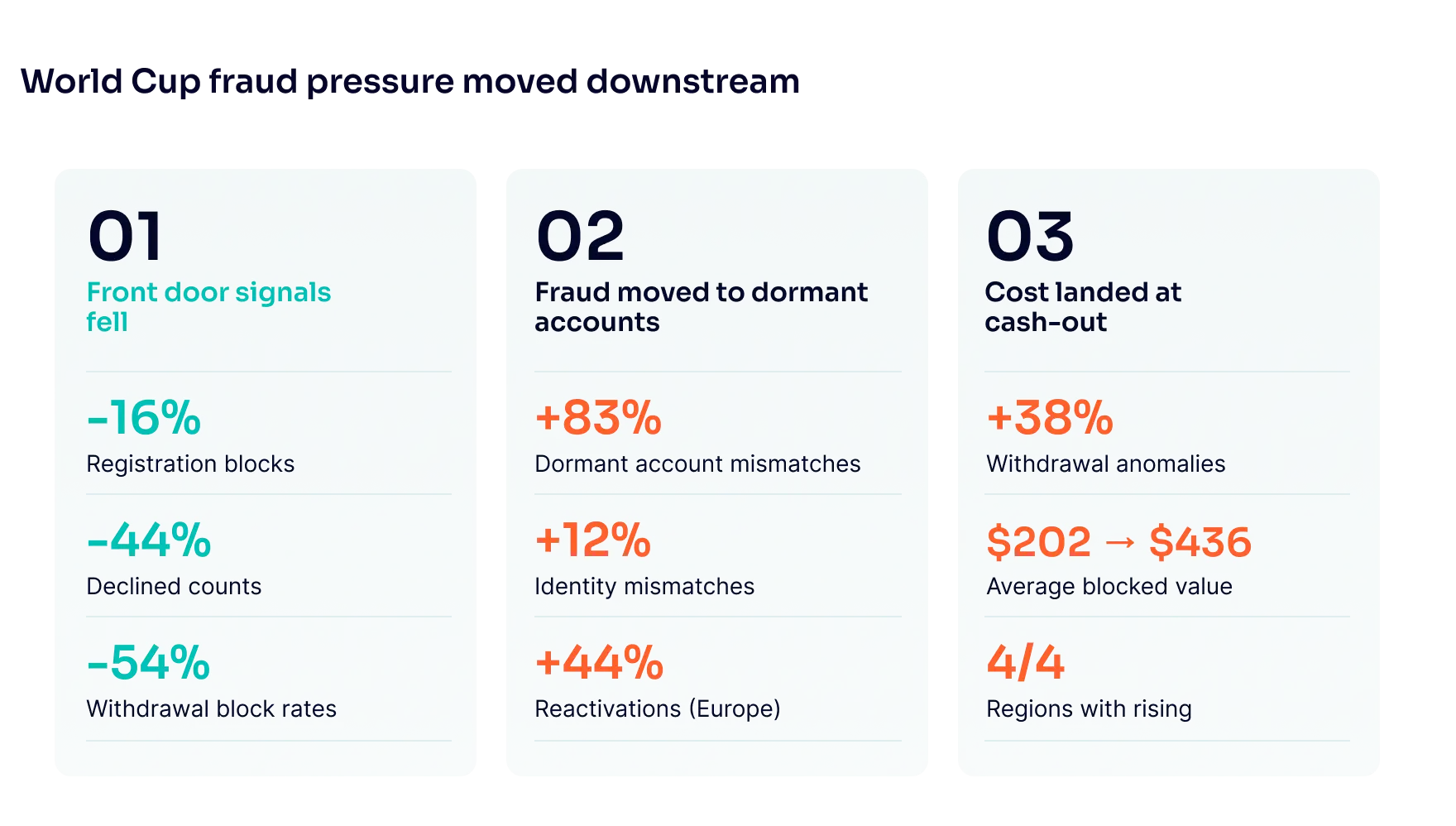
SEON’s 2026 World Cup Benchmarking Report tracked fraud signals across four regions during the tournament and found that registration fraud quieted during the tournament. By every metric, operators watched existing fraud rules doing their job. Instead, fraud bypassed identification and protection mechanisms by leveraging dormant accounts with already-vetted trust scores. In Europe, reactivations rose by 44%, where accounts crossed three distinct flags: reactivation, identity mismatch and suspicious withdrawal. And no one connected the dots.
Pressure hit at the most expensive stage in the player journey: cash-out, with the average blocked value more than doubled compared to summer 2025.
How To Break The Growth Trap Loop
Earlier this year, SEON found that 47% of operators planned to hire more analysts, 28% planned to rip and replace at least one vendor and 99% anticipated launching a new product or entering a new market. But this attempt to scale to stay atop of the program enacts a futile cycle: analysts inherit the same blind spots, new vendors plug into the same fragmented stack, and the next growth wave feeds right back into stage one.
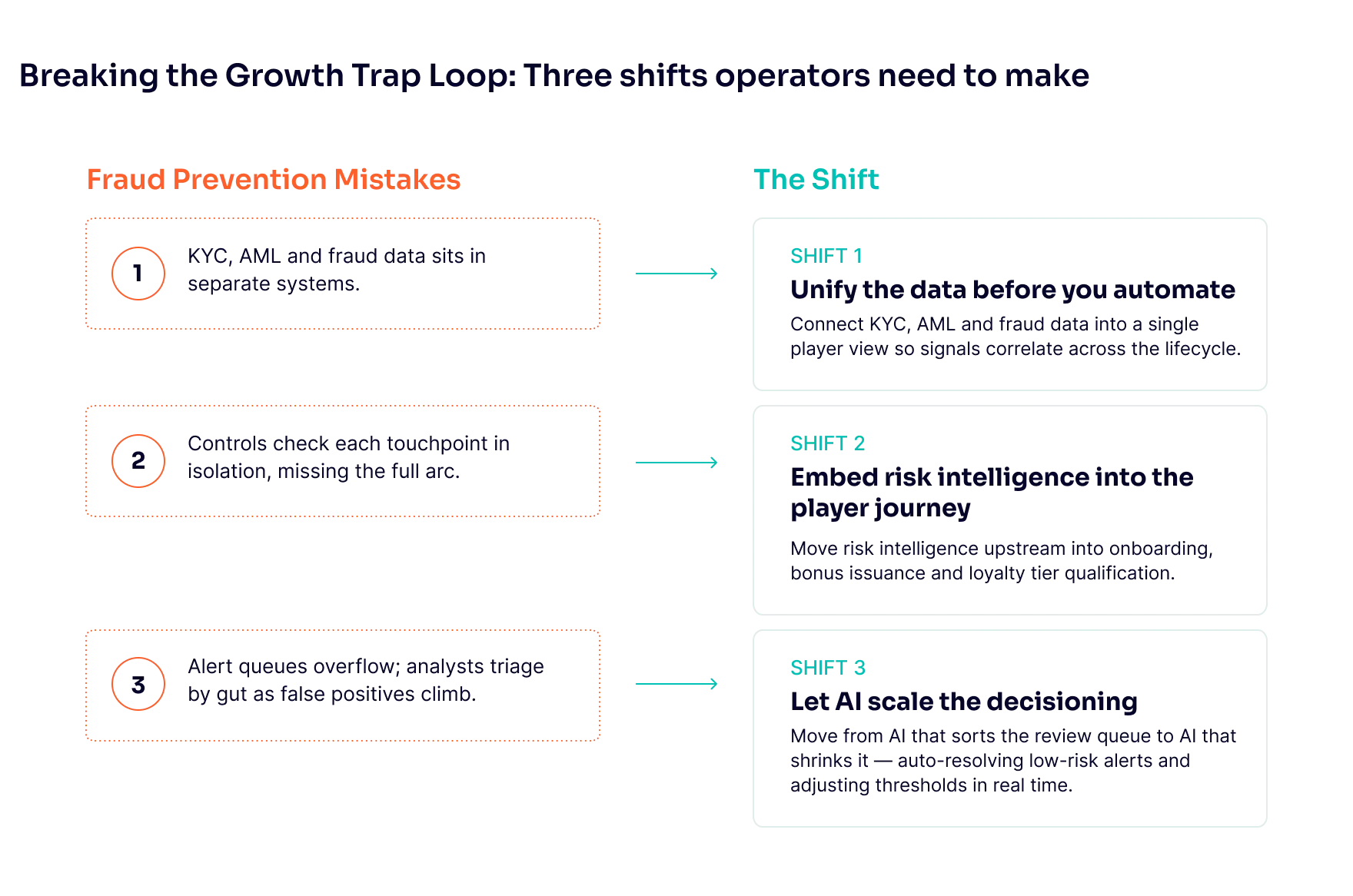
What keeps the loop fed is a fundamental design issue in which systems cannot see the entire player journey, and building on top of a broken foundation makes the problem worse. But it’s fixable, and the following three shifts, when in sequence, can unlock the next stage to breakout.
Shift 1: Unify the Data Before You Automate
During the World Cup, dormant accounts in Europe were reactivated, triggering identity mismatches at login and suspicious withdrawal attempts. That sequence succeeded because registration, login and cash-out data lived in separate systems. A KYC check from two years ago never reached the fraud engine reviewing the withdrawal attempt. The identity mismatch at login never correlated with the dormant reactivation from the week before.
The first move is to connect KYC, AML and fraud data into a single player view so that signals correlate across the player journey rather than sit in isolated queues. When 55% of operators call data visibility “extremely or very challenging,” the starting point is clear and so is the cost of ignoring it.
For an operator starting from a fragmented stack, the instinct is to wire everything together — connect the KYC tool, the fraud engine and the AML system with middleware and call it done. But that doesn’t close the gap. Each system is still working off its own third-party data, updated on its own schedule, arriving hours or days after the moment that mattered. Orchestration just adds a coordination layer on top of that lag instead of removing it.
The real fix is having every system collect signals directly from the source in real time and write them to the same player record the instant they happen, rebuilding the data layer underneath KYC, fraud and AML from the ground up.
Shift 2: Embed Risk Intelligence Into the Player Journey
Tournament data showed that fraud doesn’t respect the player journey stages around which operators build their controls. A dormant account reactivated in week one of the tournament, claimed a bonus in week two and attempted a withdrawal in week three. The operators who caught the full arc were the ones whose risk signals traveled with the player.
Move risk intelligence upstream into registration, bonus issuance and loyalty tier qualification. When a dormant account reactivates from a new device in a new country during a major tournament, that signal should influence every downstream decision.
This is where the rebuilt data layer pays off for the analyst. Instead of clearing a login queue, a bonus queue and a withdrawal queue as three separate tasks, they open one case. The reactivation, the device change and the bonus claim are already tied to the same account because the systems correlated those signals as they happened, not after the fact. The manual work of connecting three events disappears. What’s left is judgment: does this pattern, on this account, need a hold?
Shift 3: Let AI Scale the Decisioning
When volume and complexity spike simultaneously, alert queues overflow and analysts triage by gut and false-positive rates climb. During the sporting event, the signals changed shape and teams tuned for high-volume, while small-value patterns missed single large withdrawals that looked like normal high rollers cashing out.
Most operators already use AI to summarize alerts and auto-fill regulatory forms, but the next step is AI that actually reduces the review queue by auto-resolving low-risk alerts and adjusting thresholds as attack patterns shift. That’s what frees analysts to focus on the cases where human judgment matters. This only works after Shifts 1 and 2 are in place, though — without unified data and journey-level context, AI just makes the same mistakes faster.
The World Cup Was Foreshadowing
The difference between operators who absorbed the pressure and operators who are still counting losses came down to whether their fraud data was connected before the tournament started.
With the Super Bowl, March Madness and the Champions League final, among other large events, it’s safe to assume that each peak operating environment will run a similar stress test on a growing scale. Operators who’ve unified their data, embedded risk intelligence across the player journey and put AI behind the decisioning will be better positioned to operate securely, safely and at better profit margins, which, after all, isn’t that the game?
Break The Loop Before The Next Surge
SEON’s Command Center unifies your data, embeds risk intelligence across the player journey and puts AI behind the decisioning — so your architecture absorbs the pressure, not your analysts.