Most fraud programs were assembled, not designed. One point solution at a time, each added when a new problem became impossible to ignore. The best onboarding tool, the best transaction monitoring solution, the best AML screener, each chosen deliberately, and every choice defensible on its own. But the stack that made sense at Series A rarely survives the next stage of growth.
Between 88 and 93% of fraud and AML leaders across fintech and payments plan to add a new vendor this year, according to SEON’s 2026 Fraud and AML Leaders Report. The instinct is to fill each gap with another specialist, but every new tool added to a fragmented stack widens the seams it was meant to close.
How Point Solutions Get Chosen
Early-stage fintechs buy point solutions for good reasons, one crisis at a time. Onboarding fraud prompts the identity verification purchase. The first chargeback spike drives the transaction monitoring decision. Regulatory pressure justifies the AML screener. A rise in mule activity brings in behavioral analytics. Each decision makes sense in isolation, and each tool is the best available answer to the specific problem visible at the moment it was purchased.
The pitch behind every one of these purchases is that the tool will integrate cleanly with what came before and what comes next, and that might be true when the stack is small and the fraud surface is narrow. The problem accrues gradually, across product launches and vendor additions, until the fraud team ends up running a stack nobody would have designed on purpose.
Where the Stack Actually Breaks Down
A point solution stack breaks in three places at once: where the tools meet, where their data should move and where the team operates them.
Each solution is optimized for a single stage or fraud type, so stacking them creates expert views with blind spots between them. An onboarding tool sees only the moment of signup. Transaction monitoring watches the payment layer and has no visibility into what happened before it. AML screening runs on its own cadence entirely, unaware of the device intelligence that would explain half of what it flags. Fraud has more room to develop between windows than any single tool has to catch it.
The data layer compounds the problem, though not always in the way it first appears. Some teams do build their own dashboards and pipelines to stitch signals from every tool into a central view, and depending on how mature the AI behind it is, that view can be useful. But the integration layer itself is now something the team has to build, maintain and evolve, and the burden falls on engineering rather than fraud. Roadmap time is absorbed into keeping the data flow current whenever a vendor changes an API, adds a field or updates a decision format. Technical debt accumulates in the background, and unless the internal build is consistently prioritized, the picture the fraud team is working from ends up as fragmented as the tools it was meant to unify.
The operational impact falls on the fraud team either way. Every point solution brings its own alert queue, case management interface, rule logic and vendor relationship, and each adds friction to the day. Analysts triage across multiple systems and stitch cases by hand, while more time gets absorbed into vendor QBRs, integration maintenance and reconciling rules between tools that overlap in coverage. None of this counts as fraud work; it is the operational cost of protecting the business, quietly consuming the hours the team should be spending on the fraud itself.
What Consolidation Actually Solves
Consolidating on a single platform is more of a build-versus-buy decision than a procurement one. Fintechs can integrate a point solution stack into a central view themselves, and some do it well, but the internal effort required to sustain that build over time is significant. Every new product surface, every vendor change, and every API update lands back on the engineering roadmap, competing with everything else the business wants to ship. A platform that arrives with the integration already built removes that ongoing cost.
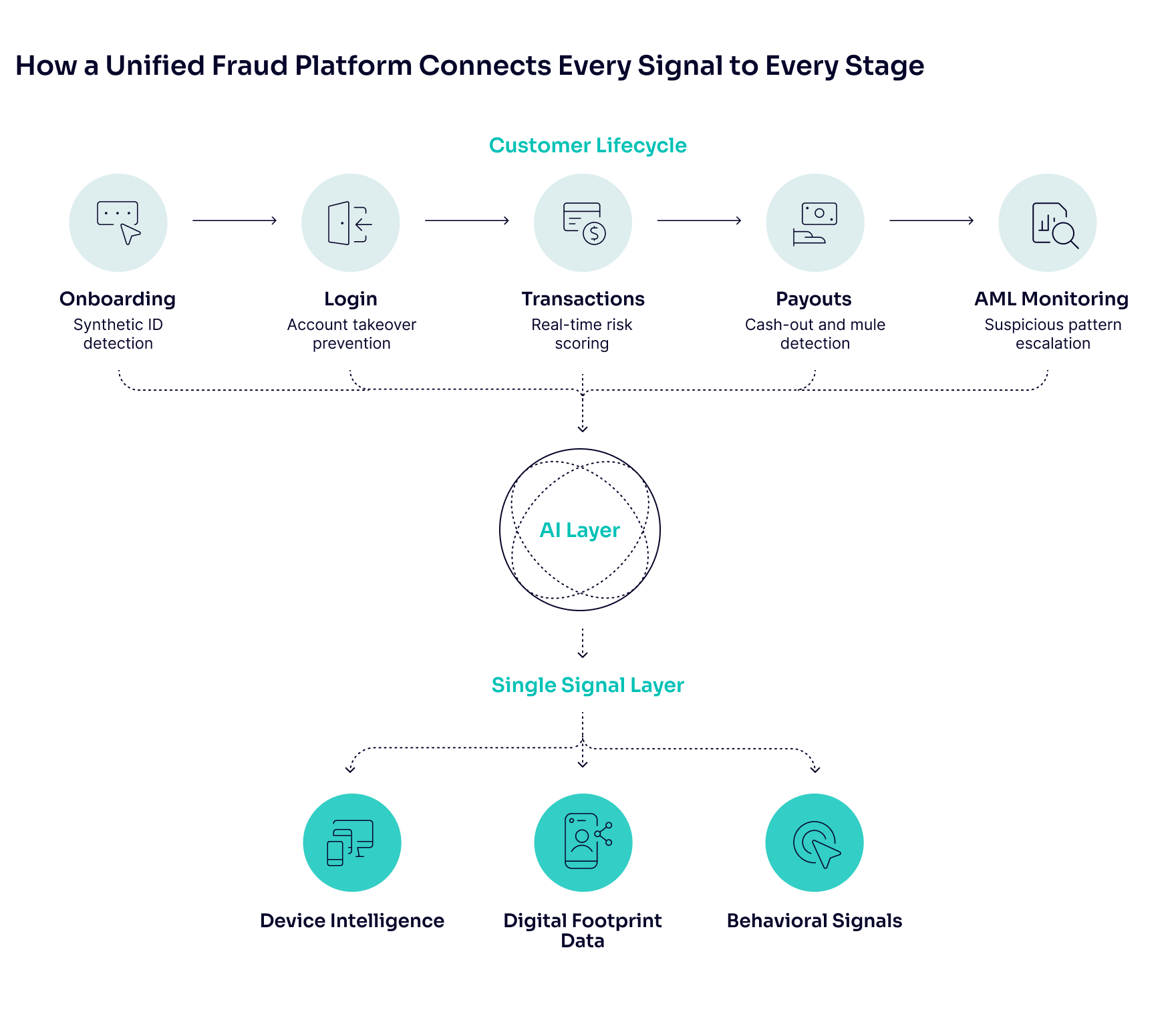
The change starts with a single signal layer. When device intelligence, digital footprint data and behavioral signals feed into every stage of the customer lifecycle from the same source, AI models learn from the full picture rather than a fragment of it. Behavioral data from onboarding informs risk scoring at the transaction layer, escalation logic at the payout layer and suspicious pattern detection in the AML layer, all against a single customer view.
A unified platform also collapses the operational sprawl. One alert queue, one case management interface, one rule logic engine, one vendor relationship. Fewer systems to triage, fewer vendor cycles to manage and fewer overlapping rules to reconcile, so analyst time reallocates from tool management back to catching fraud.
Not every platform delivers on this promise. What separates a real one from a rebranded stack comes down to a few practical criteria: cross-lifecycle real-time signal sharing, configurable rule logic that fraud teams own directly, AI trained on unified data rather than layered on top of siloed systems and case management that connects fraud, AML and dispute investigation in one workflow.
What to Do With the Stack You Already Have
You don’t need to rip and replace a five-vendor stack overnight, and few fintechs should. Start by finding the point solutions creating the biggest gaps, not the biggest bills. A cheap tool that generates disconnected alerts can cost more in analyst hours than a premium platform that unifies them.
Consolidation works best in layers. The first is the signal data itself, where a coherent customer view has to be established before the detection and operational layers built on top of it can improve. From there, the detection layer follows, moving rules and AI onto the same underlying data so detection decisions draw on everything the platform already knows about the customer. Then comes the operational layer, where alerts, cases and workflows sit in one place rather than being scattered across systems.
The results of this progression tend to show up in the same order they were built. False positives drop first as cross-stage context enters detection decisions. Analyst hours come back next as case consolidation removes duplicate work. Response to new fraud typologies gets faster because retraining now runs on a single pipeline. Finally, the coverage itself expands with the product rather than lagging behind every new launch.
The Goal Was Never the Best Tool
Every fintech will keep evaluating new fraud tools, as they should. The question to ask each time is whether the addition tightens the fabric of the fraud program or adds one more patch.
Scaling coverage successfully comes down to one thing: a coherent view of the customer across the whole business. The fintechs that get there treat their fraud program as a single system, one that grows with the business instead of trailing behind it.