A product manager, an engineer and a designer walk into a launch review. A new payment rail is scheduled to ship in three weeks, and nobody at the table works in fraud. The punchline lands a quarter later, as a loss.
Every fintech product launch creates revenue and risk in the same motion. Revenue gets a well-thought-out plan; risk rarely does. The gap between what teams plan and what they overlook is where every new risk surface sits unguarded until the program catches up.
The absence is structural. Fewer than 5% of financial-sector fraud leaders sit within digital operations, compared with 30% in other industries, according to SEON’s 2026 Fraud and AML Leaders Report. The people who best understand where fraud will travel are rarely in the room when product decisions get made, and the exposure grows either way.
The Window Between the Launch and the Loss
Product teams ship on a release cycle. Fraud programs move at the pace of incidents. The two clocks don’t typically sync, and that mismatch explains most of the industry’s coverage gaps.
Fraud programs are reactive by design. A team writes a rule after it spots a pattern, evaluates a vendor after it confirms a gap and retrains a module after enough labeled data piles up. Each step is sound in isolation, but every one depends on something already having gone wrong.
That cadence creates a window every time a product launches. The feature goes live on schedule, and the fraud program starts recalibrating only once losses on the new surface make the gap visible. How long the window stays open depends almost entirely on one variable: when the fraud team first hears about the launch. For teams that find out once the feature is already live, it stretches into months rather than weeks, and every one of those weeks carries preventable financial loss and, in cross-border or transfer-heavy surfaces, growing AML exposure.
Fraud Finds the Gap Before You Do
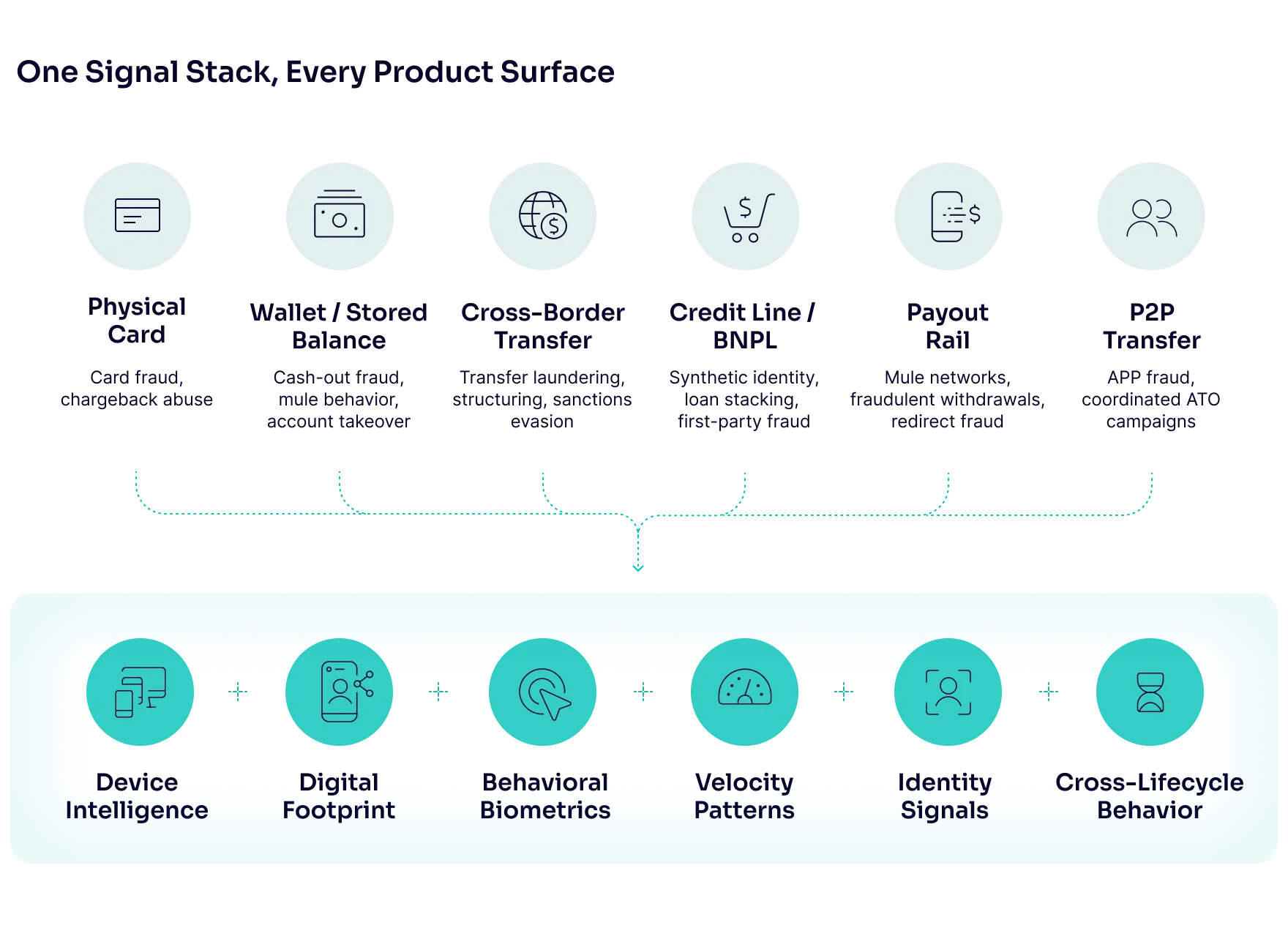
Every new product attracts fraud types the old product mix never saw. A physical card brings card fraud, a wallet invites cash-out and mule activity, a cross-border transfer opens the door to laundering and a stored balance creates account-takeover targets the existing stack was never configured to catch. Rather than scaling gradually with adoption, these threats arrive as soon as the surface goes live.
The fraud that lands in this early period is also the hardest to recover from. Fraudsters seed synthetic identities before monitoring exists, and structure mule networks before the team has written a single rule for the new surface. By the time detection catches up, the launch window has hardened into an operational baseline that the program has to unwind.
Why AI Makes This Worse Before It Makes It Better
AI is often positioned as the answer to the problem, but when deployed against historical fraud data alone, it can widen the gap before closing it. A model learns from patterns that have already happened; it has no view of the fraud a new product will attract, and no way to catch that fraud until enough labeled cases pile up to justify retraining.
The more a program leans on models trained on history, the more precisely it enforces the assumptions of a world that is already gone. Every launch shifts what normal looks like faster than the training data can follow, and models that were state-of-the-art for the previous product mix end up calibrating detection to a business that no longer exists.
The Fraud Surface Map Your Product Brief Is Missing
Closing the gap starts with a planning exercise. Before a feature ships, the fraud team should be able to answer three questions: which fraud types will the surface attract? Which lifecycle stages does it touch? Which signals already in place need to be extended to cover it?
The most practical starting point is the value flow. Any feature that moves, stores or issues something of monetary worth in a way the previous product didn’t, exposure expands. The next step is to find what’s missing before a loss points to it. If a payout function that launches without device or behavioral data at the payout stage leaves the fraud team monitoring blind — nothing to compare against, no way to separate a legitimate transaction from a fraudulent one until a pattern of losses brings it into focus.
The same principle applies to coverage thresholds: defining what normal looks like on a new surface before launch is far more useful than reconstructing it after the first incident forces the conversation.
Coverage That Moves at Product Speed
Mapping the fraud surface before launch only pays off if the coverage can be put into operation on time. Most legacy fraud programs cannot move that fast because their rule logic sits behind a vendor engagement, an engineering sprint or a quarterly review cycle, and none of those cadences match a product roadmap.
Configurable rule logic is what closes the gap in practice. The fraud team should be able to deploy new rules for a new surface directly, adjusting them by market, channel and product type in the same week the feature ships.
AI needs the same treatment. Models that update continuously on live signal data will surface anomalies on a new surface faster than models waiting for enough labeled cases to justify retraining. Cross-stage signal sharing also has to be in place from day one of a launch: device intelligence, digital footprint data and behavioral patterns generated during onboarding need to feed the transaction and payout layers from the moment the feature goes live, not after a pattern of losses forces the connection.
Adding another vendor is often the default response to a new coverage requirement. Between 88 and 93% of fraud and AML leaders across fintech and payments plan to add a new vendor in 2026, and the pattern is consistent regardless of the specific gap being addressed. But the teams that actually close the gap are the ones consolidating on platforms that can move at product speed, rather than adding tools that reinforce the delay the existing stack already has.
The Fraud Team’s Role Has to Change
All of this points to a change in how the fraud team sits within the business. The role is moving from reactive investigator, called in after a loss to explain what went wrong, to proactive surface mapper, involved in product planning alongside the teams shaping what the business is about to become.
The change matters because fraud is rarely a surprise anymore. The typologies a new product will attract have either already surfaced in the industry or can be anticipated with the right expertise and technology in place. Either way, preparation is what turns fraud coverage from cleanup into protection. The companies that get there first will treat every product decision as a fraud decision.