Reviewing transactions has always required human judgment, but as payment volumes scale and fraud patterns grow more sophisticated, manual processes alone cannot keep pace. A fraud analyst working a queue cannot simultaneously track behavioral drift across thousands of accounts, correlate signals from onboarding through payout or act on a velocity spike before the window closes.
According to our own report, payment companies now allocate 46% of their AI budget to transaction monitoring, yet the behavioral signals generated outside the transaction layer rarely reach the models making decisions within it. Automation solves the data gap, not just the volume problem.
Key Insights
Why Manual Transaction Monitoring Breaks at Scale
A PSP processing millions of transactions daily generates more behavioral signals than any review team can process. Transaction monitoring automation exists precisely because velocity abuse, mule account activity and cross-border laundering patterns only become visible when signals from across the customer journey feed the same model, something manual review structurally cannot do.
Automation shifts the workload from raw review to investigation. Analysts work flagged cases with full context rather than individual transactions without it. That distinction matters operationally, but it also matters for compliance: global regulators require ongoing monitoring and timely reporting of high-risk activity. As transaction volumes grow, meeting those obligations without a proportional increase in headcount means automating the detection layer and reserving human judgment for decisions that actually need it.
How Transaction Monitoring Automation Works: The Four-Layer Architecture
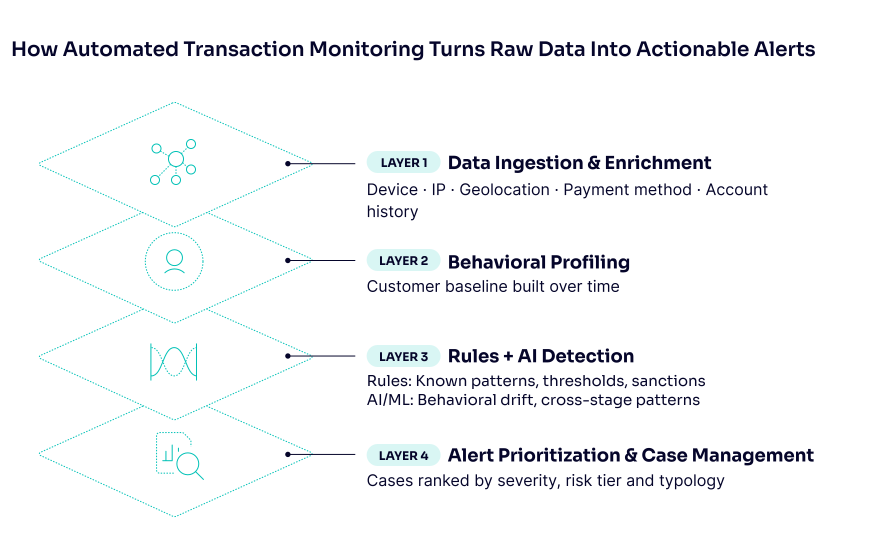
Automated transaction monitoring works by combining four interconnected layers: data ingestion and enrichment, behavioral profiling, detection logic and alert prioritization. Each layer builds on the one before it.
Data ingestion and enrichment
Every transaction carries more signal than the transaction itself. The device used, the IP address, geolocation, payment method and account history all contribute to a fuller picture of what actually happened. Effective systems ingest and enrich this data in real time, before any detection rule fires.
What that looks like in practice differs by vertical. For online lenders, enrichment means combining loan application data with repayment behavior. BNPL providers connect installment history with wallet activity and payout patterns. For PSPs, merchant behavior is correlated with chargeback rates and settlement velocity.
Behavioral profiling
Behavioral baselines are only useful if they stay current. Manual processes update them reactively, after a pattern has already caused damage. Automated monitoring updates each customer’s baseline continuously, incorporating new signals as they arrive so that a shift in transaction frequency, device behavior or counterparty relationships is scored in context the moment it appears.
This continuous updating is where automation earns its advantage. A customer who gradually increases transfer volume over six weeks looks different from one who spikes overnight, and only a system tracking the full sequence in real time can reliably make that distinction at scale.
Rules-based and model-based detection
Most production systems run two detection layers in parallel. Rules-based logic catches known patterns with speed and precision: transactions above a reporting threshold, transfers to sanctioned jurisdictions or unusually fragmented payment sequences that suggest deliberate avoidance of reporting limits. Rules are fast, auditable and straightforward to explain to regulators.
Automated fraud detection earns its deeper value at the model layer. Gradual behavioral drift, coordinated activity across accounts that appear unrelated, these only become visible when signals from across the customer journey feed the same model. A synthetic identity that passed onboarding cleanly and lay dormant for weeks before activating at the transaction layer is a pattern no single rule would catch. The two layers are most effective together, with clear escalation logic between them.
Alert prioritization and case management
Alert volume is the main operational challenge in any automated system. Legacy tools with broad, static rules generate high volumes of low-quality alerts that overwhelm review queues and expose compliance risks.
Modern systems address this through alert scoring: cases are ranked by severity, customer risk tier, typology match and recency, so analysts work the most consequential cases first. Integration with case management tools means the full investigation trail from initial flag through to SAR filing is documented automatically, reducing administrative burden and improving audit defensibility.
Why Automation Matters Differently Across Verticals
Transaction monitoring automation is not a generic capability. The signals that matter, the typologies to detect and the regulatory obligations that apply differ meaningfully across payments, online lending and fintech. A system calibrated for one vertical will underperform in another.
Payments and PSPs
PSPs face fraud at both the merchant and cardholder level simultaneously. Merchant onboarding fraud — falsified business categories, inflated transaction volumes, deliberate chargeback generation requires monitoring logic that evaluates merchant behavior in aggregate rather than reviewing individual transactions in isolation. Automated systems need to correlate settlement patterns with dispute frequency across entire merchant portfolios to reliably surface these risks.
For cross-border PSPs operating under PSD3 and PSR, automated monitoring also needs to account for Strong Customer Authentication (SCA) exemption logic and transaction risk analysis (TRA) thresholds alongside real-time payment screening obligations. Card-present and card-not-present fraud require different detection approaches, and a system built only for one will create gaps in the other.
Online Lending and BNPL
Loan fraud concentrates on the application: synthetic identities, stacked applications and falsified income documentation. As BNPL providers introduce card products and wallet functionality, however, fraud migrates further into the lifecycle, toward account takeover, cash-out behavior and payout manipulation. Automated monitoring needs to span the full journey because application fraud and post-disbursement fraud are frequently connected, seeded by the same identity at different stages.
Thin-file borrowers present a specific detection challenge. Standard behavioral baselines assume established transaction history, which many legitimate borrowers simply do not have. For these customers, models need to weigh alternative signals, like device consistency and email age, more heavily to distinguish genuine thin-file applicants from synthetic identities with manufactured histories.
Digital Banks and BaaS Platforms
Digital banks carry the full range of fraud and AML risk across every product they offer. The particular challenge for BaaS platforms is that they inherit the fraud surface of every product their clients build on top of them, making program-level visibility a baseline requirement rather than an advanced capability.
Automated monitoring for BaaS requires the ability to detect coordinated fraud or laundering patterns across multiple client programs simultaneously, alongside customer-level monitoring within each program. A platform approach to both data and detection is the only architecture that covers this surface at scale.
The Role of AI in Transaction Monitoring Automation
AI in automated fraud detection operates across two distinct functions: pattern recognition at scale and investigation acceleration.
On the detection side, ML models reduce false positives by learning which signal combinations reliably indicate fraud rather than legitimate but unusual behavior. A transaction from an unfamiliar location on a new device is suspicious in isolation; it is far less so if the customer recently updated their device and traveled for work, which behavioral and metadata signals confirm. Beyond reducing noise, models trained on recent case data surface emerging typologies before a rule has been written to catch them, closing the gap between when fraud evolves and when detection catches up.
On the investigation side, AI-assisted tools such as alert summaries, case narrative generation and SAR drafting assistance shift analyst time away from documentation and toward judgment. According to SEON’s 2026 Fraud & AML Leaders Fraud Report, financial sector organizations allocate 67% of their fraud budget to AI and ML solutions, the highest among industry groups. The return on the investment scales with how broadly the AI is deployed, a model trained only on transaction-stage data sees a fraction of the behavioral picture that cross-lifecycle automated monitoring provides.
How SEON Supports Transaction Monitoring Automation
SEON’s real-time transaction monitoring capability sits within a unified platform that connects fraud detection and AML compliance across the full customer lifecycle. Rather than monitoring transactions in isolation, SEON brings together device intelligence, digital footprint signals, behavioral analytics and AML screening into a single risk assessment that updates in real time.
For fraud teams, SEON’s rules engine allows fully configurable detection logic by market, product or customer segment without engineering dependencies. AI-assisted rule creation helps teams identify detection gaps and suggests rule logic based on observed fraud patterns, while ML models trained on connected, cross-lifecycle data surface behavior that stage-specific rules cannot reach on their own.
For compliance teams, SEON’s AML transaction monitoring module covers customer screening, payment screening and ongoing transaction monitoring with integrated case management, SAR filing support and full audit trails. Sanctions and watchlist screening is built in, with real-time updates across OFAC, UN, EU and domestic lists.
For organizations operating across multiple verticals or geographies, SEON’s platform approach means a single integration covers payments fraud, lending risk and AML compliance, removing the data silos that limit AI performance and create the coverage gaps where fraud and financial crime concentrate.
Fraud surfaces grow as businesses scale. SEON’s transaction monitoring connects signals across the full customer lifecycle, so your detection coverage always keeps pace.
Speak with an Expert
FAQ
What is transaction monitoring automation?
Transaction monitoring automation uses rules engines, machine learning models and behavioral analytics to continuously review financial transactions and flag suspicious activity in real time, replacing manual review with a scalable, adaptive detection layer.
How does automated transaction monitoring reduce false positives?
By building behavioral baselines for each customer and scoring deviations in context rather than applying uniform thresholds, automated systems distinguish genuinely suspicious activity from legitimate but unusual behavior. ML models improve this further by learning which signal combinations reliably indicate fraud.
How does transaction monitoring differ for BNPL vs. traditional lending?
Traditional lending monitors primarily at the application stage. BNPL requires coverage across a wider product surface — installment behavior, wallet activity and payout patterns — because fraud typologies shift as providers expand into adjacent financial services.
What transaction monitoring rules should PSPs use?
PSPs typically monitor for velocity abuse, structuring behavior near reporting thresholds, chargeback rate spikes and merchant category mismatches. Rules should be configured by customer segment and market rather than applied uniformly, since the same transaction value carries different risk profiles depending on context.