93% of lenders report credit-loss impact from fraud in 2026, and 61% identified synthetic identity fraud as the fastest-growing threat they face, despite most already running dedicated origination controls. The technology exists, what’s missing is coverage of the full borrower lifecycle.
Most lenders invest heavily in application-stage controls and assume that once a loan is funded, the risk is priced in. Fraudsters who pass origination behave like good borrowers for weeks or months before the pattern breaks. By the time the signal appears, the loan is funded, and the team is looking at a write-off.
Most lenders catch fraud at the wrong stage, either too early, blocking legitimate thin-file borrowers, or too late, after the loan has funded and the borrower has gone quiet. Getting the configuration right means building detection logic that follows the fraud, not just the application.
Key Insights
Lending fraud runs on a longer timeline than payment fraud, and the cost per incident is higher. A synthetic borrower may spend 6 to 18 months building a credit profile before busting out, and a funded fraudulent loan is a write-off, not a chargeback. That extended window shapes where detection needs to sit.
Post-funding monitoring is the only thing that catches bust-out fraud after origination. Thin-file borrowers make calibration harder, since the signals that flag a synthetic identity often describe a real first-time borrower. That makes composite scoring the difference between blocking fraud and turning away a good customer.
Why Lending Fraud Is a Different Problem Than Payment Fraud
Payment fraud surfaces fast. Lending fraud compounds quietly over months, and by the time the pattern breaks, the financial damage is already locked in. The distinction shapes everything about how detection rules should be structured and where they sit in the workflow.
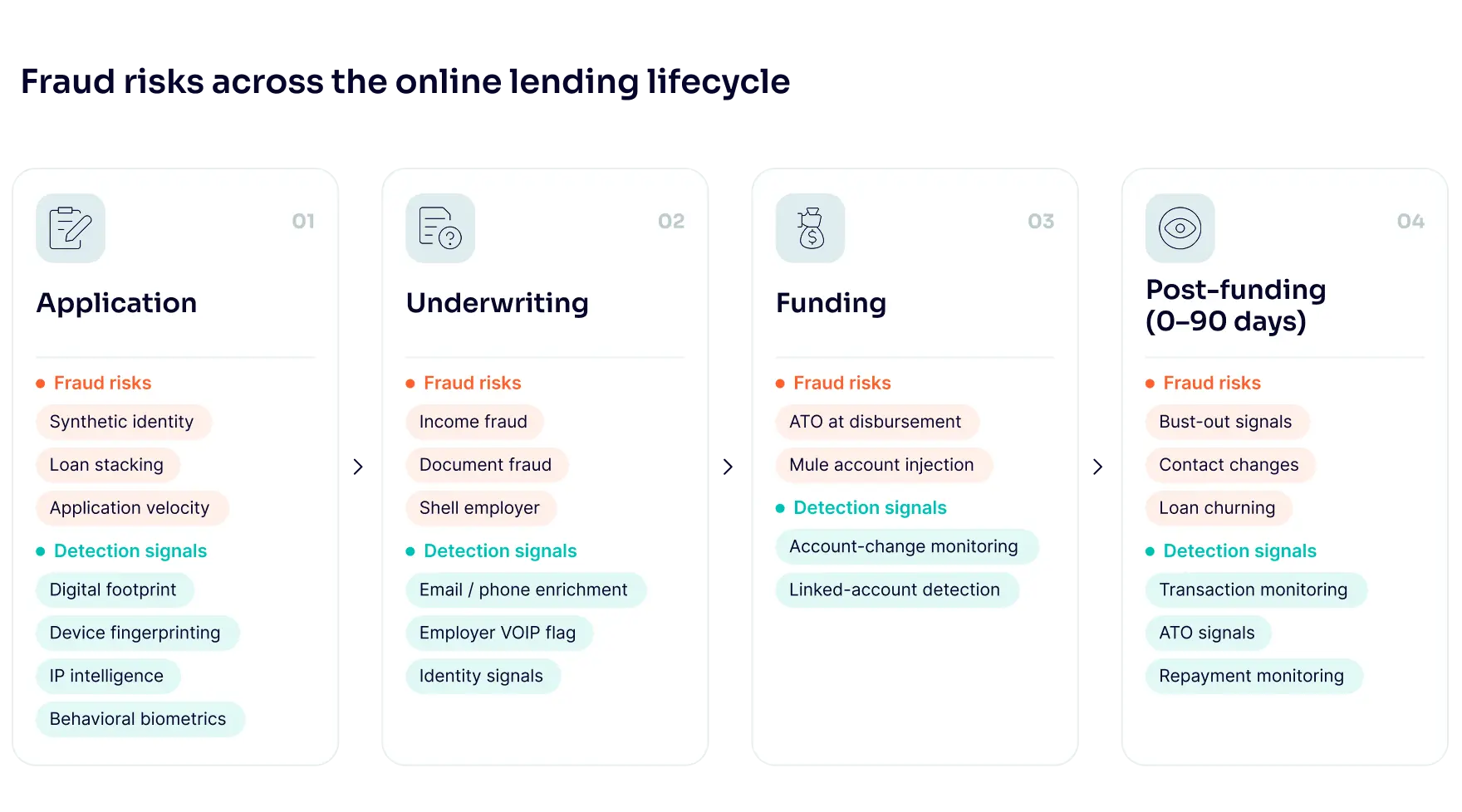
The fraud lifecycle in lending is long by design. A synthetic identity borrower builds a credit profile before attempting a bust-out. A loan stacker submits applications across multiple lenders within a 48-hour window, before bureau inquiry data has updated across the network. A velocity rule tuned for card testing fires on the wrong signals for both patterns.
The cost per incident also reshapes the risk calculus. A blocked transaction creates friction that the customer resolves by retrying. A declined loan application means permanent churn. At scale, systematic over-blocking of thin-file borrowers produces discriminatory exclusion of underserved populations who share surface characteristics with synthetic identities.
Post-funding monitoring is the gap most origination-focused programs leave open. Bust-out fraud is engineered to pass every application control. The behavioral signals that distinguish a fraudster from a legitimate borrower only appear after the loan funds are disbursed, within a predictable window in the repayment period.
Most lending fraud teams have plenty of rules at origination but few answers about what happens after funding. Speak with a SEON fraud expert to find the gaps across your fraud lifecycle.
Speak with an expert
The 8 Rule Types That Actually Move the Needle
These are the rule categories with the highest signal quality across the lending fraud lifecycle, from application submission through early repayment. Each maps to a specific fraud typology and the implementation gap that most lending teams don’t catch until it’s already costing them.
1. Velocity Checks
Velocity checks in lending catch application probing (fraudsters submitting multiple applications from the same device or IP under different identities) and loan churning (early repayment followed immediately by re-application to extract funds repeatedly). Application count from the same device within a 48-hour window is the core signal. Social security number (SSN) consistency across applications is a cleaner indicator than IP alone, because legitimate rate-shoppers use the same credentials across multiple lenders.
The false positive risk is real: borrowers who compare rates across multiple lenders before committing are a large and legitimate segment in personal lending. Loan churning rules also need a minimum balance threshold to avoid flagging customers who settle small loans early.
2. Device Fingerprinting
Device fingerprinting catches organized application fraud: multiple loan applications submitted under different identities from the same device. A session originating from an emulator or virtual machine is a near-certain fraud indicator in lending, because legitimate applicants do not submit loan applications via automated tools. A device fingerprint appearing across multiple prior applications filed under different SSNs surfaces fraud ring activity that individual application review misses.
The false positive rate for emulator and VM detection is effectively zero among genuine loan applicants. Flagging all applications sharing a device ID with any prior fraudulent application and reviewing the full device history is the highest-yield action this rule type should trigger.
3. IP Intelligence
IP intelligence catches location misrepresentation: an applicant claiming a domestic address while applying through a datacenter IP in a different jurisdiction, or a fraud ring submitting applications from a shared proxy layer. The geo-mismatch signal is stronger in lending than in payments because applicants provide a stated address as part of the application itself.
The classification determines the response: Tor exit node traffic warrants a categorical block; datacenter IP traffic on a first application warrants review; residential proxy traffic warrants enhanced verification. The false positive population — B2B applicants on corporate VPNs and privacy-conscious users — is smaller and more identifiable in lending than in payments.
4. Digital Footprint Analysis / Email & Phone Enrichment
Digital footprint signals serve two purposes in lending that payment fraud doesn’t require: assessing thin-file identity plausibility where bureau data is sparse and detecting income fraud through employer-level signals. A VOIP number listed as the primary employer contact and an employer domain under six months old are strong shell-employer indicators. In combination with a thin credit file and a new applicant email, they form a credible composite of income fraud.
Self-employed borrowers and gig workers share some of these surface characteristics, so neither an employer VOIP phone nor the domain age alone warrants a decline. Stacked with thin bureau data and a recently created email, the composite warrants routing for enhanced verification.
5. Behavioral Biometrics
Behavioral biometrics in lending catches two patterns that don’t arise in payment fraud: bot-assisted form fill on sensitive fields like SSN and income, and coached fraud, where an applicant is being directed by a third party in real time. Copy-paste detection on the SSN field is the most reliable signal — a legitimate applicant entering their own SSN types it. A full application completed in under three seconds is a bot indicator with a low false positive rate.
Mobile applicants using autofill trigger copy-paste signals on multiple fields simultaneously, but in a structured, consistent pattern that differs from scripted bot fill. Channel- and device-specific baselines are what make the signal precise rather than a source of friction for legitimate applicants.
6. Synthetic Identity Signals
Synthetic identity fraud in lending targets account opening: a fabricated or composite identity passes KYC, builds a borrowing record and executes a bust-out before the fraud is detected. No single signal is definitive. An SSN issue date that predates the applicant’s date of birth is a near-certain block. A credit file under 12 months old, a VOIP phone number, a near-zero digital footprint and a new email domain together form a composite that distinguishes fabricated from genuine thin-file borrowers.
Calibration matters because younger borrowers and people who have recently relocated share surface characteristics with synthetic identities. A composite score calibrated against the actual customer base yields a false positive rate low enough to keep legitimate thin-file borrowers in the funnel.
7. Network / Linked Account Detection
Fraud rings and loan stacking share a common characteristic: they look clean at the individual application level. The signal only emerges when multiple applications are viewed together. A device fingerprint appearing across applications filed under different personal details points to fraud ring activity in a way that reviewing each application in isolation never would. In a stacking scenario, a borrower submits to multiple lenders simultaneously, before any single lender can see what the others are seeing. Device signals are the only cross-lender view available in that window.
Family members applying from a shared household device account are the primary source of false positives. The distinguishing factor is identity consistency: a shared device with the same applicant details reflects normal household behavior, but one with different applicant identities is a fraud signal worth acting on.
8. Post-Funding Transaction Monitoring
Bust-out fraud and account takeover after loan funding cannot be caught at origination. A phone number and email updated simultaneously within the first 30 days of funding is a strong account takeover signal. A repayment account change to a recently opened bank account shortly after disbursement is a bust-out preparation indicator.
The monitoring window that matters most is the first 90 days post-funding, when bust-out behavior almost always manifests. Contact detail changes and repayment account updates in the first 30 days should be treated as high-priority review items rather than routine account management.
The False Positive Problem in Lending Hits Different
False positives in lending carry a cost that payment fraud teams don’t face in the same form. A blocked transaction creates friction the customer resolves by retrying. A declined loan application is rarely revisited, and when the rules systematically flag thin-file borrowers, the cost stops being operational and starts being legal.
The fix is composite scoring and review queues for ambiguous cases. Tracking true positive rate per rule on a regular cadence is what keeps the engine honest as the product scales.
What SEON Brings to Your Fraud Stack
Most lending fraud stacks are built around bureau data. SEON’s AI platform for fraud prevention and AML compliance fills the gap bureau data leaves — the 48-hour inquiry lag where loan stackers operate, the thin-file applicants bureau models can’t reliably score and the post-funding window where bust-out fraud actually manifests.
Email and Phone Enrichment covers employer-level signals that bureau data doesn’t touch: VOIP phone classification on employer contacts, employer domain age and social footprint scoring to assess identity plausibility at the point of application. Device Intelligence links applications across shared device identifiers, surfacing fraud ring coordination before a bureau inquiry has had time to register. IP Intelligence classifies every session by connection type, providing the proxy context that geo-mismatch signals in lending require.
The rule engine supports composite score configuration with a natural-language builder, so risk teams can tune thresholds by applicant cohort without an engineering dependency. Link analysis builds a cross-application identity graph across shared devices, phone numbers and employer records, catching coordination patterns that per-application review misses entirely. AML Screening covers PEP and sanctions checks at origination alongside transaction monitoring post-funding, with documented decision logic that satisfies FinCEN, FCA and CFPB requirements.
FAQ
What is loan stacking fraud, and how do lenders detect it?
Loan stacking occurs when a borrower submits applications across multiple lenders within 48 to 72 hours, before any single lender can see what the others are seeing. Detection combines monitoring for repeat applications within a lender’s own system with device fingerprinting, which surfaces cross-lender patterns that shared credit data misses during the lag.
How do online lenders detect synthetic identity fraud at origination?
No single signal identifies a synthetic identity at origination. An SSN issue date that predates the applicant’s stated date of birth is a near-certain block; beyond that, the assessment is composite across credit file age, digital footprint signals and phone carrier data.
What signals indicate income or employment fraud on a loan application?
The clearest employer-level signals are a VOIP primary business number and an employer domain registered within the last six months. Neither alone warrants a decline, but combined with a thin credit file and a new applicant email, they form a credible composite of income fraud.
What is bust-out fraud in lending, and how does post-funding monitoring catch it?
Bust-out fraud is when a borrower builds a credit profile over weeks or months, draws down a large loan and defaults intentionally, passing all origination controls by design. Post-funding monitoring catches it: contact detail changes, repayment account updates and missed payments in the first 90 days are the signals that distinguish bust-out from standard default.