Fraud detection application programming interfaces (APIs) provide businesses with powerful tools to identify and prevent fraudulent activities in real time. Companies can assess risks in transactions and user activities more effectively by integrating advanced algorithms, AI & machine learning and data analysis into existing systems.
Widely used in the financial and eCommerce sectors, APIs integrate seamlessly with existing tech stacks, providing an easy way for companies to protect themselves from fraud, including chargeback fraud, bot attacks, fake accounts, credit card fraud and more.
How Do Modern Fraud Detection Systems Work?
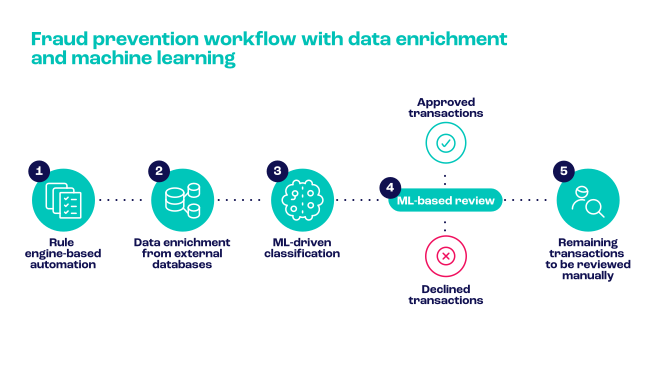
Modern fraud detection tools rely on real-time analysis of digital signals to assess user legitimacy and detect anomalies. At their core, these systems use advanced data enrichment, AI-enhanced analysis and behavior monitoring to determine the level of risk associated with users or transactions. Here’s a high-level look at how they operate:
- Data Collection: Critical data is collected through an API at several vital points: onboarding, login, transactions, and when other activities, such as deposits or withdrawals, occur.
- Data Processing: The collected data is sent to the fraud detection system, which enriches and analyzes it using preset rules or machine learning algorithms.
- Risk Scoring: The system generates a risk score for each user or transaction based on the analysis. If built with whitebox machine learning, the system will provide transparent and human-readable explanations of how it arrived at these scores.
- Action Triggering: Depending on the risk score, the API can trigger actions like approving, declining or flagging a manual review. With users classified based on their risk profile, they can be redirected toward additional security measures as needed.
Examples of Risky User Behaviors
- A user registers with a disposable email address domain. This can be flagged using reverse email lookup, as legitimate users typically use established email providers. Taking it a step further, examining related social media accounts linked to an email address can reveal insights into an individual’s authenticity.
- When a user signs in from a new device in an unfamiliar country, your IP analysis tool and device fingerprinting module detect the anomaly. This signals a potential account takeover (ATO), where someone may have obtained the login credentials.
- When customers purchase with a credit card that doesn’t match their name, it suggests the possible use of a stolen card, which could lead to costly chargebacks.
Fraud Detection APIs vs Manual Data
Manual fraud reviews are slow, inconsistent and difficult to scale. As digital businesses face higher volumes and more complex fraud tactics, APIs offer a practical, reliable alternative, delivering real-time insights, consistent decision-making and greater operational efficiency.
By replacing static, labor-intensive checks with automated analysis and enriched signals, APIs help businesses stay agile and secure, even during periods of rapid growth or high transaction volumes.
What Are the Benefits of a Fraud Detection API?
Fraud detection APIs offer a range of benefits that make them an essential tool for businesses looking to streamline their fraud prevention efforts. From scalability and automation to customization and flexible pricing, APIs provide a more efficient and cost-effective solution than manual data processing.
Good for Scaling
APIs handle thousands of logins, signups and transactions per second, enabling fraud detection to keep pace with growth without adding headcount or complexity. SEON’s fraud prevention platform delivers real-time results in under a second, even at high volumes.
Automation
APIs connect seamlessly to web apps, eliminating the need for constant tweaks or waiting for IT updates. All updates and fixes are handled server-side, reducing IT resource costs and allowing you to focus on your core business.
Ease of Use
SEON’s API integrates seamlessly with your existing tech stack, allowing developers to get up and running quickly. There is no need for massive development changes; just consult the documentation to access the necessary functions, saving time and reducing IT workload for more cost-effective fraud prevention.
Customizable to Your Risk Needs
APIs allow you to choose which signals matter — whether you prioritize device intelligence, digital footprint or behavioral analysis — creating a flexible fraud prevention layer tailored to your business.
Flexible, Usage-Based Pricing
With SEON’s API-based pricing model, you only pay for what you use. This approach supports both rapid scaling and lean periods without long-term commitments.
Use Cases for Fraud Detection APIs
Fraud detection APIs support a wide range of use cases across the user journey, from signup to payment. By integrating enriched data and behavioral signals, businesses can make informed decisions instantly and reduce exposure to fraud risks.
- Real-Time Transaction Monitoring: APIs enable businesses to analyze transactions as they happen, applying risk rules and contextual data such as device, IP and location. Suspicious activity can be blocked or flagged for review before the transaction completes, helping prevent fraud and chargebacks at scale.
- Identity and Account Verification: During onboarding and login, APIs validate user details like emails, phone numbers and IP addresses. By layering in digital footprint analysis and device intelligence, businesses can uncover synthetic or fraudulent accounts before they’re active.
- Behavioral Risk Assessment: AI and machine learning models assess patterns in user behavior, such as frequency, timing and transaction velocity, to identify deviations from expected baselines. This helps detect fraud involving bots, account takeovers and hidden collusion tactics like money muling.
Why Use REST APIs for Fraud Detection Systems?
APIs are usually categorized as SOAP or REST, both of which have advantages. At SEON, we use REST APIs, which are more lightweight and use the JSON format to receive or send information.
Don’t hesitate to contact us for a meeting to see how we can help you grow your business safely today.
Speak with an Expert
How SEON’s Fraud Detection API Works
SEON’s fraud prevention uses a modular, API-first approach to help businesses detect and respond to fraud in real time. The API integrates easily with your existing systems and leverages advanced analytics, digital footprint analysis and AI to align with your risk strategy. Here’s how it works:
1. Data Collection and Enrichment
SEON’s API collects signals such as email, phone number, IP address and device details at key user journey points. These inputs are enriched in real time through 1100+ real-time, first-party signals, evaluating everything from domain reputation to online activity and geolocation.
2. Analysis and Risk Scoring
The enriched data is processed using AI & machine learning and rule-based logic. Key layers of analysis include:
- Digital Footprint Analysis: Assesses online credibility and presence.
- Device and IP Intelligence: Flags suspicious patterns and inconsistencies.
- Behavioral Analysis: Detects anomalies in user actions across sessions.
The system generates a risk score for each user or event, based on your configured thresholds.
3. Real-Time Monitoring and Actioning
SEON’s API operates in real time, scanning every login, signup or transaction as it happens. Based on the risk score, it can trigger automated actions (approve, block, escalate) or route events for manual review with all contextual data attached.
4. Seamless Integration and Flexibility
Built for fast deployment, SEON’s API works across a wide range of industries and platforms. Developers can integrate via REST, customize signals used in scoring and adapt workflows to meet specific compliance or fraud objectives.
5. Unified Fraud Prevention
All of SEON’s capabilities, from data enrichment and scoring to monitoring and reporting, are accessible through a single API call. This unified access supports fraud prevention, KYC streamlining, chargeback reduction and improved user trust.
Fraud Detection API FAQ
How much does a fraud detection API cost?
This varies depending on how the company operates ie some offer a set fee for overall usage whereas others, including SEON, offer more flexible pricing based on the number of API requests.
How long does it take to set up a fraud detection API?
Integration can be done within 24 hours but this differs depending on the product you choose and results are often be more precise once the solution has been in operation.
When should I be using a fraud detection API?
As soon as realistically possible. The longer you leave your business unprotected, the risks of fraudulent attacks/activities will continue to rise. No business is safe from online fraud, no matter its size, type or sector.
You might also be interested in reading about:
Learn more about:
Device Fingerprinting | Device Intelligence | Digital Footprinting
- Techcrunch: APIs are the next big SaaS wave
- University of Cambridge: Explainable Machine Learning for Fraud Detection
- OCADO Group: Using Google Cloud and machine learning to improve fraud detection