A legitimate player signs up in under a minute, and so does a fraud ring running 400 accounts off a single device farm. Registration is the one moment you see both before any money moves, yet most iGaming stacks barely look.
By the time a bonus abuser triggers a withdrawal alert, you have already paid the KYC fee and funded their balance. SEON’s 2026 research ties 23% of iGaming losses to promotion abuse, so the cheapest place to catch it is at signup.
At a glance:
Why Registration Is the Highest-Risk Moment in iGaming
Nearly every fraud scheme starts with a new account. Bonus abuse, multi-accounting and synthetic identities all need the same first step: clearing the signup form. Stop the account there and you stop the scheme before it costs you anything.
Across the industry, 57% of operators report fraud losses growing faster than revenue, and three fraud categories generate 68% of those losses: account takeover at 27%, promotion and bonus abuse at 23% and loyalty rewards abuse at 18%. Each one exploits the same incentives operators built to acquire and retain players, so the faster you grow, the wider the attack surface gets.
The attacker mix has shifted, too. Low-effort fraud is in retreat: cookie-stuffing, crude multi-accounting and IP-only attacks no longer clear the bar. What remains is heavier: career professionals running large account clusters through virtual machines and emulators, plus rings using residential proxies, fresh devices and generative AI to defeat liveness checks.
A long-tail threat raises the stakes further: meet retention bonus abuse. Fraud rings now buy aged, verified accounts, hold them dormant to bypass risk-observation windows, then activate them to claim retention bonuses worth more than welcome offers. The decision to let that account onto the platform was made at signup, sometimes years before the loss landed on the books.
What a Registration Fraud Stack Looks Like
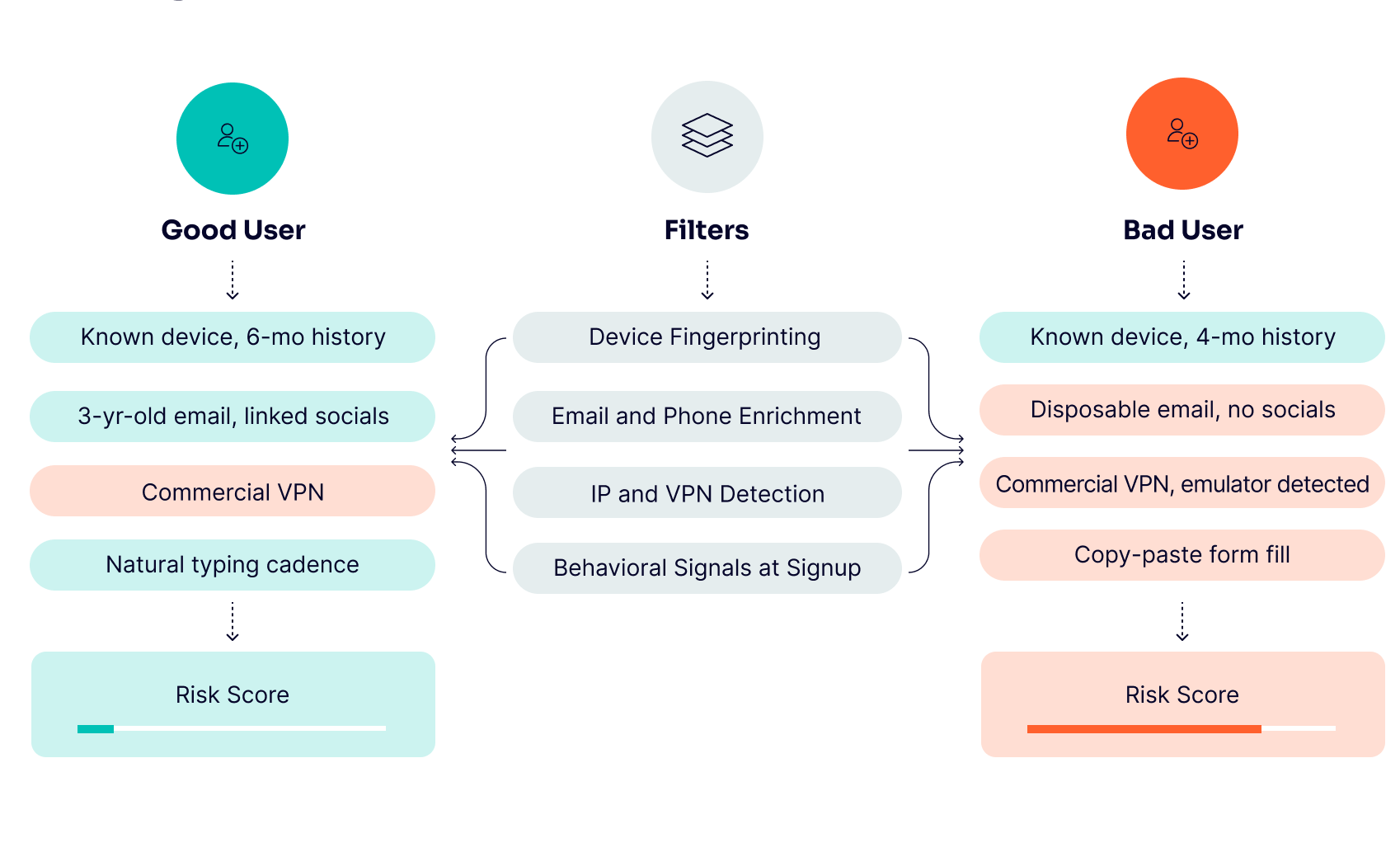
A registration fraud stack is four signal layers working in parallel at signup: device fingerprinting, email and phone enrichment, IP intelligence and behavioral signals. Each layer answers a different question, and the value lives in the overlap: a disposable email may not be suspicious on its own, but a disposable email on a device tied to 30 other accounts behind a data-center IP is a different story altogether.
Device Fingerprinting
Device fingerprinting identifies the hardware and software behind a signup, even when the fraudster clears cookies or switches accounts. Strong fingerprinting captures hundreds of parameters, from hardware specs and sensor data to canvas hash, font list and GPU signature, then produces a stable device ID that survives incognito mode and proxy switching. Career fraudsters running emulators leak telltale signs: missing hardware data, identical hashes and reused device IDs across accounts that claim to be unrelated.
Email and Phone Enrichment
Email enrichment checks whether an identity has a real digital history. It scores an address on age, breach history, social media presence and signs of disposable provider use. A genuine player’s email address carries a multi-year history across several accounts, while a throwaway address created an hour ago and linked to nothing is a strong fraud signal. Phone enrichment works the same way, collecting the carrier, age and registration country tied to the phone number and assigning a risk score based on the information.
IP and VPN Detection
IP intelligence reveals where a signup actually originates and whether the player is hiding it. IP fraud scoring and VPN detection flag traffic from data centers, anonymizers, Tor exit nodes and residential proxy networks. The hardest category is the last one: fraud rings now pay for residential IPs that look identical to legitimate local traffic, so IP signals only work when paired with device and behavioral context. Concentrated proxy use across new registrations remains a classic multi-accounting tell.
Behavioral Signals at Signup
Behavioral analysis reads how a user fills the form, not just what they enter. Form-fill velocity, copy-paste detection, time between fields and keystroke dynamics expose automation and account farms. Career fraudsters running scripts move at inhuman speeds and without mistakes, while real users hesitate, mistype and correct themselves. These signals need no extra input from the user, so they add no friction to legitimate signups while catching attackers who passed every other layer.
When to Run Each Check (and in What Order)
Most operators dump every check into one engine and fire it at every event. That wastes money and adds friction where it does not belong, because each stage of the player lifecycle answers a different question.
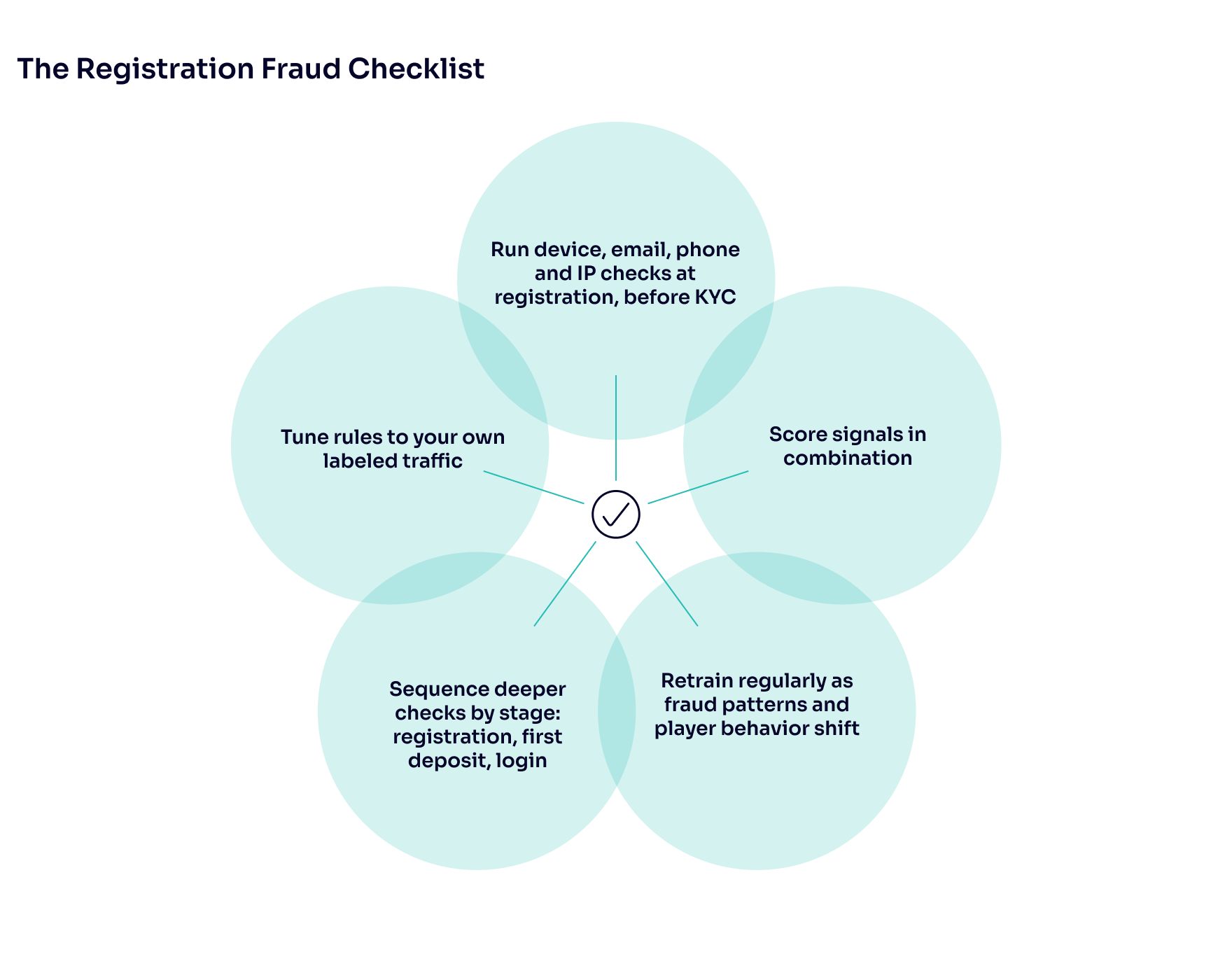
At registration, the question is simple: does this look like a real, unique person? Device fingerprinting, email and IP intelligence and behavioral signals answer this question in milliseconds, require no documents and cost almost nothing. They belong at the top of the funnel, where they filter the bulk of professional rings and amateur abusers before you spend a cent on anything heavier.
At first deposit, the question shifts: does the payment method match the identity and the device? That is when enriched checks earn their cost: full email intelligence with social scoring, phone enrichment and digital footprint analysis. Save biometric document verification and full KYC for this stage and for first withdrawal, where money actually moves and the risk justifies the expense.
At login, the question changes again: is this still the same trusted user, or an account takeover? Here you are comparing the current session against a known baseline (device, location, login cadence) rather than building a risk profile from scratch. A returning player who suddenly logs in from a new device in a new country on a new IP should raise alarms.
Running cheap checks first protects your budget and your detection logic. A fraud ring that fails at registration never learns what tripped it. A ring that fails at KYC walks away with a clean device profile, a verified email and a confirmed phone, ready to retry with one variable changed. Pushing detection upstream is both cheaper and harder to reverse-engineer.
The Signals That Give Away Bonus Abusers and Multi-Accounters
Bonus abusers and multi-accounters give themselves away through clusters of weak signals that are all visible at signup. While no single flag is conclusive on its own, the combination of them usually is. Read together across a group of accounts, these patterns stop looking like coincidence and start looking like a network.
The most reliable tells:
- Disposable or newly created emails: Throwaway addresses with no digital history, often generated in bulk minutes before signup.
- Reused device IDs: One device fingerprint linked to many accounts, the clearest sign of a single operator running a farm.
- VPN and residential proxy clusters: Multiple registrations routed through the same masking infrastructure to hide a common origin.
- Shared phone numbers and identity fragments: The same number, address or partial identity reappearing across accounts that claim to be new, including VoIP and SIP numbers used for primary verification.
- Identical form-fill timing: Matching keystroke and navigation patterns across registrations, signaling scripted automation.
- Matching hardware signatures: Identical canvas hashes, font lists or GPU signatures across supposedly unrelated accounts.
Individually, each has an innocent explanation. A shared device could be a household, and a VPN could be a privacy-conscious player. But device signals are where professional rings are hardest to hide. SEON’s Global iGaming Risk & Fraud Report found that career professionals running massive account clusters through virtual machines and emulators were neutralized by identifying missing hardware data and reused device IDs. Surface those signals alongside digital-footprint data and most rings get caught on attempt one or two, not after they have drained 10 welcome bonuses.
How to Tune Your Rules Without Blocking Legitimate Players
Building rules from your own labeled traffic instead of relying on vendor defaults is the fastest way to cut false-positive rates. Right now, 36% of iGaming operators report false-positive rates between 26% and 50%, a number that says more about bad tuning than bad technology. Every one of those flags lands in a manual queue, and most of them are real players you have slowed down or lost for good.
The cause is almost always the same: default vendor rules applied to a traffic mix the vendor never saw. Out-of-the-box settings can easily push one in three legitimate registrations to manual review, burying fraud teams in noise while the product team watches conversion drop. The rule set is the problem, not the signals underneath it.
How to tune rules to your own player base:
- Label everything: Tag “good” players and confirmed fraud so the system has something to learn from.
- Build custom rules against your own traffic: A blanket “block all VPN” rule fits some markets and sinks conversions in privacy-conscious ones.
- Use whitebox rules you can read and edit: A blackbox score is impossible to defend in an audit and impossible to fix when a market shift causes drift.
- Shadow-test before deploying: Run new rules against historical traffic and check the false-positive impact.
- Review the bottom 10% of your scoring band weekly: Edge cases hide there and watching them catches drift early.
Operators who do this work see review rates fall into single digits. Betflag posted a 20% efficiency gain by combining real-time signals with tuned rules that kept the player journey frictionless, according to its SEON case study.
What a Good Registration Fraud Stack Looks Like in Practice
In practice, a good registration fraud stack turns signup from the weakest point in the funnel into the strongest filter. The difference shows up in the numbers, not the architecture diagram.
Before tuning, default rules flag a third of signups for manual review, analysts drown in false positives, and bonus abusers still slip through because no single check connects the dots. After tuning, layered signals resolve most decisions automatically at registration, high-risk clusters get caught before any KYC spend, and analysts focus on the small pool of genuinely ambiguous cases.
| Capability | Default stack | Tuned, unified stack |
|---|---|---|
| Review rate at registration | 25% to 35% | Under 10% |
| Detection of professional rings | Often misses device clusters | Catches on attempt one or two |
| Time to add a new market or rule | Weeks, vendor support required | Hours, in-house team owns it |
| Visibility into why a player was flagged | Limited, black-box score | Full whitebox rule trail |
| Manual review queue | High, team is reactive | Low, team is proactive |
| Cost per signup decision | Multiple vendor calls stack up | One API, predictable cost |
The results back it up. Soft2Bet automated 95% of its fraud checks and cut fraudulent registrations by 90% after moving risk decisions upstream to signup. Lottoland safeguarded its marketing spend and eliminated bonus abuse at scale, unlocking 32x ROI on its fraud investment. The technology is not exotic. The architecture is unified, the rules are owned by the operator and the data is first-party.
SEON’s platform unifies device intelligence, email and phone enrichment, IP analysis and behavioral signals on top of 1100+ proprietary data points and 240+ prebuilt rules, deployable in 14 days through a single API. Most operators do not need a bigger fraud team, they need a foundation that lets their team scale.
FAQ
What is registration fraud in iGaming?
Registration fraud is when bad actors create fake or duplicate accounts on iGaming platforms, usually to claim bonuses, launder money, or avoid bans. It typically involves disposable emails, VPNs, or shared devices to appear as new legitimate users.
How do iGaming operators detect multi-accounting?
By combining device fingerprinting, email/phone verification, and IP analysis to spot accounts that share the same device, location, or identity signals. Patterns like the same phone number across multiple accounts or VPN usage are strong indicators.
What signals indicate bonus abuse at registration?
The most common ones are disposable or newly created email addresses, VPN or data center IPs, shared phone numbers, and device IDs linked to multiple accounts. These signals together paint a clear picture of someone gaming the system.
How do you reduce false positives in registration fraud detection?
By moving away from default rules and building custom ones based on your actual traffic. Labelling known good and bad users over time trains your system to make smarter decisions and reduces unnecessary friction for legitimate players.
Can fraud checks happen before KYC in iGaming?
Yes, and they should. Device intelligence, email verification, and IP analysis can all run at registration before any identity documents are collected. This lets operators catch high-risk users early without adding friction to the KYC process itself.