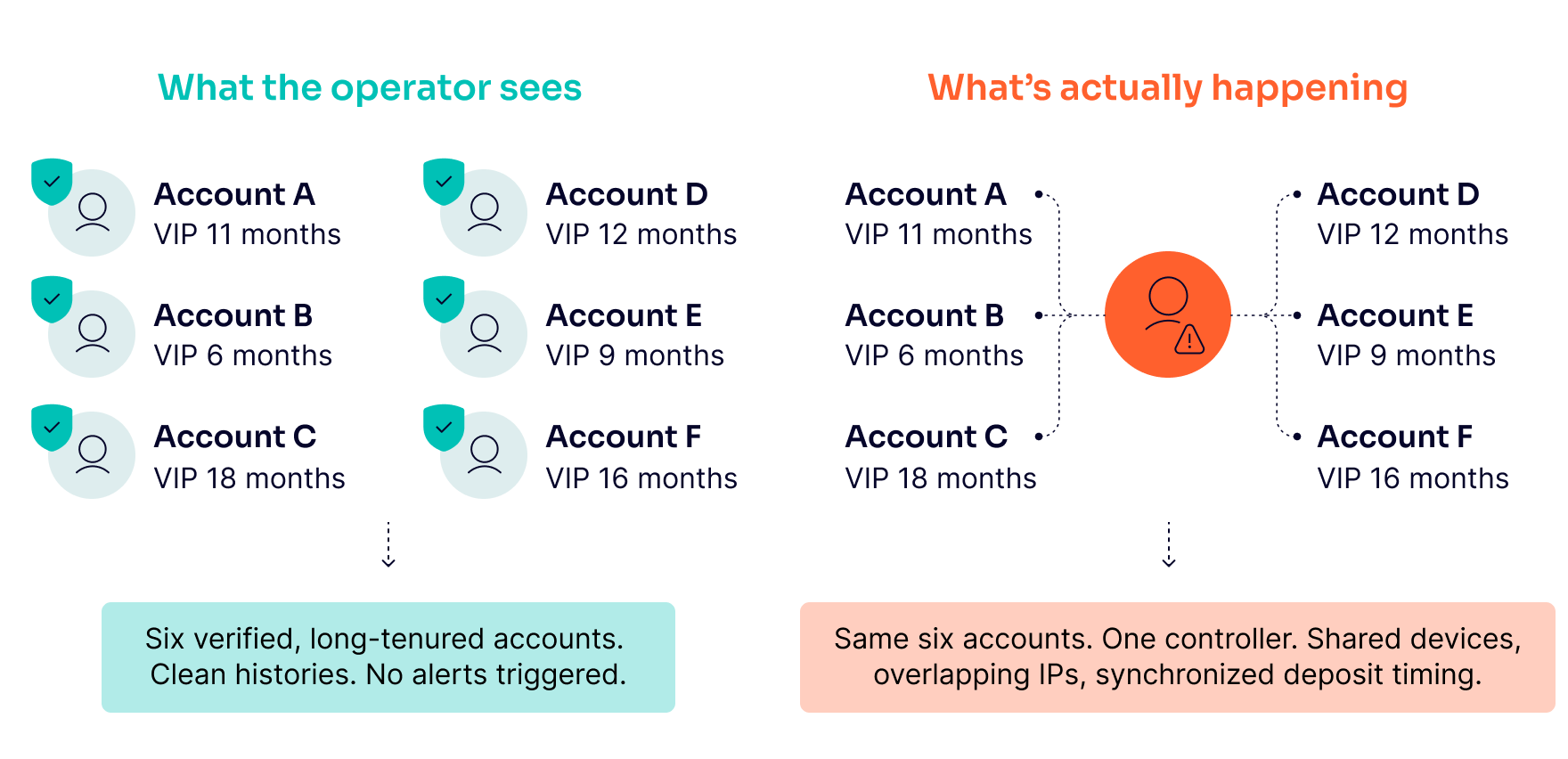
The account is 11 months old and passed KYC checks on day one. The play history shows small wagers, long intervals and the profile of a casual recreational player. When a major sporting event starts, it logs in from a new device, claims the event reload, clears the wagering requirement across the next few days and withdraws the cashback at cycle end. Forty other accounts move through the same sequence in the same window.
That pattern has no standardized industry name. Welcome bonus fraud gets the most attention, while account takeover gets the compliance line. Still, the fraud tactic that ties account takeover, promotion abuse and loyalty program abuse together at the retention layer is still operating in the gap between categories.
Call it retention bonus abuse: fraud that targets the incentives betting and gaming operators use to keep players active. According to SEON’s 2026 Fraud & AML Leaders Survey of 332 betting and gaming operators, those three growth-tied categories account for 68% of all fraud losses in the sector. While operators watch the front door, fraud rings are walking out the back.
How Retention Bonus Abuse Works
Fraud has moved past onboarding, and the defenses haven’t caught up. Many operators are still concentrating their spending on signup controls: multi-accounting checks, fake ID detection and day-one KYC, but the attack surface shifted months ago. Retention bonus abuse runs on time horizon, not speed.
Whereas welcome bonus fraud is a smash-and-grab: fake account, claim the offer, cash out, disappear, retention bonus abuse needs accounts with verified identities, clean play histories and platform tenure. Attackers either steal that trust by hijacking dormant accounts or manufacture it from scratch over months. Three methods dominate the playbook for retention bonus fraud.
Method 1: Dormant Account Takeover
Fraudsters buy credentials for inactive, KYC-verified accounts from credential stuffing dumps, breach databases and underground marketplaces. They don’t activate right away. Instead, they let the account sit below the operator’s observation window.
Once it drops off the risk radar, they reactivate it to claim retention bonuses and VIP perks. The identity was verified long ago. The play history is clean. Every trust signal the operator built now works in the attacker’s favor.
With identity supposedly verified at signup, asking whether the account still belongs to the same person 365 days later isn’t on the radar. In mature European markets, fraud rings have been observed specifically targeting premium, verified accounts with brute-force attacks rather than creating new ones. The economics are straightforward: a verified high-value account is worth more than any new registration.
Method 2: Account Aging and Sleeper Fraud
Some rings skip the takeover entirely and build their own accounts. They clear KYC with real or synthetic identities, then do something counterintuitive: nothing much.
For 180 days or longer, these sleeper accounts place small, infrequent wagers that look indistinguishable from those of a recreational player. The goal during that window isn’t profit; it’s trust accumulation. Once the account unlocks VIP tier access, cashback eligibility or reload bonus qualification, extraction begins.
A single ring might have dozens of sleepers aging simultaneously under a single operator, managed as a coordinated cluster. Individually, each account is invisible. Collectively, they drain retention budgets at a scale that welcome-bonus fraud can’t match.
Method 3: Coordinated Promotional Exploitation
Tentpole sporting events create natural spikes in promotional activity — the World Cup, March Madness, the Super Bowl, a new state launch. Fraud rings synchronize attacks around those windows, activating account clusters simultaneously to claim reload offers, cashback and event-specific bonuses.
The volume of legitimate activity provides cover. Transaction monitoring systems, already strained by the surge, can’t separate coordinated abuse from genuine behavior. The commercial pressure to avoid friction during high-acquisition moments can further widen the window.
Why Retention Bonus Abuse Is So Hard to Detect
These attackers look like the operator’s best customers. That’s the point. On every metric, the loyalty program rewards — deposit consistency, session frequency, wagering volume — a sleeper account scores identically to a genuine VIP. The behavioral signature was engineered to match.
Standard fraud detection doesn’t close the gap. KYC confirms identity at onboarding. The fraud engine evaluates transactions in isolation. The AML stack reviews withdrawals. No single tool connects a dormant reactivation to a suspicious bonus claim to an unusual cashout three weeks later. This arc is invisible when the data sits in silos.
Data quantifies the gap: 55% of betting and gaming operators say achieving a unified data view across the player lifecycle is extremely or very challenging; operators are nearly four times more likely than peers in other industries to call unified data “extremely challenging” (22% vs 6%). This evidence of fragmentation is what fraud rings are monetizing.
See how operators spot the lifecycle patterns that siloed tools miss.
Learn How
How to Detect and Prevent Retention Bonus Abuse
Detection requires lifecycle visibility, not touchpoint controls. Four shifts matter more than the rest:
- Monitor login behavior continuously
Dormant account takeover leaves fingerprints: device changes, geolocation shifts, session-time anomalies and unusual browser configurations. Those signals are invisible to a fraud stack that only validates identity at onboarding. Continuous authentication identifies reactivation patterns that legacy systems treat as normal user behavior. - Track activity cadence across the player journey
Sleeper accounts show artificially consistent play before loyalty thresholds and sharply different behavior afterward. The shift itself is the signal, not the absolute numbers on either side. Systems that only inspect the transactions miss the manufactured trust that made them possible. - Correlate signals across account clusters
Coordinated promotional exploitation depends on each account looking clean in isolation. Device fingerprints, IP patterns, deposit timing and behavioral similarity are often only visible once the data is cross-referenced across accounts. Single-account analysis misses coordination by design. - Embed risk logic into the retention layer
Shift reward criteria away from pure volume and tenure toward engagement signals that are harder to fake: session diversity, game variety, organic deposit cadence and genuine in-product interaction. Tie high-value retention offers to behavioral milestones rather than calendar ones.
The goal isn’t to cut offer generosity — it’s to protect it. Operators who build controls into the retention layer can afford to run more aggressive programs, not more conservative ones. The economics break when incentives reach the wrong accounts. And the wrong accounts are specifically designed to look indistinguishable from the right ones. When the retention layer has its own fraud logic, the program becomes something competitors without those controls can’t safely match.
From bonus abuse to coordinated bot rings, SEON gives operators the visibility to act on threats before they hit the bottom line.
Speak with an expert
FAQ
What is retention bonus abuse?
Retention bonus abuse is a form of betting and gaming fraud that targets the incentives operators use to keep players active: loyalty tier rewards, VIP perks, reload bonuses and cashback offers. Unlike welcome bonus fraud, which is a same-day smash-and-grab, retention abuse requires verified accounts with clean histories and tenure, so it looks indistinguishable from genuine player behavior until fraudsters extract the payout.
How is retention bonus abuse different from welcome bonus fraud?
Welcome bonus fraud is a same-day smash-and-grab: fake accounts, a single bonus claim and the fraudsters disappear before the operator can react. Retention bonus abuse runs on a months-long timeline using verified accounts that behave like legitimate players before extracting value. The economics also shift. Retention bonuses are routinely more lucrative per account than welcome offers because they target higher-tier players, which is why professional syndicates have moved their focus past onboarding and into the retention layer.
What is a sleeper account in betting and gaming fraud?
A sleeper account is a verified player account that fraudsters deliberately keep inactive for 180 days or longer to accumulate the trust signals operators rely on: consistent deposits, a clean play history and platform tenure. Individually, each sleeper looks like a legitimate, lightly engaged player. The fraud only becomes visible when accounts are clustered, showing artificially uniform behavior before a loyalty threshold and coordinated activity immediately after the bonus lands.
Why do standard fraud detection tools miss retention bonus abuse?
Most fraud stacks are organized around touchpoints rather than lifecycles. KYC vendors confirm identity at onboarding. AML systems flag suspicious withdrawals. Device intelligence catches obvious anomalies at login. Each tool does its job, but none of them correlate dormant-to-active reactivation patterns, loyalty threshold timing and cross-account behavioral similarity. According to SEON’s 2026 Fraud and AML Leaders Survey, 55% of betting and gaming operators say achieving a unified data view across the player lifecycle is extremely or very challenging.
How can operators prevent retention bonus abuse without reducing offer generosity?
The solution is not to cut offers but to build lifecycle-aware controls that let operators be more aggressive with rewards, not less. Four controls matter most. First, continuous authentication that monitors device changes, geolocation drift, session-time anomalies and unusual browser configurations, so dormant reactivations get a fresh identity check rather than inheriting trust from onboarding.
Second, cadence analysis that tracks activity patterns across the full player journey, since sleeper accounts show artificially consistent play before loyalty thresholds and sharply different behavior afterward.
Third, cluster correlation that connects signals across accounts, because coordinated exploitation is invisible at the individual account level but obvious once device fingerprints, IP patterns, deposit timing and behavioral similarity are cross-referenced.
Fourth, engagement-based reward criteria that shift the retention layer away from pure volume and toward signals that are harder to fake, such as session diversity, game variety, organic deposit cadence and genuine in-product interaction. Operators who build these controls into the retention experience can afford to be more generous with rewards, because the economics only break when incentives reach genuine players.