Betting bots are scripts that place bets, grind slots and play hands on gambling sites without a human. They scrape odds, farm bonuses, rig multiplayer games and now hide inside live sessions pretending to be real players.
This guide covers the main types of betting bots and the signals that detect and stop them.
quick summary
What Is a Betting Bot?
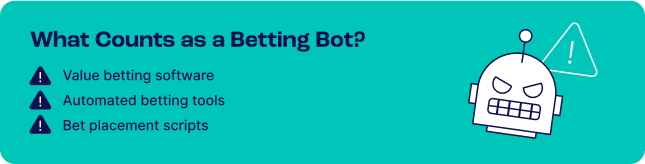
A betting bot is a script designed to automatically perform set actions on a betting website without direct human input. It is also known as a casino bot, gambling bot or value-betting software.
Its core purpose is speed, usually placing bets on sports or other events through a site’s Application Programming Interface (API) faster than any person could. More sophisticated bots have moved beyond the sportsbook into casino games, slots, online poker tables and other multiplayer formats, where they play directly rather than just scraping data.
5 Types of Betting Bots
Betting bots range from simple scripts to highly sophisticated systems. These five types cover the ones operators run into most.
1. Scraping Bots
A scraping bot is built to gather data from a website. In betting, it pulls odds from selected bookmakers so a user can manually compare who offers the best price. A whole cottage industry of “odds providers” relies on these bots to collect data, run calculations and sell the results to the public. On their own they place no bets, but the constant automated requests inflate traffic, skew analytics and feed the arbitrage tools that come next.
2. Arbitrage Bots
Arbitrage bets, or “sure bets”, make money by covering two different outcomes of the same event. An arbitrage bot scrapes all the odds for an event and calculates automatically whether a guaranteed-profit bet is possible against a pre-set formula. Because the edge is small and time-sensitive, these bots fire the moment a soft price appears and place near-identical stakes across accounts, a repetition pattern that stands out against normal play.
3. Iceberg Bots
In finance, an iceberg order hides one huge order behind hundreds of small ones. Betting bots borrow the concept: an iceberg bot spreads numerous small bets across dozens of betting companies instead of placing one large one, which can quietly shift the price or odds. The aim is to move the market without tripping the limits that a single big stake would, so the abuse hides in volume rather than size.
4. AI Bots
Artificial intelligence bots are the sophisticated end of the spectrum, playing games through algorithms rather than fixed scripts. They carry two advantages for the fraudster: they play many hands at once to multiply returns, and they play with cold, rational logic that no human emotion distorts.
The most common are poker bots, which have grown sharper on both fronts, better algorithms and better evasion. Because poker is uniquely exposed to coordinated bots, it has its own detection playbook, covered in our guide on how to detect a poker bot farm.
Researchers have also spotted bingo and blackjack AI bots. The newest wave goes further still: AI agents that register accounts and place bets on their own, driven by a prompt rather than a fixed set of steps, which makes them harder to catch on the data they submit and easier to catch on how they behave.
5. Casino and Slot Bots
Casino bots automate play across slots and table games, and the tell is behavior no human would repeat. On roulette, a bot covers every outcome at once, betting all the numbers, taking a small guaranteed loss and cashing out the rest. On slots, it grinds thousands of identical spins to clear wagering requirements or farm a bonus.
The giveaway is that the automation script keeps running. When the withdrawal comes, device intelligence can catch the tool still active on the session, along with device-farm signals like dozens of rapid clicks within seconds. That is why the strongest casino-bot checks fire at the money-out stage, not just at signup.
Are Betting Bots Illegal?
Betting bots are not necessarily illegal, but the industry and honest players both frown on them. At a minimum, online casinos, sportsbooks and other providers forbid them in their terms and conditions.
What is certain is the cost. Research by Imperva and Netacea found that:
- Arb betting costs the iGaming industry at least $14 million a year.
- During Euro 2020, some gambling sites received up to 52,000 bad bot requests per hour.
- 27.7% of all online gambling traffic appears to come from bots.
How to Detect Betting and Casino Bots
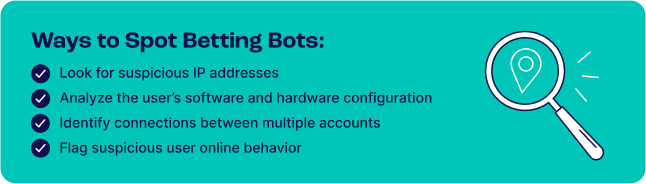
No single check catches every bot, so operators combine several. The same methods that scan a casino or sportsbook for automated play, traffic monitoring, IP scoring, device intelligence, connection analysis, behavioral signals and velocity rules, each expose a different part of the pattern, and they are strongest layered together. Whether the bot is grinding slots, farming a casino bonus or placing sports bets, the underlying signals are the same.
Monitor traffic for early bot detection
The first step is watching for irregular spikes:
- A jump in visitors that does not match your spend or expectations.
- One channel suddenly bringing in far more new sessions than the rest.
- Traffic clustering from a single location.
Location is the telling one, which brings us to IP fraud scoring.
Use IP scores to gauge risk
To judge whether a player is legitimate, start with their connection. SEON’s IP lookup, for example, can flag a user whose fraud score is only moderate but who is hiding behind a VPN and a data-center proxy, a common sign someone is masking where they really connect from. It could still be a legitimate user, so the IP is a starting point for investigation, not a verdict on its own.
Leverage device fingerprinting
How a user connects is often the single strongest signal of whether they are human. Bots tend to run from the same device, and they spoof their setup with virtual machines and emulators.
A device fingerprinting module extracts data such as the browser and operating system, installed plugins, window size, device identifiers and much more. That serves two goals: spotting emulator or virtual-machine red flags, and creating a device hash, an identifier that links a device across accounts so you can trace connections later.
Detection also means recognizing the tools bots hide behind. Automation frameworks like Selenium, Puppeteer, Playwright and headless Chrome, along with anti-detect browsers such as multilogin, are built to make a script look like a real browser.
Device-level tampering, from fake operating systems to phone and WebGL “noising”, tries to defeat the fingerprint itself. Detecting the tool, not just the device, is often what separates a real player from a bot. A useful tell at scale: a single true device ID tied to dozens of accounts, or one user showing 50 or more device IDs, points to automation rather than a person.
Look for connections between accounts
Betting bots rarely work alone, so catching one often means catching many. The method is to cross-reference a flagged bot’s data against every other user and surface the accounts that share it, something a platform like SEON does automatically.
The shared signal is often the one the fraudster forgets to rotate. In one real ring, a fraudster created roughly 14,000 accounts, each with a new IP, device, phone number and email, but reused the same password every time. The matching password hash linked the accounts and exposed the whole farm by the third signup. Device hashes, cookie hashes and true device IDs work the same way, tying “distinct” accounts back to one operator.
Watch the live session, not just the signup
The newest bots reveal themselves during play, not at registration. Session monitoring watches the active gameplay session for signs no human generates: an emulator or virtual machine attaching mid-session, screen-sharing or remote-access software running in the background, or bot-like cursor and click patterns. This is how operators catch AI poker bots and scripted play that pass every check at the front door and only turn suspicious once the hands start.
Read behavioral biometrics
Behavioral biometrics track how a user physically interacts with your site rather than what they type. A person hesitates, moves the mouse in irregular arcs and types at a human cadence; a script or AI agent does not. Copy-paste into credential fields, unnaturally uniform keypress timing and mechanical mouse movement all flag automation, which is increasingly the clearest way to separate a real bettor from an AI agent filling the same form.
Analyze behavior with velocity rules
A velocity check measures how often an action happens within a set window, the most effective way to catch the repetition that defines bot traffic. However sophisticated a bot is, the steps repeat almost identically across every instance.
Typical bot patterns worth scoring against:
- Logs in and places a bet within 3 seconds.
- Logs in at odd hours compared with other players in its locale.
- Places 10 bets within 5 minutes.
- Places 10 bets of near-identical value.
Any one of these can be human, but logging and measuring them builds a picture of a user’s intent, and ultimately tells you whether you are dealing with a person or a script.
How SEON Helps Detect Betting & Gambling Bots
SEON is a fraud prevention platform that gives operators the tools to spot suspicious users and behavior, and to know their customers through KYC verification.
Combining data enrichment, device intelligence, velocity rules, behavioral signals and real-time monitoring and alerts, it comes as close as possible to watching every player at once. SEON’s True Device ID holds even when a bot resets its browser, clears cookies or spoofs its setup, which is what makes device farms visible. Confirmed outcomes feed back into the machine-learning models, so every bot you catch sharpens detection of the next one.
All of it is customizable to your risk appetite. One operator may want to flag the slightest deviation from human behavior; another may whitelist trusted VIPs and block only the most obvious bots. The platform bends to the policy you set.
FAQ
Which are the best betting bot detection tools?
The most effective setups combine device intelligence, IP analysis, behavioral biometrics and velocity rules in one platform rather than stitching together separate point tools. Layering these signals is what turns individually ambiguous data points into a confident bot verdict.
What is automated betting software?
It is any script or program that places bets or plays games on a gambling site without a person acting in real time, from simple odds scrapers to AI poker bots that play hands on their own.
How do you tell a bot from a human player?
Bots repeat actions with machine precision and often run from spoofed or emulated devices. The clearest tells are behavioral: uniform keypress timing, mechanical mouse movement, near-instant login-to-bet speed and automation frameworks like Selenium or headless Chrome detected on the session.
How do casino and slot bots get caught?
The clearest tell is a bot covering every outcome at once, betting all the numbers on roulette or grinding hundreds of identical spins to farm a bonus. Because the automation script stays running, device intelligence can catch it at the withdrawal stage, along with device-farm signals like dozens of rapid clicks within seconds, even when the signup data looked clean.