Bonus and promo abuse accounts for 23% of reported betting and gaming fraud losses. Add the 18% attributed to loyalty program abuse and the combined figure reaches 41%, the single largest fraud category in the sector. Most operators carrying the heaviest losses are also the ones with the healthiest retention KPIs.
That’s not a coincidence. Retention bonus abuse conceals itself within the same behavioral signals operators use to measure success: engaged accounts, returning VIPs and high redemption rates. It does not appear in a fraud summary report. It appears as revenue.
The patterns are visible at the transaction level long before they surface in a fraud review — in redemption data, false positive rates, campaign reporting and vendor cycle timelines. Most operations already show three or four of the signs below.
1. Consistent Redemption Rates Across Player Tiers
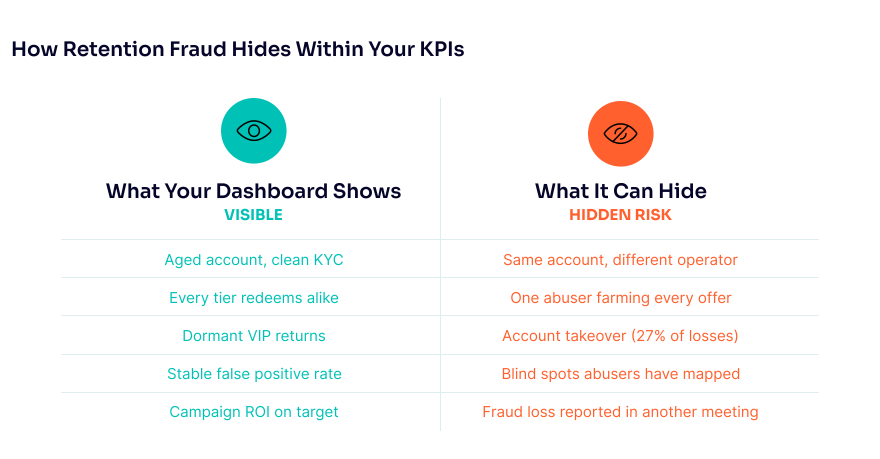
When your silver-tier reload offer and your platinum VIP bonus produce nearly identical redemption percentages, that is not evidence of a well-designed promotional ladder. It usually means someone is farming every tier.
Legitimate players are selective. They claim offers that match their play patterns and ignore the rest. Abusers claim everything, and they do it predictably — within minutes of an offer going live, at consistent intervals, across accounts that never deviate from the minimum qualifying activity. The 23% of fraud losses tied to bonus and promo abuse and the 18% tied to loyalty abuse overlap heavily here. Your highest-redemption bonus is almost certainly your most-abused one.
2. Overperforming Reactivation Campaigns
A dormant account that suddenly returns, claims a win-back offer and withdraws within 48 hours is not a reactivation success story. It may be an account takeover.
Account takeover represents 27% of reported fraud losses in the sector. A meaningful share of that volume enters through reactivation campaigns, where operators actively push incentives to accounts that have gone cold — accounts that may have been compromised weeks or months earlier. The player who ‘came back’ may not be the player who left. If your reactivation conversion rate sits significantly above industry benchmarks, the explanation is probably not that your CRM team is unusually talented.
3. Fraud Teams Are Not Involved in Retention Campaign Planning
In the SEON survey, 99% of operators said they are planning or executing a new product, market or campaign launch this year. The relevant question is how many of those launches included a fraud impact assessment before the promotional terms shipped.
Every retention bonus designed without a fraud team at the table goes live with the abuse pattern already built in. The qualifying thresholds, wagering requirements, payout mechanics — a fraud analyst can identify the exploit in the terms sheet. If that analyst first sees the campaign when the segment email lands in the test inbox, the damage is already baked into the unit economics.
4. You Can’t Trace The Claimant’s Full Fraud History At Claim Time
More than half (55%) of surveyed leaders called data visibility across the customer lifecycle ‘extremely’ or ‘very’ challenging. Among those who rated it ‘extremely’ challenging, the figure was 22%, nearly four times the 6% rate seen in other verticals SEON benchmarked.
Know Your Customer (KYC) is a snapshot of a single moment in time, but retention is relevant across the entire player journey. If your fraud team cannot pull a player’s full behavioral history, payment instrument changes, device fingerprint drift and previous investigation flags at the point a retention bonus is claimed, you are approving payouts against an incomplete record. The account may have passed KYC nine months ago. It does not mean it is still clean, or that the same person is behind it now.
5. Your False Positive Rate Is Predictable
Among surveyed operators, 36% reported false positive rates between 26% and 50%. Inside most teams, that number has a name: the cost of doing business.
A stable, known false positive rate actually signals something more specific: predictable rule behavior. If your fraud team knows roughly what the false positive rate will be next month, so does anyone paying attention to how your detection works. Consistent false positives mean consistent blind spots. Abusers who test the boundaries once and survive learn exactly how far they can push.
6. Retention Bonus Performance Is Reported Gross, Not Net of Fraud Loss
When the retention team reports campaign return on investment in one meeting and the fraud team reports loss trends in another, the operator is running two separate narratives about the same money.
The survey found that 47% of operators are scaling fraud response through headcount while only 34% are investing in AI or machine learning — a 13-percentage-point gap that shows where most teams are operationally stuck. The retention campaign hitting its key performance indicator and the fraud report bleeding red are usually describing the same campaign. Until those numbers sit side by side in a single view, no one in the room has the real margin figure.
7. You Replaced a Vendor, and The Abuse Pattern Came With You
Twenty-eight percent of operators reported replacing a fraud vendor in the past year — roughly four times the replacement rate SEON sees in other verticals. If the pattern you were trying to solve followed you to the new platform, the problem was never the vendor.
Switching tools without fixing the underlying data architecture is expensive treadmill running. The detection model changes. The abuse pattern does not. A new interface on the same fragmented signals will produce the same blind spots at a different price point.
The Common Thread
All seven signs trace to the same root cause: retention programs designed, launched and measured without fraud as a variable in the equation.
Three diagnostic questions separate the operators who will close that gap from the ones who will keep cycling through the same losses:
- Data architecture: Can you connect a player’s signup signals to their behavior at the point of a retention bonus claim, in real time rather than a retrospective investigation?
- Detection capability: Is your model improving specifically against retention-stage abuse, or are you adding features that replicate coverage you already had?
- Fraud function scale: Is your fraud team growing at the same rate as your promotional spend, or are you absorbing more exposure with the same headcount?
If the answers are uncomfortable, the losses described above are not hypothetical. They are already in your operation, mislabeled as a marketing cost.
Frequently Asked Questions
What is retention bonus abuse in betting and gaming?
Retention bonus abuse is the systematic exploitation of loyalty programs, VIP tiers, reload offers and personalized promotions by accounts that passed onboarding checks but exist primarily to extract promotional value. Unlike welcome bonus fraud, it targets the ongoing relationship rather than the first deposit.
How is retention bonus abuse different from welcome bonus fraud?
Welcome bonus fraud is bounded — the attacker takes one offer and the account typically closes out. Retention bonus abuse is recurring. The abuser claims promotions every campaign cycle, often across multiple aged accounts, and the losses compound over months rather than ending at signup.
Why is retention bonus abuse hard to detect?
The accounts committing it appear to be good customers. They passed KYC, they have transaction history and they meet the qualifying criteria for loyalty offers. Most fraud detection stacks evaluate risk at onboarding and do not re-score accounts when they claim a retention promotion months later.
What share of betting and gaming fraud losses comes from retention-stage fraud?
In a 2026 SEON survey of 332 industry leaders, bonus/promo abuse (23%) and loyalty program abuse (18%) together accounted for 41% of reported losses. Account takeover, another retention-stage problem, added 27%. The majority of fraud losses in the sector occur after onboarding.
How can operators detect retention bonus abuse earlier?
Connect onboarding signals to ongoing behavioral data so the fraud team can evaluate a player’s full history at the point of a bonus claim. Involve fraud analysts in campaign design before promotions launch. Report retention bonus performance net of fraud loss, not gross.