Payment screening is the real-time process of checking the parties to a transaction against sanctions lists, watchlists and databases of high-risk individuals or entities, and blocking prohibited payments before the money moves.
The risk concentrates on the counterparty at the moment of execution, because that is the point where a business often learns the least about who is on the other side. That gap makes screening both a regulatory obligation and a practical defense.
Our own report “2026 Fraud & AML Leaders” shows how fast that pressure is building: the share of fraud and AML leaders who disagreed that their losses are growing faster than revenue fell from 56% to 35% in a single year.
As instant transfers become the norm, payment screening is the first line of defense for financial institutions, fintechs, payment providers and iGaming operators that must catch prohibited activity in real time rather than after settlement.
quick summary
What is Payment Screening?
Payment screening is a real-time check that compares incoming and outgoing transactions against global sanctions lists, watchlists and high-risk databases, so a business can stop prohibited or suspicious payments before they complete. In banking and payments, the same term describes screening the counterparty to a transfer at the moment of execution, which is why practitioners often treat it as counterparty screening rather than customer screening.
Screening is not only best practice, it is a regulatory requirement under global anti-money laundering (AML) and counter-terrorist financing (CFT) frameworks. These include standards set by the Financial Action Task Force (FATF), the European Union Anti-Money Laundering Directives (EU AMLDs) and enforcement bodies such as the U.S. Office of Foreign Assets Control (OFAC).
Proactive payment screening means running that check before the payment settles rather than reconciling after the fact. A real-time call can screen the parties in milliseconds and return a decision that holds or releases the payment automatically, so a compliance officer only reviews the genuine gray-area cases.
Payment Screening vs. Transaction Monitoring
Payment screening and transaction monitoring are frequently discussed together, yet they address risk at different points and answer different questions. Screening focuses on a single transaction, comparing its parties in real time against sanctions lists and watchlists to block prohibited payments at the point of processing. It exists to stop the obvious, high-severity risk before the money moves.
Transaction monitoring takes the broader view. Rather than examining one payment in isolation, it evaluates customer behavior across real-time activity and historical data to surface anomalies, suspicious patterns and money laundering typologies that a single payment would never reveal.
Combined, the two create a layered compliance framework. Screening prevents immediate exposure to a sanctioned or prohibited party, while monitoring uncovers the slower, more sophisticated activity such as structuring, layering and smurfing. Running both is how financial institutions, fintechs and payment providers balance regulatory obligations with genuine protection against financial crime.
How Does the Payment Screening Work?
The payment screening process begins when a payment message is sent or received. Before funds can move, the transaction must pass through a series of checks designed to detect and block prohibited or suspicious activity. While the exact process can vary across institutions, the essential steps typically include:
- Data Collection
- List Screening
- Alert Generation
- Investigation and Resolution
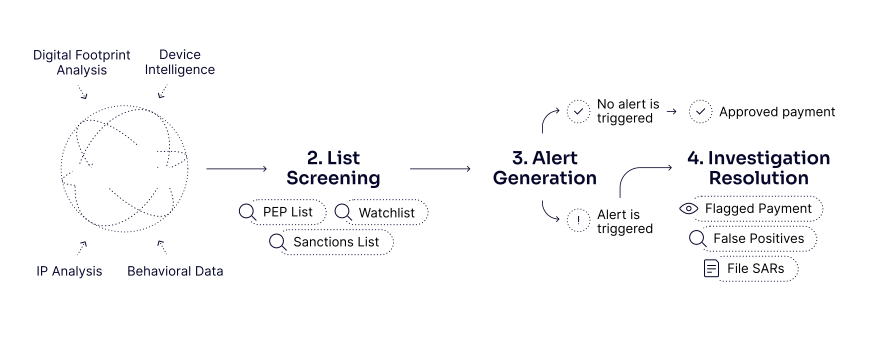
Together, these steps create a layered workflow that ensures compliance with AML and counter-terrorist financing regulations while reducing exposure to financial crime.
1. Data Collection
The first step is gathering the key details of the transaction. This includes the amount, sender and recipient information, geographic locations and customer identifiers or credentials tied to the payment. The accuracy and completeness of this data are critical, as they form the foundation for effective screening. Without reliable inputs, the risk of missed matches or false positives increases significantly.
2. List Screening
Once the data is collected, it is compared against global and regional sanctions lists, watchlists, and other high-risk databases. These include the U.S. Office of Foreign Assets Control (OFAC) Consolidated List, OFAC’s Specially Designated Nationals (SDN) List, the European Union’s Consolidated List of Sanctions and the United Nations Security Council’s Consolidated List. Many jurisdictions also maintain local watchlists, which must be included to ensure compliance.
While PEP screening is usually performed at onboarding and during periodic reviews, politically exposed persons may still require enhanced due diligence. As the UNODC highlights, the ability to screen against updated and authoritative lists is central to preventing money laundering and terrorist financing.
3. Alert Generation
If a potential match is identified during list screening, an alert is triggered. This safeguard ensures that potentially high-risk or prohibited payments are not automatically approved. For example, if a customer attempts a cross-border transfer and the recipient’s name appears on a global sanctions list, the transaction will be flagged for review.
At this stage, the alert does not automatically mean the payment is illegal or fraudulent. Instead, it signals the need for escalation, so compliance officers or investigators can examine the case more thoroughly.
4. Investigation and Resolution
The final stage involves a deeper investigation into the flagged payment. Compliance teams analyze the alert to determine whether it represents a genuine or false positive threat. If the transaction is cleared, it can proceed as intended. If not, the payment is blocked, and the organization must file a Suspicious Activity Report (SAR) with the appropriate regulatory authority. This resolution step is critical for compliance and for demonstrating transparency and accountability to regulators, auditors, and stakeholders.
Discover SEON’s Payment Screening Solution for real-time protection against illicit transactions.
Payment Screening Solution
Why Payment Screening Matters
Payment screening is a cornerstone of AML compliance and financial crime prevention. Global frameworks such as the FATF Recommendations, the EU AMLDs and enforcement bodies like OFAC require regulated entities to screen payments, both to block illicit transactions and to meet international compliance standards. For payment service providers in the EU, real-time monitoring now sits at the center of PSR and PSD3 compliance, tightening the expectation to act before funds move.
“Every leap in payments innovation comes with a trade-off; the faster money moves, the less time there is to stop it from moving in the wrong direction.”
Husnain Bajwa, SVP of Product, Risk Solutions at SEON
For financial institutions, fintechs and other regulated businesses, screening ensures that transactions do not involve sanctioned individuals, high-risk entities or prohibited jurisdictions. That reduces the risk of inadvertently facilitating money laundering, terrorist financing or other illegal activity, and it does so at the one moment the business can still stop the payment.
Beyond compliance, screening protects the business from reputational harm by demonstrating due diligence in safeguarding the financial system. Effective screening shows regulators, customers and stakeholders that an organization is committed to preventing financial crime while keeping legitimate payments moving.
Payment Screening Challenges
The hardest part of screening is rarely the detection itself. Managing false positives is the recurring pain point, because overly sensitive matching drives up review costs and frustrates legitimate customers with delayed payments. Balancing thorough screening against a smooth customer experience is the core operational tension every team has to resolve.
Data quality sits underneath that tension. In SEON’s 2026 Fraud & AML Leaders Report, more than half of fraud and AML leaders said limitations in their data sources account for at least a quarter of their false positives, which is why the completeness of the input matters as much as the matching logic.
Scope is the second challenge, and it is as much commercial as it is regulatory. Screening every single transaction is the safest position, but at high volumes it carries real cost, so many businesses weigh a risk-based approach that concentrates screening on higher-risk merchants or corridors. Where that line sits depends on the regulator, the risk appetite and the price of getting it wrong.
Staying ahead of changing requirements adds a third burden. Sanctions lists change constantly, and organizations must keep their sources current, retrain rules and refine thresholds as regulations evolve. That demands ongoing investment in technology and process, especially at scale where high transaction volumes consume significant computational resources.
Sanctions Data and List Coverage
Payment sanctions screening is only as reliable as the data behind it, so how a provider sources and refreshes its lists is a decision worth scrutinizing. Screening should draw directly from the official sources, with lists indexed frequently enough that a change to a sanctions regime reaches production within a short, defined window rather than days later.
Coverage also has to be configurable. A business needs to screen the global regimes that apply to it, such as OFAC, the EU and the UN, while adding internal or country-level lists and switching off jurisdictions that create noise without reducing real risk. Fuzzy matching settings then tune the balance between catching name variations and generating false positives, with a mid-range relevancy score serving as a sensible starting point before testing against live data.
Proactive and AI-Assisted Screening
Modern payment screening has moved well beyond manual list checks. Artificial intelligence (AI) and machine learning (ML) now improve match accuracy and reduce false positives, so legitimate payments clear without unnecessary delay while genuinely suspicious ones are flagged in real time for review. Our Fraud & AML Leaders Report puts this in context: AI and ML for transaction monitoring is already the most common AI use case among fraud and AML leaders at 30%, while AI agents for sanctions screening are still emerging at 5%.
An AI screening assistant does not make the decision for the analyst. It ranks the likelihood that a hit is a true match, factors in context such as a date-of-birth mismatch that points to a false positive, and highlights the highest-risk items first, which speeds up review and gives the team more confidence in each call.
Speed is decisive in the digital economy, and real-time screening lets businesses process payments as they happen without sacrificing security or compliance. Just as important, the latest payment fraud detection tools are built for seamless integration, connecting to existing payment systems and workflows so organizations can strengthen defenses without costly infrastructure overhauls.
Strengthening Your Payment Screening Process
Systematic payment screening is how businesses meet AML obligations, protect their reputation and keep customer trust, and doing it well means analyzing each transaction in real time without adding friction to legitimate payments.
SEON’s payment screening solution screens both the sender and the receiver of a transaction in a single API call, checking names, bank identifiers and crypto wallet addresses against global watchlists in milliseconds. Because SEON owns its data mechanism rather than reselling third-party lists, teams control their sources and fuzzy settings directly, block high-risk payments through a real-time webhook and keep every decision logged for audit. The result is smarter screening, stronger compliance and safer transactions, delivered through one integration rather than a stack of separate tools.
FAQ
What is payment screening?
Payment screening is the real-time process of checking the parties to a transaction against sanctions lists and watchlists, then blocking or holding any payment linked to a prohibited individual or entity before it settles. It helps businesses comply with AML and CFT regulations, avoid fines and protect their reputation.
What is the difference between payment screening and transaction monitoring?
Payment screening analyzes real-time transactions at the point of processing to block prohibited or high-risk payments. Transaction monitoring, on the other hand, evaluates broader customer behavior by reviewing both real-time and historical activity to identify suspicious patterns over time. Together, they form a multi-layered defense against money laundering and fraud.
What is proactive payment screening?
Proactive payment screening runs the sanctions check before a payment settles rather than reviewing transactions after the fact. A real-time API call screens the sender and receiver in milliseconds and can automatically hold a suspicious payment through a webhook, so the business prevents exposure instead of remediating it later.
What are the best tools for real-time payment screening?
The best real-time payment screening tools check transactions against sanctions lists and high-risk databases in milliseconds without slowing payments down. SEON stands out with real-time sanctions, bank identifier and crypto wallet checks, configurable fuzzy matching and customizable rules in a single workflow