Most chargeback problems are solved too late. The 2025 chargeback landscape is defined by a striking rise in friendly fraud, with 62% of merchants reporting an increase in first-party misuse. By the time a dispute lands in your queue, you have already lost the transaction, absorbed the fee and added to your chargeback ratio.
At SEON, we have seen how a prevention-first strategy can counter this trend, helping partners like Unbuffered reduce chargebacks by 91% in a single month. This guide covers what chargeback fraud actually is, why it is growing and how to build a prevention strategy that reduces disputes before they are ever filed.
Key takeaways:
What Is a Chargeback?
A chargeback is a payment reversal that happens when a customer disputes a transaction with their bank or card issuer due to suspected fraud, dissatisfaction, or errors by the business. The bank refunds the customer and deducts the amount from the merchant’s account, which can lead to revenue loss, fees, reputational damage, and even restrictions on accepting card payments. In some cases, fraudsters exploit this process, known as “friendly fraud”, to obtain goods or services without paying.
What Is Chargeback Fraud?
Chargeback fraud refers to the misuse of the chargeback process, whether intentional or opportunistic, resulting in financial harm to merchants. Often termed friendly fraud or first-party fraud, it occurs when a customer disputes a legitimate transaction, falsely claiming the product wasn’t delivered, was defective or that the purchase wasn’t authorized.
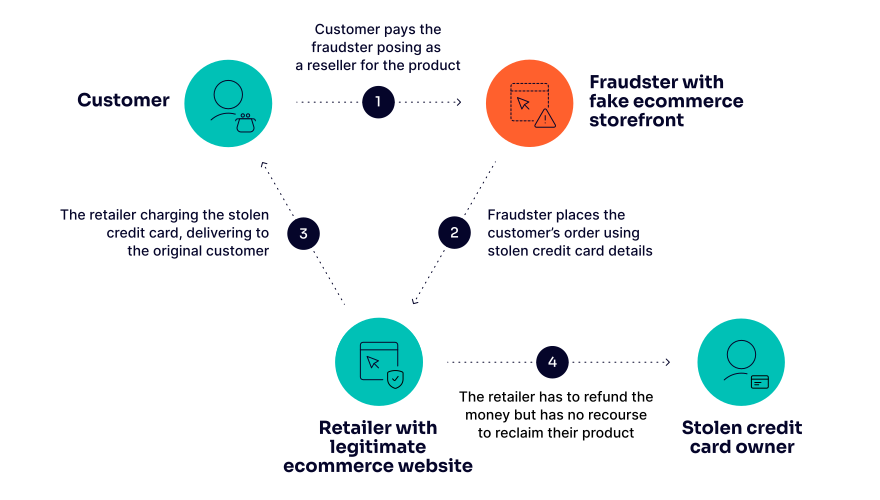
On the other end of the spectrum, third-party fraud involves bad actors using stolen card details to make purchases, which are later charged back when the actual cardholder notices the unauthorized transaction. In both cases, merchants not only lose revenue and goods but also incur processing fees and face potential reputational damage.
How Does Chargeback Fraud Work?
The process closely mirrors that of legitimate chargebacks, making detection especially challenging. A customer, maliciously or mistakenly, contacts their issuing bank to dispute a charge. Common reasons include claiming the item never arrived, the transaction was unauthorized or the product did not match expectations.
The bank then initiates a chargeback through the card network, prompting the merchant’s acquiring bank to temporarily reverse the transaction. The merchant must either gather evidence to challenge the claim or accept the financial loss. For high-volume retailers and digital-first businesses, this creates operational strain and opens the door to repeated exploitation, especially when teams rely on disconnected or different chargeback management tools that fragment visibility and slow response times.
Three Common Types of Chargeback Fraud
Not all chargebacks have the same cause, and the prevention approach differs significantly depending on the type.
- Third-party card fraud covers chargebacks caused by unauthorized transactions made with stolen payment credentials. The genuine cardholder did not make the purchase, and the dispute is a legitimate exercise of the consumer protection mechanism. Prevention requires upstream fraud detection at the transaction stage to block fraudulent payments before they are completed.
- Friendly fraud covers chargebacks filed by the legitimate cardholder after a valid transaction. The purchase was genuine, but the cardholder disputes it, either intentionally to get a refund without returning goods or because they genuinely do not recognize the transaction. 62% of merchants reported an increase in first-party misuse in 2025. Friendly fraud requires behavioral evidence from the transaction record to be successfully disputed, not just card block data.
- Merchant error covers chargebacks triggered by operational failures, such as billing confusion, fulfillment issues, unclear subscription terms or poor customer communication. These disputes are technically legitimate and are best addressed through operational improvements rather than fraud detection.
How to Prevent Chargeback Fraud
Preventing chargeback fraud begins long before disputes are filed. While dispute management is important, the most effective strategy is proactive: stopping fraud before it reaches the checkout. That means accurately identifying users, understanding behavior patterns and applying layered fraud detection across the customer journey from account creation to payment.
1. Strengthen Payment Security with Proven Protocols
Implementing robust, secure payment practices is a critical first line of defense. These measures help reduce unauthorized transactions and discourage opportunistic chargebacks:
- Chargeback fees and cost control: Minimizing disputes helps reduce exposure to chargeback fees, which can cost merchants up to $100 per case, not including lost revenue or goods.
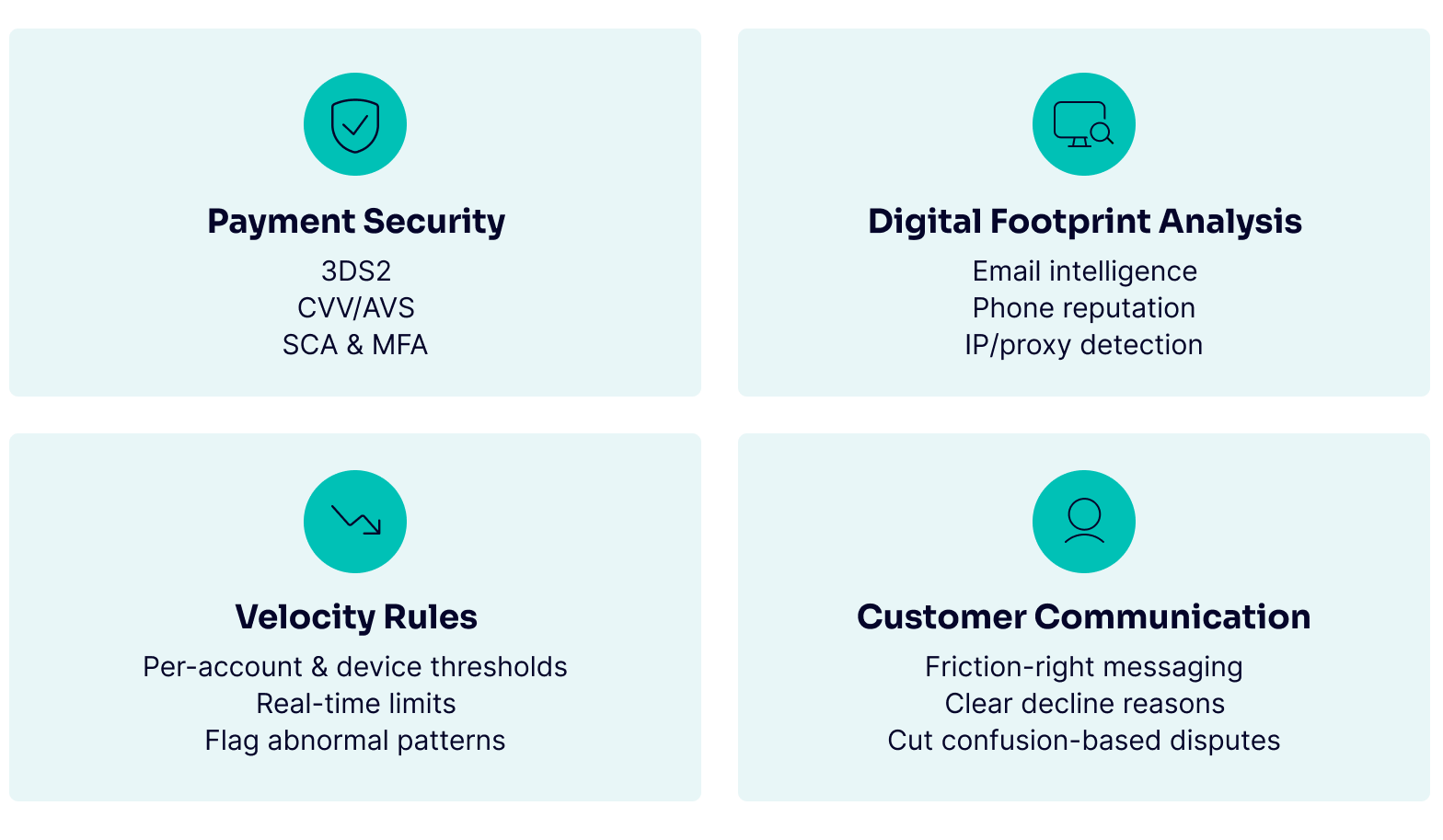
- 3D Secure 2.0 (3DS2): A key card network protocol that supports frictionless authentication. It uses transaction data (IP, purchase history, behavior) to help banks assess risk in real time.
- CVV, AVS and tokenization: Combining Card Verification Value (CVV) and Address Verification Service (AVS) at checkout offers layered validation. Tokenization further protects the cardholder from transaction fraud data by substituting sensitive info with randomized strings.
- SCA & MFA: Under PSD2, Strong Customer Authentication (SCA) mandates enhanced identity verification. Multi-factor authentication (MFA), biometrics, and one-time passwords (OTP) can help validate genuine users.
- SSL encryption: Displaying a secure SSL certification reinforces customer trust while protecting payment data during transmission.
2. Leverage Digital Footprint Analysis to Identify Risky Behavior
Every online interaction leaves a digital trace. Analyzing this data enables merchants to distinguish legitimate users from high-risk actors:
- Email intelligence & domain analysis: Flag suspicious domains (e.g., temporary or disposable addresses), verify the age of email accounts and assess if the identity aligns with account or billing details.
- Phone number & carrier analysis: Validate numbers against messenger app presence, carrier origin, SIM type and detect fake or invalid entries.
- IP, ISP & proxy detection: Identify risky connections via proxy, VPN or Tor usage. Analyze ISPs and geolocation to highlight inconsistencies between claimed identity and technical signals.
- Blacklist & BIN checks: Check against blacklists for negative behavior and run BIN lookups to verify issuing banks and card country.
Carefully investigating users’ digital footprints not only helps in real-time decision-making but can also provide evidence for dispute resolution.
3. Set Up Smart, Flexible Velocity Rules
Velocity rules monitor how often specific actions occur over a set timeframe, flagging repeat patterns that point to chargeback abuse:
- Multiple refund or dispute requests from the same customer over time
- Repeat orders tied to a payment method or device with a prior chargeback
Feeding this data into a dynamic risk-scoring engine lets you calculate fraud risk using weighted rules tailored to your business. When a customer crosses your threshold, you can flag them for review before the next dispute is filed.
4. Communicate Clearly with Customers
Sometimes, chargebacks result from misunderstandings and not malicious intent. To reduce friendly fraud:
- Provide transparent product descriptions
- Make support channels easy to find
- Send order confirmations and tracking details
- Respond quickly to customer concerns
A clear, communicative customer experience reduces friction, builds trust and makes it less likely that buyers will turn to their banks for a refund.
What Are the Costs of Chargeback Fraud for Businesses?
A single $100 chargeback costs over $260 in true losses when the refund, dispute fee, fulfillment cost and operational overhead are included. At scale, those individual costs add up to a material revenue problem.
The broader impact extends beyond individual transaction losses. Card networks flag merchants whose chargeback ratios exceed roughly 1% of monthly transaction volume. Exceeding this threshold triggers the implementation of monitoring programs, which incur additional fees. Sustained non-compliance risks merchant account termination and damage to acquiring relationships that can take years to rebuild.
Friendly fraud alone costs online retailers over $132 billion annually. The combination of direct loss, fee exposure and processor risk makes chargeback fraud one of the most commercially significant fraud problems for eCommerce and payments businesses.
A Holistic Approach to Chargeback Fraud Prevention
Chargeback fraud is evolving, but so are the tools to address it. Businesses that combine behavioral insights, digital footprint analysis, secure payment protocols and smart decision rules, supported by SEON’s chargeback prevention software, can prevent disputes earlier and handle recovery more efficiently without disrupting the customer experience.
The result? Lower fraud losses, fewer chargeback fees and a checkout that’s both secure and seamless.
FAQ
How many chargebacks are too many for a merchant?
Chargeback risk becomes more serious when merchants approach or exceed card network monitoring thresholds. Visa’s threshold is approximately 0.9% of monthly transaction volume, and Mastercard’s is 1%. Exceeding these levels triggers monitoring programs with additional fees and risks for payment acceptance if the ratio is not reduced.
Can chargeback fraud be prevented completely?
Chargeback fraud cannot usually be eliminated entirely, but layered prevention can reduce dispute volume significantly before cases ever reach representment. Businesses that combine upstream fraud detection with strong payment security controls and clear customer communication consistently achieve lower chargeback ratios than those relying solely on dispute response.
What is the difference between chargeback prevention and chargeback management?
Chargeback prevention focuses on stopping fraudulent or disputable transactions before disputes are filed. Chargeback management focuses on handling, triaging and responding to disputes after they have been filed. The two are complementary: prevention reduces volume, management recovers revenue from disputes that do occur.
What evidence do you need to win a chargeback dispute?
The most useful evidence includes delivery confirmation with the customer’s name and address, device data showing the same device was used at account creation and at the time of the disputed transaction, session logs proving the account was actively used after the purchase, and digital identity signals confirming the buyer had a consistent, credible online presence. For digital goods, evidence of download, access or use is critical. Generic screenshots of terms and conditions rarely succeed on their own.
How do fraud prevention tools reduce chargeback rates?
Fraud prevention tools cut chargeback rates by blocking risky transactions before checkout, not by fighting disputes afterward. Digital footprint analysis and velocity rules stop disputes at the source. SEON’s automated chargeback management helped Unbuffered reduce chargebacks by 91% in a single month, lowering fees and losses.
How does 3DS2 affect chargeback liability?
When a transaction passes 3DS2 authentication, liability for fraud-related chargebacks shifts from the merchant to the card issuer in most cases. This makes 3DS2 a meaningful protection against third-party card fraud chargebacks. It does not protect against friendly fraud chargebacks, where the genuine cardholder authorized the payment and is disputing it after the fact.
Why do some businesses have high chargeback rates despite using fraud detection?
The most common cause is that fraud detection is applied only at the transaction stage, while fraud originates earlier. Accounts created with stolen or synthetic identities pass checkout fraud checks because the risk was never scored at registration. Friendly fraud is another driver that transaction-level detection cannot address, since the payment was authorized by the real cardholder.
Sources
- Merchant Risk Council – 2025 Global eCommerce Payments and Fraud Report