Telecom fraud (also known as telecommunications fraud or telco fraud) refers to any illegal activity that abuses communication networks, billing systems or customer accounts for financial gain. While legacy threats target carrier call-routing rates, modern attacks increasingly exploit customer signups, logins and payment checkouts.
Stopping these losses requires matching the right detection tool to the specific stage where the fraud occurs. In this guide, we break down 11 common telecom fraud types and how to detect and prevent them.
quick summary
What Is Telecommunications Fraud?
Fraudsters manipulate phone networks and online portals to steal hardware, intercept user logins and generate fake call traffic. These activities exploit structural gaps in call routing protocols and user authentication setups.
Common examples include International Revenue Sharing Fraud (IRSF) and interconnect bypass fraud, which exploit call rate differences between operators. Both schemes target network infrastructure to siphon revenue directly from legitimate providers
How Telecom Fraud Works
Fraudsters exploit telecom operations by targeting weak entry points across both carrier networks and digital subscriber portals. On the network side, bad actors use automated scripts to compromise unsecured Private Branch Exchange (PBX) systems or lease premium-rate numbers. They then flood those lines with artificial call traffic, pocketing per-minute payout margins before operators detect the volume spike.
On digital subscriber portals, attackers use stolen credentials or residential proxies to buy bulk SIM cards and high-end handsets. Fraudsters then register fake affiliate accounts or submit bogus signup forms to trigger automated referral payouts and hardware shipments. Once in control, bad actors deploy remote-access software or execute SIM swaps to intercept One-Time Password (OTP) messages and hijack user accounts.
11 Common Types of Telecom Fraud
Understanding specific attack vectors helps teams deploy targeted controls across network and account layers. The following 11 schemes represent the most frequent threats targeting communications providers today.
1. International Revenue Sharing Fraud (IRSF)
Bad actors lease premium-rate phone numbers and hack into unsecured business phone networks. They run automated calls to those numbers off-hours, leaving the targeted business with massive phone bills while taking a cut of the per-minute rate. Because telephony lacks chargeback protocols, operators rarely recover these losses.
2. Wangiri Fraud
Wangiri fraud (from the Japanese for “one ring and cut”) is a telecom scam where fraudsters call a customer, let it ring once, then hang up. The goal is to trigger a callback, which routes the victim to a high-cost premium-rate number controlled by the attacker. An SMS version also exists, prompting users to call or text a specific number.
Common red flags include sudden spikes in calls to high-cost destinations and repeated short-duration calls. Telecom operators and call-heavy businesses can reduce risk by monitoring outbound dialing patterns and using tools like reverse phone lookup to flag suspicious numbers before customers are prompted to call back.
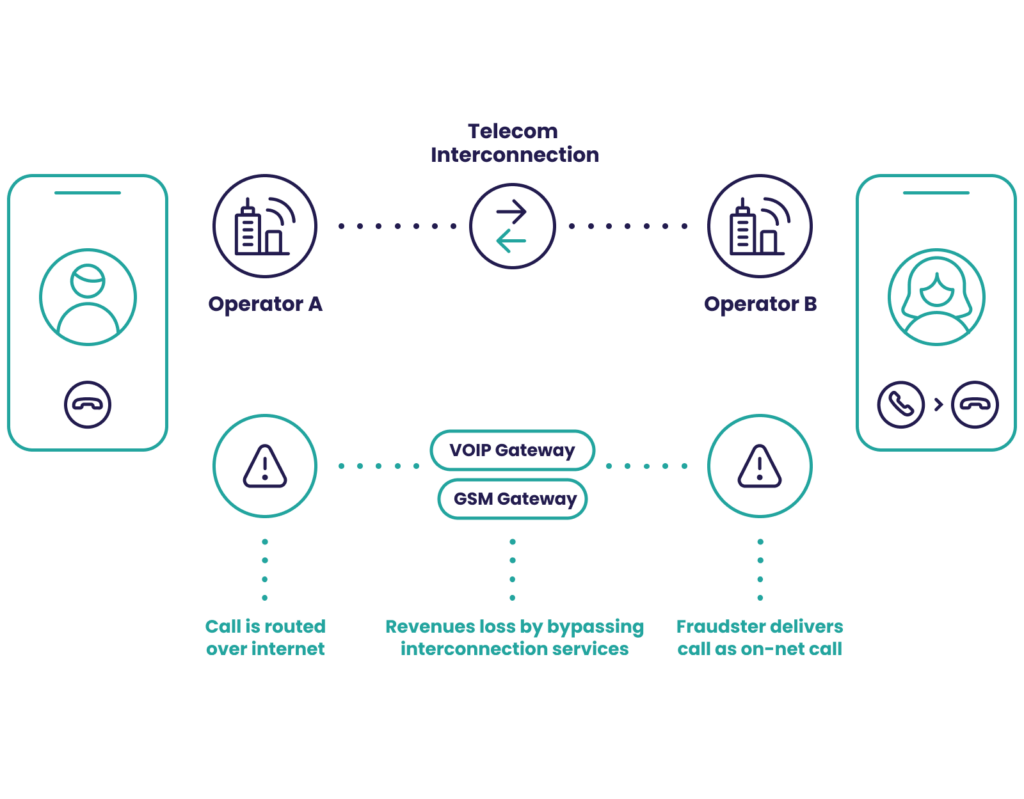
3. Interconnect Bypass Fraud
Fraudsters exploit call termination rates between different operators using SIM boxes or Global System for Mobile Communications (GSM) gateways. They intercept international calls and route them locally at near-zero rates. Callers pay full international rates, but the fraudster collects the margin while degrading call quality.
4 Telecom Arbitrage Fraud
Arbitrage is the general practice of capitalizing on price differences. In the telco world, these differences appear in the long-distance rates between countries.
Just like with international bypass fraud, it can lower the international cost for customers, but also open the door to fraudulent companies who insert themselves between operators. They claim to connect directly from country A to B, whereas, in fact, they go through a cheaper rate country to connect the call.
5. PBX Hacking
PBX hacking allows fraudsters to take control of phone lines by exploiting unsecured phone networks.
A PBX (private branch exchange) is a private phone network that connects to external networks. It’s what allows companies to share lines and to reduce the number of numbers needed in an office, for instance.
Because a lot of these PBX are IP-based, they can be an easy target for hackers. They will log into the system and use it to their advantage – for instance for instances of IRSF fraud mentioned above. This is a cybersecurity and IT issue that can be avoided with better internal controls and password security.
6. Traffic Pumping
Local exchanges artificially inflate incoming call volumes to collect higher regulatory access fees. Under regulatory frameworks like those managed by the Federal Communications Commission (FCC), major carriers must pay compensation fees to rural networks, creating an incentive for access stimulation.
7. Deposit Fraud
Deposit fraud is a form of credit card fraud where criminals use stolen card details to buy prepaid SIMs or devices from telecom online stores. The impact often shows up later as chargebacks, and aggressive chargeback protection can increase false positives by blocking legitimate buyers.
A growing risk comes from 5G proxy networks, where fraudsters buy SIMs and USB dongles in bulk to build residential proxy setups and rotate IPs at scale. Using IP intelligence, including an IP fraud score, can help flag suspicious locations and network patterns before a purchase is approved.
8. Subscription Fraud
Bad actors acquire high-end smartphones on contract using stolen or synthetic identities. They bypass Know Your Customer (KYC) verification with rented credentials, jailbreak the handsets and resell them on secondary markets before default collections begin.
9. Account Takeover
Telecom providers offering online accounts face frequent Account Takeover (ATO) attacks. Fraudsters use stolen credentials to hijack user profiles, alter sensitive details and make unauthorized purchases. Controlling a subscriber account also allows bad actors to intercept One-Time Password (OTP) messages and reset credentials across connected banking, fintech and digital services.
Beyond direct financial losses, ATO erodes customer trust and triggers regulatory penalties. To mitigate these risks, operators deploy real-time behavioral monitoring, strong authentication and login anomaly tracking to ensure only legitimate subscribers access their accounts.
Rebtel Blocks 30% More ATO Attempts
“What’s really cool is the way you can set up rules. There’s a whole bunch of logic that we’ve started playing with”

10. Smishing/SMS Phishing
Smishing, or Short Message Service (SMS) phishing, uses mass text campaigns to trick subscribers into revealing sensitive personal data. Phishing rings deploy automated software to filter active mobile numbers, host fake login portals and run online marketplaces for stolen credentials.
Attackers frequently exploit business-to-business (B2B) messaging gateways to deliver spam at scale, damaging operator reputations. Monitoring B2B account signups and messaging traffic ensures providers do not accidentally facilitate phishing operations.
11. SIM Jacking and SIM Swapping
SIM swapping, also known as SIM jacking, occurs when fraudsters trick customer support representatives into transferring a subscriber’s phone number to a new Subscriber Identity Module (SIM) card under attacker control. Once the transfer completes, attackers intercept incoming calls and text messages.
Because online services use text messages for One-Time Password (OTP) delivery and Two-Factor Authentication (2FA), controlling a number allows attackers to hijack banking, crypto and social media accounts. Telcos mitigate this risk by enforcing Multi-Factor Authentication (MFA) before approving number transfer requests.
“The problem with Multi-Factor Authentication (MFA) is that it cannot answer the most critical question in a SIM swap scenario: has this phone number been reassigned to a different SIM card?”
Balint Toth, Head of Product – Digital Footprint & Device Intelligence at SEON
Fraud Detection in Telecom Industry: The 4-Stage Workflow
Effective telecom fraud detection requires separating carrier-network traffic monitoring from digital customer-journey analysis. Network anomalies like IRSF and SIM boxing demand Call Detail Record (CDR) monitoring and call routing controls. Digital risks like subscription abuse, account compromise and checkout fraud require identity, device, IP and behavioral intelligence.
| Workflow Stage | Risk Vectors | Detection Signals | Recommended Control / Action |
| 1. Subscription & Onboarding | Synthetic identities, stolen credentials and reseller abuse | Identity consistency, IP risk score, device context and signup velocity | Pass, step up verification, send to manual review or decline under operator policy |
| 2. Login & Account Changes | Account takeover (ATO), SIM-related account changes and credential abuse | Unrecognized device, location mismatch, emulators, proxies, remote-access tools, screen sharing and session behavior | Step up authentication (MFA), hold sensitive account changes or route to review. Learn more about SEON’s Device Intelligence solution |
| 3. Payment & Hardware Purchase | Stolen credit cards, deposit fraud and repeated checkout attempts | Device fingerprint, IP risk context, behavioral indicators and payment velocity | Allow payment, review high-risk checkouts or decline automatically |
| 4. Network Traffic & Calls | IRSF, wangiri, interconnect bypass, traffic pumping and PBX compromise | CDR spikes, destination routing anomalies and signaling network checks | Alert, dynamically reroute, rate limit or block via network controls |
How to Prevent Telecom Fraud
Implementing comprehensive telecom fraud prevention requires combining real-time digital customer analysis with carrier-level monitoring:
Screen Applicant Identities at Onboarding
Analyze applicant contact details against digital footprint signals to confirm that name, email and IP context belong to a real person before approving mobile contracts. Screening social footprints early catches synthetic profiles without forcing legitimate users through unnecessary verification steps.
Catch Account Takeover Attempts at Login
Monitor user sessions for residential proxy usage, emulator tools or linked devices using SEON’s Device Intelligence solution to block unauthorized account changes. Tracking behavioral flags like screen sharing or active remote-access sessions prevents ATO before fraudsters execute SIM swaps.
“A customer can present a pristine digital footprint, a clean IP address and a history of normal behavior, yet still be in the process of having their account taken over. Without direct visibility into the status of a phone number at the Mobile Network Operator (MNO) level, fraud prevention systems are blind to a crucial layer of risk.”
Balint Toth, Head of Product – Digital Footprint & Device Intelligence at SEON
Enrich Payment Context at Checkout
Apply risk-based transaction scoring via SEON’s fraud prevention solution to catch stolen card usage during SIM card or handset purchases. Comparing billing details with device location flags high-risk checkouts instantly.
Monitor Traffic Anomalies on Carrier Networks
Deploy CDR analysis and real-time traffic rules to detect and block IRSF, PBX hacking and SIM box bypass schemes. Automated routing checks throttle suspicious destination spikes before unbilled charges accumulate.
FAQ
What is telecom fraud?
Telecom fraud encompasses any deceptive or illegal activity where bad actors exploit telecommunications products, services or networks for illicit financial gain. It includes network-level schemes like IRSF and interconnect bypass, alongside digital customer attacks like SIM swapping and account takeover.
How to prevent telecom fraud?
Preventing telecom fraud requires a multi-layered approach: verify customer identities during onboarding, use device intelligence and behavioral monitoring to protect account logins, apply automated risk scoring to prevent payment fraud at checkout and run network traffic monitoring to intercept call-routing abuse.
What is obr in telecom fraud?
Origin-Based Rating (OBR) fraud occurs when bad actors manipulate or spoof the Caller Line Identification (CLI) of an incoming international call to mask its true country of origin. By spoofing the origin location, fraudsters exploit lower call-termination rates or evade surcharges levied on high-cost international destinations.