Curious about how much information you can uncover from an email address to prevent fraud? SEON’s powerful search tool can scan over 350 platforms and social networks to reveal insightful details about the email’s owner.
Enter an email to see the digital footprint behind an email:
By using this tool, you agree to our Privacy Policy and General Terms of Service. This demo uses predefined example values for illustrative purposes only. No personal data is collected or stored.

Read on to learn how this process works and how it can enhance your business’s security and awareness.
How to Find Social Media from Just an Email Address
Social media platforms like Twitter (X), Facebook, and LinkedIn, along with services like GitHub, Netflix, and Airbnb, often make some of their data public. Simply having an account on these platforms provides useful information, known as social data, which is accessible through open-source intelligence (OSINT).
Tools and techniques, such as SEON’s, can aggregate and filter this social data to uncover details about the email owner, including:
- full name
- gender
- age
- location
- avatar picture
- registration details
How to Use SEON’s Social Media Lookup to Fight Fraud
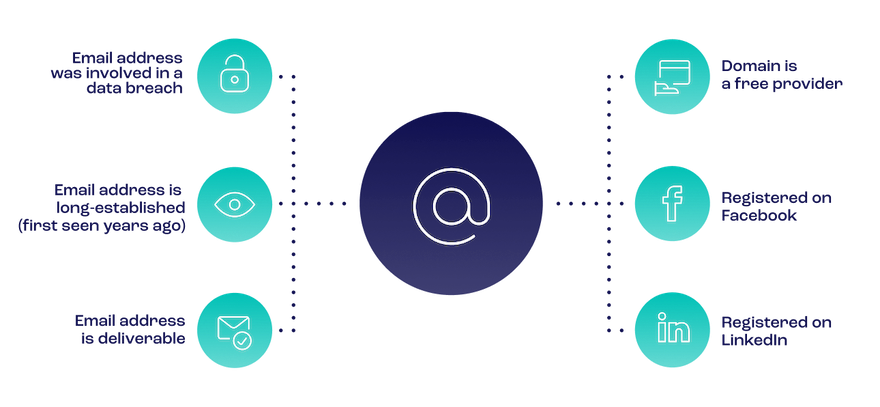
SEON integrates social and digital checks into its email verification and phone analysis APIs. Our reverse email check enriches data based on an email address alone, efficiently flagging potential fraudsters at the onboarding stage before they can register on your website.
This method improves the user experience by requiring minimal primary data points, benefiting legitimate customers. You can integrate our Email API directly into your platform without any hassle.
SEON’s tool searches over 350 platforms and social networks to assess users’ trustworthiness. Genuine customers usually have a wider social media presence, making it easier to spot risks. Additionally, it filters out mass-generated emails used for fraud, catching unsophisticated attacks instantly.
Improve your risk management with SEON’s real-time data enrichment tools.
Speak with an expertIs Social Media Lookup Legal?
Yes, as long as the data you source is in public, open databases.
This is particularly important if you are in Europe and need to remain compliant with the GDPR. SEON’s solution, for instance, is fully GDPR compliant, and there is also an API to help your company purge data when required: the Erase API.

Limitations of Working with Social Data
Social data may sometimes be outdated, incomplete, or fake. Data accuracy can be a challenge with one in four people having a fake social media profile. In addition, fraudsters may use real stolen data to create synthetic identities, which must be filtered out for effective profiling.
Despite these challenges, social data is highly effective for fraud detection. While creating fake email addresses is easy, replicating a legitimate social media presence is more difficult and doesn’t scale well for multiple fraudulent accounts.
If no social media data exists, it indicates a higher risk, prompting the use of additional fraud prevention methods like device fingerprinting and velocity checks. Social media data can also expose identity theft if it doesn’t match other user information.
Case Study: Using Digital Footprinting to Verify Lending Applicants
Digital footprinting offers an innovative way to verify identity and prevent fraud, especially in countries with limited traditional credit histories. By leveraging social signals and behavioral data, it verifies identity and detects fraud using minimal information, like an email address. This approach is crucial for over 1.4 billion unbanked adults worldwide, including 7.1 million households in the US.
Sun Finance, a leading online loan company, uses SEON to improve onboarding and debt collection. SEON’s email analysis and social media profiling verify identities and detect fraud. Exposed variables help flag fraudulent applications, while the flexible scoring system facilitates customer segmentation and manual reviews without adding friction for other applicants.
By calculating a risk score based on social media presence and digital footprint, you can decide whether to take additional security measures for high-risk users or smoothly onboard low-risk ones. Once validated, you can further investigate their social profiles for more information.
Email Address Lookup & Social Data: A Winning Combo
Whether you’re manually checking a single account or automating data enrichment, combining email profiling with social media analysis is a robust tool for businesses. It helps you better understand your users, make informed decisions with limited data, and protect against chargebacks and first-party fraud, especially when integrated into dedicated fraud prevention platform.
Frequently Asked Questions
Can you see the full profile or URL of each account found?
Usually not. A lookup confirms that an account exists and returns whatever each platform makes public, which can include a username, profile photo or last-seen date. A private LinkedIn profile will still show as registered, but without profile details. What comes back varies by platform, because each one has its own privacy policy and decides what it shares.
How many networks can you find with a social media lookup tool?
Coverage varies by tool and the sources it can access. SEON’s Digital Footprint solution checks data from over 350 platforms and apps, which gives fraud teams a broader view than a manual search.
How many social profiles does a legitimate user usually have?
There’s no universal number, but the pattern repeats across industries. In one analysis of 100,000 registrations, users with more than eight profiles across their email and phone mostly turned out to be good customers. Users with fewer than five were mostly fraudulent. The right threshold depends on your users, so teams set it from their own labelled fraud data.
How does social media lookup help detect synthetic identities?
Fraudsters can now use AI and breached data to generate hundreds of realistic-looking email addresses, so checking whether an email looks auto-generated no longer works. What they can’t fake at scale is years of real activity across dozens of platforms. A new account with fewer than three registrations across social and ecommerce sites is a strong sign that the identity was created for the attack.
Can social media lookup help detect fake job applicants?
Yes. A common pattern in application fraud is a LinkedIn URL on the CV that isn’t linked to the email the candidate applied with, which can point to a stolen or borrowed identity. Checking whether the email has a registered LinkedIn, along with a phone and footprint check, helps recruiting teams decide who moves forward before investing interview time.
You might also be interested in reading about:
Sources
- DMA: Three reasons you should look again at your email campaigns
- Entrepreneur: One in Four People Have a Fake Social Media Profile Somewhere