Brazil’s iGaming market is evolving fast, with projections estimating the online betting sector will surpass $3.6 billion by 2028 and new regulatory frameworks rolling out. For operators, that means a market full of upside, and a growing exposure to organized digital threats.
One of the most urgent risks is account takeover (ATO) fraud. These attacks are no longer just brute force. In Brazil’s fragmented mobile ecosystem, fraud rings test credentials at scale, mimic player behavior, and exploit gaps in login and onboarding flows.
That local reality matters. “Brazil’s compliance landscape isn’t just strict, it’s uniquely specific. Systems built for other markets often break when applied directly to Brazilian users and regulations.” — Husnain Bajwa, SVP of Product, Risk Solutions
This article explores how login and activity monitoring strategies designed for Brazil’s iGaming landscape can help prevent ATOs, strengthen fraud resilience, support compliance, and protect a seamless user experience.
Why Account Takeovers Are Surging in Brazil’s iGaming Market
Account takeovers in Brazil’s online gaming sector are accelerating alongside the industry’s rapid expansion. As operators attract users with bonus-heavy promotions and low-friction mobile onboarding, accounts become more lucrative targets, often holding stored payment methods, CPF-linked identity data and access to promotional rewards.
This combination of high-value incentives and minimal entry barriers has created ideal conditions for fraud. Attackers exploit reused credentials, test stolen logins across fragmented mobile devices and blend in by mimicking typical user behavior. Local fraud rings, deeply familiar with Brazil’s infrastructure, are adapting faster than most imported fraud prevention systems can respond.
In this context, traditional security postures fall short. Real-time monitoring and localized intelligence are becoming essential for iGaming security in Brazil, not to mention sustaining growth in a market shaped by regulatory precision and customer-led development. Real-time monitoring and localized intelligence are essential not only for iGaming security in Brazil but for sustainable, compliant growth in a high-pressure market.
Login Weak Points Fraudsters Exploit in Online Gaming
For fraudsters targeting Brazil’s iGaming platforms, the login phase is where most ATOs begin and succeed. One of the most common exploits is credential reuse. Players often recycle passwords from other breached platforms, leaving their accounts vulnerable to credential stuffing, where bots test stolen login pairs at speed. On mobile-heavy platforms, this tactic blends easily with regular traffic.
Bot-driven credential testing amplifies the threat, automating thousands of login attempts per minute. Fraud rings coordinate these actions across multiple accounts to breach high-value profiles tied to CPF data or bonus wallets. Layered onto this is IP and geolocation spoofing. Attackers use VPNs or mobile proxies to appear local, bypassing region-based controls and hiding behind familiar traffic patterns.
The convergence of automation, reused data and spoofed environments creates ideal conditions for undetected access — unless platforms monitor logins in real time, with contextual intelligence built for local conditions.
How Login Monitoring Helps Detect Risky Access Attempts Early
In Brazil’s fast-paced iGaming sector, static login checks no longer hold up as fraudsters exploit gaps faster than ever. Real-time monitoring rectifies this by evaluating not just credentials but context.
Velocity anomalies, such as multiple rapid logins across accounts or regions, often indicate automated credential stuffing. A sudden device mismatch can reveal takeover attempts, while IP inconsistencies, like the use of VPNs or mobile proxies, help fraudsters appear local.
The most effective systems go further, layering in real-time digital and social signals. By analyzing an email’s footprint, including linked social profiles, domain age and activity patterns, platforms can instantly gauge user legitimacy.
These signals collectively power adaptive risk scoring, allowing operators to escalate verification only when needed. It’s a shift from rigid rules to responsive detection, vital in a threat environment defined by speed and sophistication.
Activity Monitoring to Spot Takeover Behavior After Login
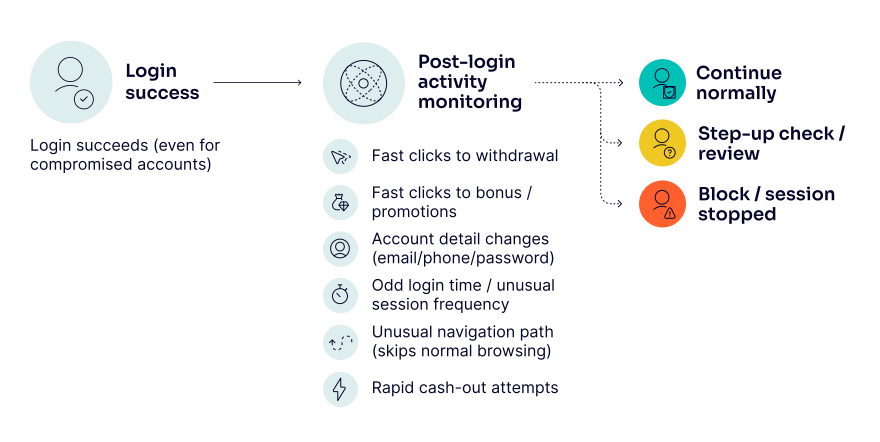
While login monitoring is essential, many ATOs only reveal themselves once fraudsters have gained access to an account. That’s why continuous activity monitoring plays an equally critical role in defense.
Once logged in, compromised accounts often follow abnormal usage patterns that deviate from legitimate player behavior. This might look like rapid navigation to high-risk areas, such as withdrawal pages or bonus redemption flows or sudden attempts to change account details. Timing is often off: sessions occur at odd hours or with unusual frequency. In many cases, fraudsters will attempt to cash out rewards or exploit promo mechanics before detection systems respond.
By continuously monitoring user actions after login, platforms can spot behavioral red flags that suggest takeover, even if the login itself appeared legitimate. Real-time alerts triggered by anomalous session flows give fraud teams the visibility to act quickly, minimizing damage without disrupting normal users.
See the risk signals that matter most, device and network anomalies, login velocity, and suspicious post-login behavior.
Find here
Device & Behavioural Intelligence for ATO Prevention in iGaming
To detect sophisticated ATOs, operators must understand not only what users do, but also how, when and from where they do it. This is where device and behavioral intelligence prove invaluable.
Every user carries a unique digital signature. Their devices, usage patterns and behavioral rhythms form a baseline that fraud prevention systems can use to identify subtle changes. A new device fingerprint, a shift in transaction speed or an unfamiliar browsing path can all indicate takeover.
In Brazil, where mobile device diversity is vast and login behaviors are highly contextual, having this depth of insight makes the difference between detection and oversight. Behavioral intelligence tools can flag deviations in real time, correlating them with known fraud patterns or emerging threats.
Combined with real-time monitoring, this creates a multilayered defense that adapts to the evolving tactics of fraud rings, providing operators with both visibility and control in one of iGaming’s most dynamic markets.
Building a Brazil-Ready ATO Strategy for Long-Term Growth
In Brazil’s high-stakes iGaming landscape, the cost of reactive fraud prevention is simply too high. With account takeovers evolving faster than ever, success depends on precision and not just protection.
Proactive operators that invest in real-time monitoring, device and behavioral intelligence and adaptive risk signals aren’t just stopping fraud. They’re building infrastructure that scales — one that aligns with regulation, respects user experience and anticipates the next wave of threats.