The Philippines’ Anti-Financial Account Scamming Act (AFASA) is about to redraw the risk map for every BSP-supervised fintech, from digital banks and e‑wallets to lenders and payment processors. By June 2026, fraud management can no longer be a patchwork of manual reviews, basic KYC checks and after-the-fact investigations; regulators expect real‑time visibility into devices, transactions and scam patterns across the entire customer lifecycle.
For product, risk and compliance leaders, this shift is more than a compliance checkbox. AFASA creates a rare moment where doing the right thing for customers — stopping mule accounts, synthetic identities and high‑velocity scam flows — directly aligns with regulatory expectations and long‑term growth. Forward‑thinking Philippine fintechs can use AFASA as a catalyst to modernize fraud controls, get live in weeks rather than months and turn compliance into a genuine growth driver.
Key Takeaways for Philippine Fintechs Under AFASA
- The Anti-Financial Account Scamming Act (AFASA) is a law that requires BSP-supervised fintechs to strengthen protections against online fraud with real‑time, automated monitoring, mule detection and defensible audit trails
- Fintechs must detect mule accounts and synthetic identities with digital footprints and behavioral analytics from onboarding onward
- Continuous, AFASA‑compliant real‑time monitoring helps balance regulatory visibility with seamless customer experiences
- AFASA readiness can support growth, improving trust, retention and customer acquisition.
From One-Off Checks to Continuous Protection
AFASA marks a clear turning point for fraud strategy in the Philippines. Instead of relying on point-in-time checks at onboarding or investigating scams only after customers report losses, BSP‑supervised institutions now need automated, real-time fraud management systems across the entire customer journey. That includes device and velocity rules, behavioral anomaly detection and the ability to hold or freeze suspicious funds while teams investigate.
This shift goes hand in hand with more demanding expectations on authentication and account security. Circular 1213 pushes institutions away from easily intercepted SMS and email OTPs and toward phishing‑resistant multi‑factor methods, while AFASA itself criminalizes mule networks, synthetic identities and the knowing use of accounts for scams. Together, these changes show that static controls and manual reviews no longer suffice; Philippine fintechs need live, intelligence‑driven defenses that can detect and block scams in milliseconds, not days.
The New Front Line: Onboarding & Mule Control
AFASA tightens expectations long before the first transaction, raising the bar for what “good enough” onboarding looks like. If a fake, stolen or shared identity passes KYC and later facilitates scams, institutions face not only fraud losses but also regulatory and legal exposure. In practice, teams must now assess for applications for mule behavior, repeated devices and synthetic identity patterns that traditional KYC alone cannot reliably catch.
To meet that standard, leading Philippine fintechs enrich onboarding with deeper digital signals from the very first interaction. Email, phone, IP, device fingerprint, social and digital footprint, and behavioral analytics combine to create a high‑resolution risk profile before an account goes live. Instead of responding to AFASA with blunt friction, these organizations use intelligent pre‑KYC screening to block obvious mules and synthetic identities, keeping fraud and disputes low while preserving a smooth experience for genuine customers.
Real‑Time Monitoring Without Killing the Customer Experience
AFASA raises the expectation that teams assess every transaction in real time, not sample or review activity in batches hours later. Velocity across accounts, unusual geolocation patterns, device changes and behavioral anomalies all need to feed into a live view of risk so that analysts can hold or review suspicious flows before funds disappear. That model looks very different from traditional, end‑of‑day monitoring or ad‑hoc case reviews triggered only after a customer complains.
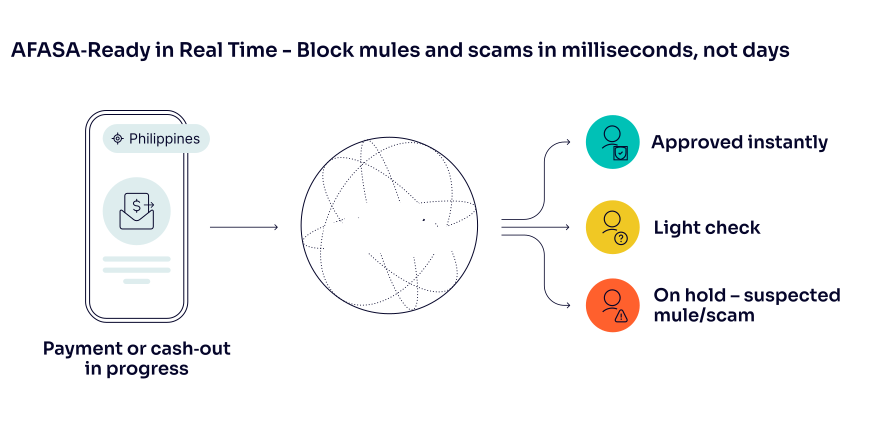
The key is designing AFASA-compliant real-time monitoring controls that act decisively while remaining almost invisible to legitimate users. A modern risk engine scores each payment, transfer, or cash-out in milliseconds using hundreds of data points, then applies differentiated responses. Low-risk activity goes through instantly, medium-risk flows trigger light challenges or step-up checks, and truly high-risk transactions are automatically routed to analysts or placed on hold.
Fintechs that achieve this balance can meet AFASA’s requirement for continuous surveillance while still delivering the near-instant, low-friction experiences customers expect from digital wallets and banks.
Learn how SEON supports transaction monitoring, mule prevention and continuous compliance.
Transaction Monitoring Services
Turning AFASA Readiness Into a Growth Engine
AFASA forces every BSP‑supervised institution to invest in stronger fraud controls; the question is whether those investments simply satisfy auditors or actively support the business. When fraud teams can resolve cases faster, prevent repeat scams and reduce false positives, they free budget and bandwidth that product and growth teams can redirect into new features and customer acquisition. Cleaner portfolios also mean lower write‑offs and a more predictable risk profile — factors that influence every funding round and partnership conversation
The reputational impact matters just as much in a market where high-profile scams have eroded trust. Fintechs that can credibly demonstrate AFASA‑aligned controls — real‑time monitoring, strong authentication, mule account prevention and transparent reporting — position themselves as safer places to store and move money. That confidence drives higher activation and retention, smoother conversations with regulators and partner banks and a stronger story for merchants and ecosystem partners who need assurance that their customers will be protected.
From Requirements to Real-World Results
AFASA sets a clear direction for the next phase of Philippine fintech, making real-time, intelligence-led protection the default, not the exception. The institutions that respond by upgrading their fraud stacks will be better placed to protect customers and navigate regulatory scrutiny with confidence
The good news is that this transformation does not need to take years. By consolidating signals into a single platform and aiming to go live in weeks rather than months, fintechs can use the AFASA timeline to align teams, modernize controls and prove that strong security and fast, intuitive customer experiences can coexist.