Marketplaces face a fraud problem that traditional eCommerce does not. A single retailer controls who sells on its platform, but a two-sided marketplace must continuously vet thousands of sellers it has never met, often without the verification infrastructure to do so effectively and under pressure to grow and quickly adapt the seller base.
That tension creates a gap, and bad actors know how to find it. Seller onboarding fraud, where fraudsters create accounts using fake identities, stolen credentials or synthetic profiles, has become one of the fastest-growing and least-addressed threat vectors in marketplace risk. The goal varies: listing counterfeit goods, processing stolen card payments or evading existing platform bans. But the entry point is almost always the same.
What makes it so hard to catch is structural. Platforms have historically treated seller onboarding as a growth function, not a security one, optimizing for speed and conversion rather than verification. That framing leaves the front door open.
Key takeaways
What Is Seller Onboarding Fraud?
At its core, seller onboarding fraud is an identity problem. Bad actors apply to sell on a marketplace not as themselves, but as someone (or something) that doesn’t exist: a fabricated persona, a stolen identity or a synthetic profile assembled from real and fictitious data.
Once they’re in, the playbook varies. Some use their new seller status to move counterfeit or prohibited goods. Others run payment fraud through the platform’s checkout infrastructure. Some are repeat offenders who were previously banned and are simply finding a new way back in. What connects all of these isn’t that the fraud didn’t start with a transaction, it started with an application.
Why Fake Sellers Are Harder to Catch Than Buyer Fraud
Buyer fraud comes with a built-in safeguard: when a card is used, the issuing bank runs its own verification. Marketplaces benefit from that layer without having to build it themselves. No equivalent exists for sellers. The platform becomes the only verification layer, responsible for a job that card networks handle on the buyer side, but without the same infrastructure or regulatory mandate to do it.
Fraudsters understand this asymmetry well. Onboarding is where verification is weakest and time pressure is highest, so a fraudulent seller who clears signup on day one can operate undetected for weeks, the damage only surfacing later in chargebacks, disputes or eroded platform trust.
The 5 Most Common Seller Fraud Patterns
- Fake identity documents: Fraudsters submit edited or AI-generated identity documents during onboarding. Obvious fakes are caught, but sophisticated forgeries pass basic checks with relative ease. The signals that document verification tools miss — email age, phone carrier, device history — are where digital footprint analysis and automated identity verification add the detection coverage that documents alone cannot provide.
- Stolen business credentials: Legitimate business registration numbers, VAT IDs and company documents are harvested from data breaches or purchased on fraud forums, giving fraudsters real credentials for companies they have no connection to. Because these accounts pass document checks entirely, cross-referencing business data against the submitting user’s digital identity is the only reliable way to surface the mismatch.
- Stolen card fulfillment via seller payout: A fraudster creates a seller account, lists items at competitive prices and processes buyer payments using stolen card details. Goods are never shipped, and payouts clear before chargebacks arrive. This pattern is particularly hard to catch because the fraud is structural, it exploits the timing gap between payment processing and payout release.
- Counterfeit listings: Fraudulent sellers list counterfeit or non-existent products, collect payment and disappear before buyers have any reason to dispute. By the time complaints arrive, the seller account has been abandoned or the fraudster has already opened a new one under a different identity.
- Ban evasion via new accounts: When a fraudulent seller is removed, the simplest response is to create a new account under a different email and phone number. The device and IP range are usually the same, and without cross-account signal matching, platforms have no reliable way to detect the connection, making ban evasion one of the most persistent and lowest-effort fraud patterns on marketplace platforms.
How Marketplaces Screen Sellers at Scale
Screening a seller once at signup is not enough. Effective risk detection layers multiple signals, at onboarding and continuously after, building a picture of risk that no single check could produce alone. Each layer targets a different dimension of identity, and together they make a fraudulent identity difficult to sustain:
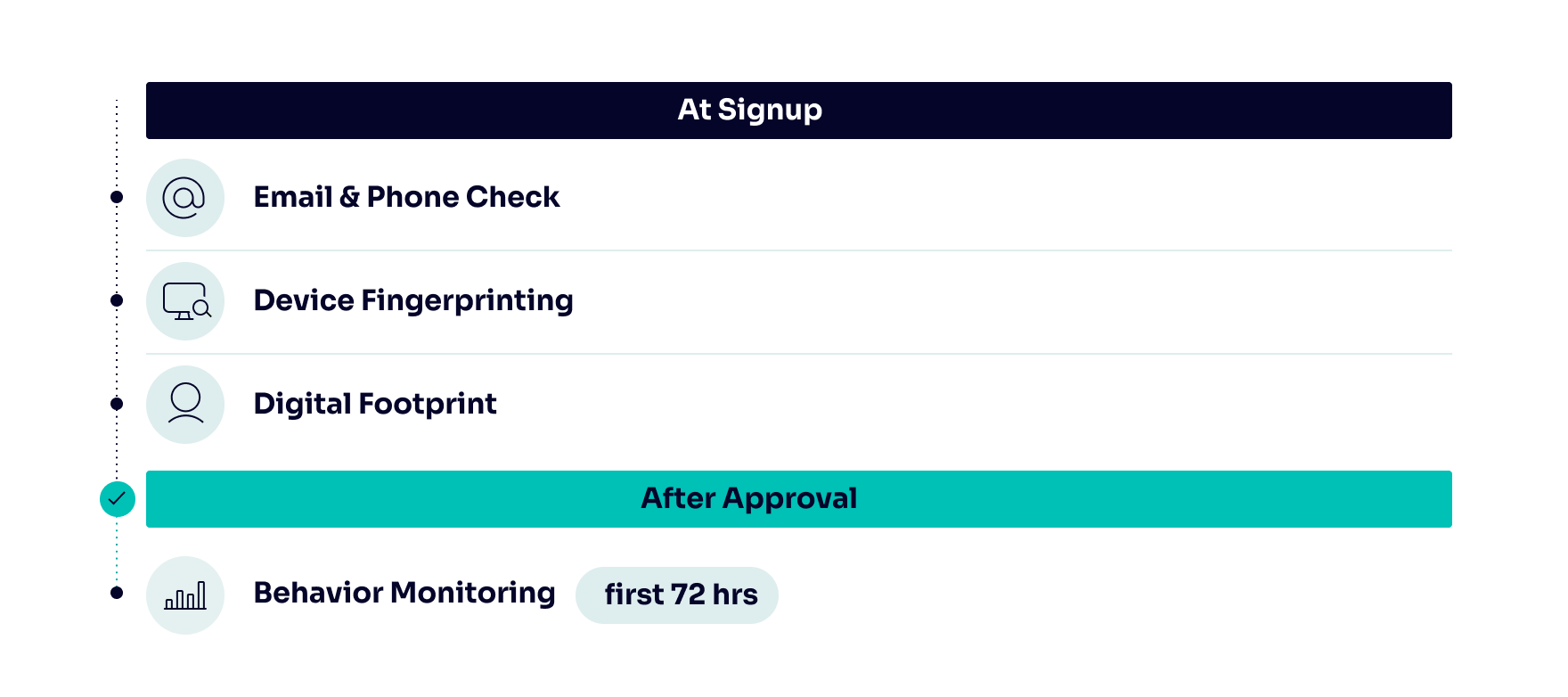
Layer 1: Email intelligence and phone validation
A seller registering with a disposable email domain, a newly created address or a VoIP number with no social media presence is a weak identity signal, and these checks are frictionless enough to run on every signup without affecting legitimate sellers.
Layer 2: Device fingerprinting
By identifying the hardware and browser environment behind a signup, device fingerprinting enables signals already associated with a previously banned account to be flagged as a high-confidence ban evasion signal even under a new email and phone number.
Layer 3: Digital footprint analysis
A legitimate seller running a real business leaves traceable evidence — social profiles, review histories, registered domains — while fraudsters using synthetic or stolen identities leave gaps that are themselves a signal. Digital footprint analysis cross-references the identity a seller provides against their observable online presence.
Layer 4: Behavioral signals post-approval
Catch what onboarding checks miss. In the first 72 hours after approval, listing velocity, messaging patterns, payout requests and account changes tend to reveal the difference between legitimate sellers and those who gamed the onboarding process.
See how SEON helps marketplace teams assess seller risk in real time.
Seller Verification vs Ongoing Monitoring: Why Onboarding Alone Isn’t Enough
Passing onboarding does not prove legitimacy. It is proof that a seller provided information that passed the checks in place at that moment. Fraudsters adapt to those checks, and the window between seller approval and the first transaction is where the risk is highest.
Ongoing monitoring tracks changes in seller behavior against established baselines: sudden listing volume spikes, new device logins, changes to payout details and communication patterns inconsistent with legitimate selling activity. When those signals appear in combination, they are far more reliable fraud indicators than any single onboarding data point.
The sellers most likely to commit fraud post-approval are those who invested the most effort in passing onboarding. Document checks and identity verification are their first obstacle, and they have already cleared them.
Real-World Example: How Cardmarket Tackles Seller Risk
Cardmarket is Europe’s largest marketplace for collectible card games, operating across multiple countries and featuring a large, active seller base. As the platform scaled, maintaining trust between buyers and sellers and keeping fraudulent sellers off the platform became increasingly difficult to manage manually.
Using SEON, Cardmarket gained greater visibility into account behavior, risk signals and suspicious activity across its seller base. The result was stronger fraud detection without adding friction to the onboarding experience for legitimate sellers.
How Cardmarket Stopped Seller Fraud at the Door
Read how Cardmarket strengthened seller trust across its platform

FAQ
What is seller onboarding fraud?
Seller onboarding fraud occurs when someone creates a marketplace seller account using fake, stolen or synthetic identity information, with the intent to list counterfeit goods, process fraudulent payments or re-enter a platform after a ban.
How do fake sellers get past identity verification on marketplaces?
Sophisticated fraudsters use edited documents, stolen business credentials or synthetic identities that pass basic document checks. The gaps they exploit — email age, device history, phone carrier — are not covered by document verification alone and require digital footprint analysis to surface.
What is the difference between seller verification and seller monitoring?
Seller verification happens at onboarding and assesses whether the identity provided is legitimate. Seller monitoring is continuous and tracks behavior after approval to detect fraud that was not visible at signup. Both are necessary; neither is sufficient on its own.
How does ban evasion work on online marketplaces?
When a fraudulent seller is removed, they typically create a new account using a different email address and phone number, but often on the same device, within the same IP range, or with the same behavioral patterns. Without cross-account device fingerprinting, platforms cannot reliably detect the connection between the banned account and the new one.
What signals indicate a seller account is fraudulent?
No single signal is definitive. The strongest fraud indicators appear in combination: disposable or newly created email, VoIP phone number, device associated with a previously flagged account, thin social media presence and atypical behavior in the first 72 hours post-approval, such as rapid listing velocity or immediate payout requests.
How can a marketplace reduce seller fraud without slowing down legitimate onboarding?
Layered, frictionless checks run in the background of the onboarding flow — email validation, phone carrier analysis, device fingerprinting, IP reputation — add no steps for legitimate sellers and catch the majority of fraudulent signups before approval. Friction is only introduced for accounts that breach risk thresholds, keeping the experience smooth for the majority.