A new regulatory era is reshaping how payment service providers manage risk in the EU. The updated PSR and PSD3 frameworks introduce stricter expectations around fraud liability, placing real-time transaction monitoring at the heart of compliance. As outlined in the legislative agreement on payment services, PSPs must now detect threats as they emerge — and prove they acted fast enough to prevent harm.
Key Takeaways
- Transaction monitoring is a core compliance mechanism under PSR & PSD3
- PSPs face clearer liability for fraud, especially in cases of impersonation scams
- Real-time payments require real-time risk management
- Impersonation fraud and authorised push payments (APP) are specific regulatory focuses
What Are PSR and PSD3? (And Why They Matter for PSPs)
PSR and PSD3 are the EU’s latest regulatory updates to the payments framework, designed to strengthen fraud prevention and clarify liability across the financial ecosystem. For PSPs, they introduce operational mandates around real-time monitoring, payee verification and customer protection, particularly in the context of impersonation scams and instant payments.
Understanding the fraud prevention obligations under PSR and PSD3 is essential to avoiding regulatory exposure and financial losses.
Why Transaction Monitoring Is Central to PSR & PSD3 Compliance
Under PSR and PSD3, payment transaction monitoring is no longer optional or secondary but a core compliance mechanism. Regulators now expect payment service providers (PSPs) to detect and respond to suspicious payment activity in real time, with clear documentation of the decision logic behind each case. This is particularly crucial in high-risk scenarios such as impersonation fraud, authorised push payment (APP) scams, and mismatched payee details.
Monitoring must go beyond simple rule checks. It requires contextual understanding of user behaviour, payee legitimacy and transactional anomalies at the exact moment a payment is initiated. Failing to act fast enough can expose PSPs to regulatory scrutiny and financial liability.
To align with expectations, many institutions are rethinking how transaction monitoring fits into broader fraud and compliance frameworks. Modern solutions are designed to evaluate multiple risk signals instantly, trigger appropriate interventions and create audit-ready case records. In this environment, effective transaction monitoring becomes a control layer that can determine whether a PSP meets its legal obligations or faces a compliance failure.
For broader context on payment fraud patterns, including APP scams and social engineering, see our guide to payment fraud detection and prevention by Matyas Varga, Head of Global Fraud Services.
Why Legacy Monitoring Falls Short Under PSR & PSD3
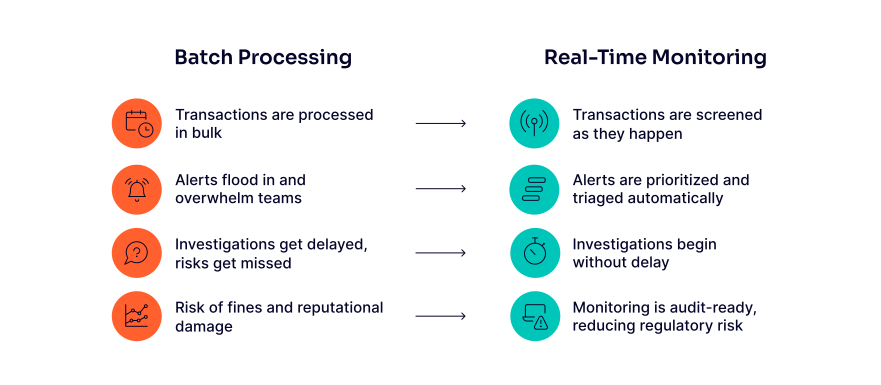
Traditional fraud detection tools were built for slower payment cycles and often depend on batch processing. Outdated systems check transactions after they’ve been initiated or settled, thereby introducing critical delays incompatible with the speed of real-time payments and instant transfers.
Under PSR and PSD3, the lag creates risk. PSPs are now expected to detect threats before funds leave the account, assess fraud risk in milliseconds and take immediate action when red flags appear. Batch-based tools can’t deliver that responsiveness.
Legacy systems also struggle with explainability. Static rules and limited data inputs may miss context or fail to justify decisions during regulatory reviews. As scrutiny intensifies, so does the need for clear, timely and defensible monitoring logic.
This shift highlights the need to move from periodic assessments to real-time compliance frameworks that support continuous evaluation and instant interventions.
What “PSR-Ready” Transaction Monitoring Means
Being “PSR-ready” means having the capability to assess payment risk as it happens, using enriched, real-time data to guide fraud decisions and meet compliance obligations. It’s not just about flagging suspicious activity but doing so before a transaction completes, with enough context to justify the outcome.
This includes matching payee names to account identifiers, detecting impersonation patterns and applying dynamic controls like step-up authentication or transaction freezing. Just as importantly, it means maintaining a defensible audit trail to support regulatory queries or dispute resolution.
PSR-aligned monitoring requires a system that’s fast, explainable, adaptable and capable of evaluating complex signals without disrupting the user experience or creating operational bottlenecks.
What Can Be Monitored to Meet PSR & PSD3 Fraud Obligations
To align with PSR and PSD3, payment service providers must go beyond basic rule sets and monitor a wide range of real-time signals. The goal is not only to detect fraud but to act decisively before funds move, while creating a traceable audit record for each decision.
Real-Time Transaction Behaviour
Monitoring how users behave during transactions is key. Indicators like unusually high transfer amounts, irregular transaction velocity or sudden changes in spending habits may flag elevated risk. Combined with historical baselines, behavioural anomalies help detect fraud types such as mule activity or synthetic ID usage.
Real-time analysis ensures that risky behaviours can be flagged and addressed immediately without waiting for post-transaction reports that come too late under PSR’s liability standards.
Payee Changes and Name–Identifier Checks
PSPs are now required to confirm that a payee’s name matches their account identifier (e.g., IBAN). This step helps prevent misdirected payments and impersonation scams.
Monitoring changes to stored payees, repeated failed attempts to match account names or transfers to new or unusual recipients can uncover early signs of fraud. These checks are especially important for authorised push payment (APP) fraud, where victims are tricked into sending money to fraudsters posing as trusted parties.
Impersonation and Social Engineering
Social engineering remains one of the most challenging fraud vectors. PSPs must watch for subtle coercion signals, such as rushed transactions, multiple failed logins followed by high-risk transfers or unusual navigation patterns through payment flows.
Real-time monitoring of customer journeys can surface these red flags. When combined with risk scoring, they support interventions like step-up authentication or transaction delays to prevent fraud without degrading the user experience.
Device, Network and Digital Footprint Signals
Every session brings technical signals that can reveal risk. Monitoring device intelligence (such as emulators or rooted phones), IP geolocation anomalies and proxy usage provides deeper visibility into potential fraud attempts.
Enriching this with digital footprint signals, like whether an email address or phone number has social or online presence, adds context. Disposable emails, newly registered domains or isolated phone numbers are often linked to fraud or synthetic IDs.
Risk Scoring and Actions
A PSR-ready approach requires explainable risk scoring frameworks. Systems must evaluate multiple data points per transaction and produce clear, defensible decisions — whether to approve, step up SCA, freeze or decline.
Every action should leave behind a case trail, with time-stamped signals and scoring logic to support regulatory audits or alternative dispute resolution. Flexible thresholds allow risk teams to respond to evolving threats while staying within the scope of PSR and PSD3 expectations.
Transaction Monitoring and Risk-Based SCA Under PSR & PSD3
PSR and PSD3 reinforce risk-based strong customer authentication (SCA) and link it directly to transaction monitoring. Payment service providers (PSPs) are expected to assess fraud risk in real time and decide whether additional authentication is needed before approving a transaction.
In practice, this means SCA decisions should be dynamically driven by digital behavioural signals, device context and transaction history. Tying authentication to live risk assessments helps PSPs reduce friction for low-risk users while applying stronger controls in high-risk scenarios, supporting both regulatory expectations and user experience goals.
Who Benefits Most from PSR-Aligned Transaction Monitoring
PSR and PSD3 introduce new operational responsibilities across the payments stack. Transaction monitoring that meets these standards supports the daily work of:
- Fraud analysts, who need timely, explainable insights to act on suspicious activity
- Risk managers, tasked with preventing financial exposure under stricter liability rules
- Compliance teams, responsible for demonstrating regulatory adherence during audits or disputes
- Case handlers, who require access to clear decision trails when reviewing escalated transactions
- Engineering and payments teams, who must integrate controls into high-speed payment flows
Each of these roles relies on monitoring tools that are accurate, transparent and fast enough to support real-time decision-making.
Why Transaction Monitoring Is Now a Liability Safeguard
PSR and PSD3 define clear expectations for how PSPs should monitor and act on payment risk. Transaction monitoring now plays a central role in meeting fraud obligations, supporting dispute resolution and preventing liability. When designed for real-time responsiveness and auditability, it becomes a foundation for defensible risk decisions — essential in high-speed payment environments and under increased regulatory scrutiny.
Learn how explainable, real-time monitoring helps PSPs detect fraud early, apply risk-based controls and maintain defensible audit trails.
Explore Transaction Monitoring