Automation has become the only realistic way for high‑growth iGaming operators to keep fraud, bonus abuse and AML risk under control while expanding into new markets and brands. Instead of relying on manual reviews and disconnected tools, leading teams are integrating real-time scoring, device intelligence and group-wide blacklists directly into their player journey, so risky activity is intercepted before it occurs.
Done well, this turns transaction monitoring from a compliance checkbox into a strategic control layer that quietly protects revenue, player experience and regulatory relationships in the background.
What Automation Means in iGaming Transaction Monitoring
Automation in transaction monitoring is less about speed for its own sake and more about absorbing exponential growth in players, brands and jurisdictions without constantly expanding the compliance headcount. Modern operators need monitoring that watches every deposit, bet and withdrawal in real time, escalates only what truly requires human review and automatically enforces decisions everywhere else.
In practice, this means expanding beyond traditional AML thresholds, sanctions screening and responsible gambling triggers into comprehensive, proactive fraud defense, so the same automated infrastructure that keeps regulators satisfied also neutralizes bonus abuse, multi‑accounting, chargebacks and scam boiler‑room activity before the funds ever look clean on the ledger. While iGaming transaction monitoring basics focus on compliance and AML, this guide explores the technical automation required to scale those efforts across multiple brands.
How To Automate Real-Time Risk Scoring Across the Player Journey
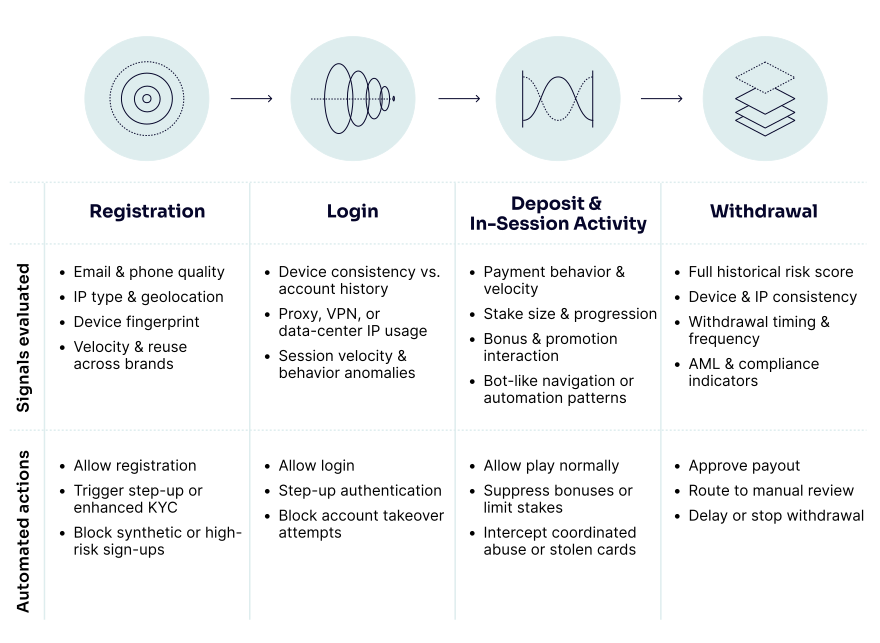
Real-time risk scoring in iGaming works best when you capture signals early (email, phone, IP, device), connect them to behavior over time, and refresh risk at each key player action.
In practice, automated scoring typically runs at:
- Registration: catch synthetic identities and obvious abuse early, and reduce unnecessary KYC friction for low-risk players.
- Login: spot account takeover signals like new devices, risky IPs, or unusual session behavior.
- Deposit and in-session play: detect stolen payment activity, bot-driven arbitrage, and coordinated bonus abuse as it happens.
- Withdrawal: run a final fraud + AML check before funds leave the platform.
Neutralizing Bot Attacks and Corporate IP/Proxy Abuse
Scam boiler rooms and arbitrage rings rarely operate from consumer-grade devices and residential IPs; they favor scripted desktops, emulators and corporate networks sitting behind data-center proxies or VPNs. SEON’s device fingerprinting detects these hostile environments by analyzing browser configurations, automation indicators, emulation patterns and risky privacy tools in real-time.
At the network level, SEON classifies IP addresses by type and risk, allowing operators to auto-block or heavily downrank traffic coming from corporate ranges, hosting providers, Tor nodes, or anonymizing VPNs. By binding these signals into rules, fraud teams can automatically:
- Hard‑block sign‑ups or logins from high‑risk data‑center IPs.
- Tag unusual corporate‑network play for further review.
- Suppress bonuses or limit stakes for sessions flagged as automated or scripted.
Critical Triggers: Scoring Sign-up, Login and Deposits
The most important automated decisions occur at the points where stolen or scammed money either enters or can be multiplied by the system: sign-up, login and deposits. SEON’s rules engine enables operators to assign higher weights to these moments, combining device, IP, velocity and behavioral indicators into a single score that arrives before the page even loads.
For example, a new registration originating from a recycled email address with no social footprint, behind a VPN, on a newly emulated device can be blocked or challenged automatically. Likewise, deposits that come from accounts showing sudden stake spikes, high‑risk geolocation mismatches or connections to known blacklisted devices can trigger instant holds, enhanced KYC or an outright decline.
Automated Decisioning: Hard Blocks vs. Real-Time Tagging
Not every suspicious pattern should result in an immediate block; some should simply change how the system treats that player in real time. SEON’s decisioning supports both approaches through configurable thresholds, risk tags and workflows that blend hard automation with human judgment.
Operators typically:
- Use a high score threshold for hard blocks (e.g., clear bot/device manipulation, known scam clusters, sanctioned entities).
- Use medium thresholds for auto-tagging and routing into queues (e.g., unusual behavior from otherwise trusted devices or mild geolocation conflicts).
- Use low thresholds for passive monitoring and model training, ensuring that rules and ML models learn from edge-case behavior without impacting legitimate, high-value players.
Implementing Whitebox Rules for Precision Fraud Detection
Blackbox AI is powerful but challenging to align with specific fraud models and regulatory expectations in iGaming, particularly when investigators and auditors need to understand why a transaction was blocked.
With SEON, operators can build granular rules around:
- Device traits (emulators, rooted devices, headless browsers)
- Network traits (data‑center IPs, geofencing violations, suspicious proxy chains)
- Behavioral markers (velocity breaches, odd stake progression, login anomalies)
- Digital footprint quality (throwaway email providers, mismatched phone country codes)
Customizing Logic for Scam Organizations
Scam organizations leave repeatable technical fingerprints: the same device clusters re‑appearing under new accounts, similar browsing paths, predictable bet sizing and orchestrated logins around the same time windows. SEON’s device intelligence and transaction data help operators codify these patterns into explicit rules rather than vague “high‑risk” labels.
For example, a rule could target “any device hash associated with more than X accounts across Y brands within Z days, combined with deposits from data‑center IPs and aggressive bonus chasing”. Another could identify crawling and scraping behaviors by looking for abnormal page-hit ratios, uniform mouse movement patterns and non-human form interaction speeds.
Reducing False Positives with Transparent Rule Logic
Aggressive fraud rules can easily cannibalize VIP revenue if they cannot differentiate between high‑stakes professionals and coordinated abuse rings. SEON mitigates this by exposing which signals contributed to a score and which rules fired, allowing fraud teams to tune thresholds and add allow-listing conditions for known, trusted profiles.
In iGaming, this often means:
- Keeping a zero‑tolerance stance on clearly hostile environments (desktop emulators, data‑center VPNs, Tor, sanctioned jurisdictions).
- Softening or offsetting rules for verified VIPs whose behavior is atypical but consistent and well‑documented.
- Iteratively adjusting rule weights using labels and outcomes so that over time, the system becomes both stricter on fraud and gentler on legitimate edge cases.
Safety-First Deployment: Using Shadow Mode to Test New Rules
Rolling out powerful automated rules directly into production can be risky if their real‑world impact is unknown. SEON provides “shadow mode” capabilities where new rules run silently in the background, scoring and tagging transactions without actually blocking them.
Fraud and compliance teams can then:
- Monitor how often the rule would have fired and against which segments, before enforcement.
- Compare shadow‑mode outcomes with confirmed fraud and chargeback cases to tune precision and recall.
- Gradually move rules from monitoring‑only to partial enforcement (tagging, limits) and finally to full hard‑block, with clear audit trails of the decision process.
Build a Group-Wide Player Blacklist Workflow
For multi‑brand groups, the real leverage comes from centralizing fraud intelligence so that an attacker discovered on one site cannot simply migrate to another. SEON’s APIs and admin features make it straightforward to build a group-wide blacklist that synchronizes risk artifacts — including device hashes, IP patterns, emails, phone numbers and payment instruments — into internal tools.
Typically, operators use SEON to:
- Capture risk outputs whenever transactions are tagged or confirmed as fraudulent (e.g., device hash, IP address, user identifiers).
- Push these into a centralized blacklist or risk registry via API, attached to clear labels (bonus abuse, scam ring, ATO, AML concern).
- Enforce the blacklist at registration, login, deposit and withdrawal across all brands and regions, with logic in internal systems calling SEON in real time.
Automation at Scale: One Block, Full Protection
The end goal is that a confirmed scammer blocked on Brand A is automatically neutralized on Brands B, C and beyond, without extra analyst work. By using SEON’s device fingerprinting and digital footprinting, blacklists stop being just lists of static identifiers and instead become dynamic clusters of linked entities.
A typical automated flow looks like:
- A transaction is flagged as potentially fraudulent in SEON and/or your case management.
- SEON exposes all associated technical identifiers (device hash, IP ranges, emails, phones, cards).
- An internal service writes these into a shared blacklist and pushes updates to brand‑level platforms.
- Future attempts from any of these identifiers—or from strongly linked devices/accounts—are blocked or heavily challenged at the edge, regardless of brand.
This turns every detected fraud incident into a defensive multiplier for the entire group, dramatically reducing repeat attacks, investigation time and cross‑brand leakage.
Why Real-Time Automation is Essential for iGaming Scalability
As online gambling volumes and regulatory scrutiny grow, manual‑first transaction monitoring becomes a bottleneck that either caps growth or drives up headcount and error rates. Real-time automation, underpinned by explainable rules, device intelligence and continuous scoring, helps operators reduce online gambling fraud while onboarding and protecting more players without sacrificing control or compliance.
With SEON, iGaming operators move fraud and AML from a reactive cost center to an always‑on defensive shield that also safeguards UX and revenue. Transactions are monitored as they occur and risky sessions are intercepted before losses are incurred. Group-wide blacklists ensure that once a scammer is identified, they are shut out everywhere — automatically.