She blinked. She smiled. She passed verification. And she didn’t exist.
On paper (and on camera), everything appeared legitimate. A government-issued ID was uploaded. A selfie matched the document photo. Liveness checks confirmed movement. Yet the system failed to catch that the identity was entirely fabricated. Today’s fraudsters use deepfake technology to mimic real people and slip past traditional identity verification (IDV) checks. In 2023 alone, synthetic identity fraud caused over $35 billion in losses, and as technology becomes more advanced and accessible, the attacks are only becoming harder to detect.
The flaw isn’t in the verification steps themselves but in what they miss. Most IDV systems are built to confirm what’s visible, but they overlook the deeper signals of legitimacy. Deepfakes can fake appearances but not a digital history. They can replicate a photo but not years of online behavior. That’s why identity verification must evolve from validating images to confirming existence and the actual person behind a flat identity document.
Deepfake Fraud Detection: Why Basic IDV Checks Fail
While traditional, surface-level checks like ID document uploads, selfie captures and liveness detection serve an important purpose, they were built for a time when visual authenticity equaled legitimacy. That assumption no longer holds.
Modern deepfakes aren’t just about celebrity face swaps or manipulated videos anymore. Fraudsters now use real-time tools like DeepFaceLive, Magicam and Amigo AI to actively alter their appearance during verification processes. With a stolen ID in hand, they use deepfake software to match their live selfie to the photo on the document, fooling systems that rely on facial comparison and liveness checks. To a biometric engine, everything lines up, and the fraudster is allowed through.These attacks are built specifically to exploit systems that only verify what’s visible. Most IDV tools confirm the artifact but never question the actor. As long as verification stops at the surface, attackers will keep slipping through. A face can be forged, a document can be stolen, but identity without context has become a vulnerability.
Synthetic vs. Authentic: What Real Identity Looks Like
Deepfakes are engineered to look the part, but even the most convincing fake identity struggles to mimic the far more complex patterns of real digital life. Genuine users leave behind layered histories like social and digital profiles, consistent signals across services and traces in breach records or domain data. These elements build a picture of continuity and presence. Synthetic identities can’t keep up as they largely rely on fresh email addresses and throwaway devices. The facade may look real, but the underlying data tells a very different story.
That’s where contextual fraud analysis becomes critical. Real identity isn’t how someone looks but the depth of their digital footprint. And that’s something deepfakes simply can’t fabricate.
Implementing a Risk-Based Identity Verification Model
With regulatory bodies like FinCEN emphasizing dynamic, risk-based approaches over static checklist compliance, identity can no longer be confirmed solely by a match. Regulators now expect context and an understanding of who is behind the data, not just whether the data checks out.
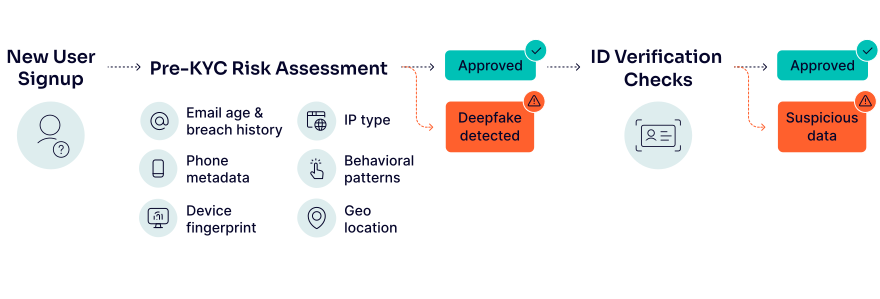
A risk-based identity verification model flips the traditional process. Instead of beginning with a selfie or ID photo capture, it begins with the signals users already emit at signup: email and phone, IP and device intelligence, behavioral velocity. These indicators can expose synthetic identities before costly KYC steps are ever triggered.
Turning Signals Into Smart Decisions
From there, verification becomes adaptive. Document and biometric checks are no longer assessed in isolation but weighed against the broader context of each session. A flawless face match may still raise flags when paired with signs of synthetic behavior, like a newly registered email or no associated profiles. Risk scoring then determines the next step: trusted users proceed with minimal friction, while questionable sessions are escalated or blocked entirely if signals indicate fraud. Identity verification is triggered only when necessary, in accordance with regulatory requirements.
Fraud context includes everything from breach exposure and domain registration history to behavioral patterns and device fingerprint consistency. These are the details deepfakes can’t mimic and what modern IDV flows must rely on to stay ahead.
Platforms like SEON make this model practical. By combining over 900 real-time fraud signals with flexible orchestration, teams can embed risk intelligence throughout their IDV workflow, eliminating the need for engineering or external dependencies.
Why Risk-Aware KYC Stops Deepfakes with Less Friction
As its primary function, stopping fraud earlier in the journey strengthens security, but it also transforms how teams operate. By flagging risk before IDV begins, businesses avoid pouring resources into verifying users who were never legitimate in the first place.
Review queues shrink. KYC spend drops. Human analysts can focus on real edge cases instead of sifting through obvious fakes. With every session, the system gets smarter, finetuning thresholds and learning from feedback in real time. And perhaps most importantly, this approach builds trust. Keeping deepfakes out of your ecosystem signals to genuine users that your doors are guarded by more than just good intentions.
Start with the Person, Not the Picture
The future of identity verification doesn’t hinge on whether a face looks convincing. It’s about whether the person behind it actually exists.
Static checks offer a moment-in-time snapshot, but real identity is cumulative. Smart systems recognize this, and they move past appearances to ask deeper questions. Does this user behave like a real person? Do they leave behind the digital traces that genuine people accumulate over time?
Even if the most advanced fraud attacks can synthesize a face, mimic a voice and fake a gesture, they can’t fabricate a digital past. No matter how convincing the image, if there’s no context, there’s no credibility. And that’s where modern identity verification must begin: not with what you see, but with what’s underneath.