What Is KYC Onboarding?
KYC onboarding is the set of checks and data collection steps you run when someone signs up, before you approve them as a customer. It typically includes gathering key personal or business details, verifying identity documents, and doing initial screening to decide whether the applicant can be approved straight away or needs extra review.
A typical KYC onboarding flow looks like this:
- The customer starts an application or sign-up.
- You collect required details (for example name, date of birth, address) and request supporting documents where needed.
- You validate the data and documents (format checks, document authenticity, and consistency across sources).
- You run initial screening (for example sanctions, PEPs, and watchlists) and assign a risk level.
- You approve the customer, or route the case for additional review (such as enhanced due diligence).
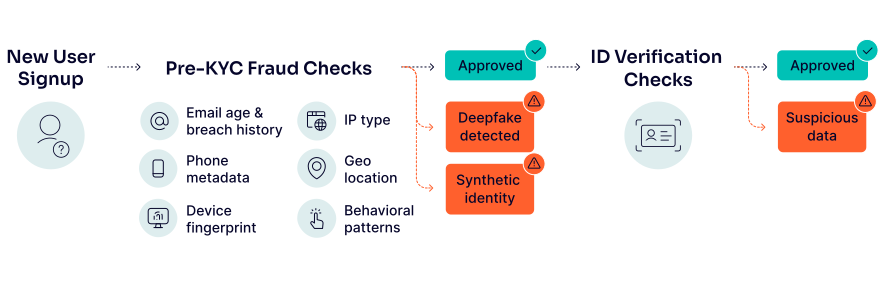
Once these steps are complete, the customer can move into full KYC verification and ongoing monitoring.
If something doesn’t match, it doesn’t always mean rejection, it usually means the case needs more information or manual review.
Why Is KYC Onboarding so Important?
KYC onboarding sets the foundation for a compliant and secure customer relationship. It’s where you collect and validate the information needed to confirm a customer’s identity and decide whether they can be approved, or whether the case needs extra checks.
Done well, it helps you meet AML and identity verification obligations, reduce fraud risk, and avoid spending time on incomplete or suspicious applications. It also improves the customer experience by keeping legitimate users moving through signup while routing higher-risk cases to review.
In practice, strong KYC onboarding supports customer due diligence (CDD), reduces false positives, and lowers drop-off caused by unnecessary friction.
SEON uses proprietary signals and 300+ digital and social platforms to verify identities, assess risk, and stop fraud early
Speak with an Expert
KYC Requirements for Customer Onboarding
KYC onboarding requirements vary by industry and jurisdiction, but most programs include the same core elements:
- Record-keeping: storing evidence and decisioning outcomes to support audits and ongoing monitoring.
- Customer information (PII): full name, date of birth, address, and contact details (and, where required, national ID numbers such as SSN in the US).
- Identity evidence: a government-issued photo ID and, in many cases, proof of address.
- Data and document validation: checks that the information is complete, consistent, and appears legitimate.
- Sanctions and PEP screening: checks against sanctions lists, politically exposed persons (PEPs), and watchlists.
- Initial risk assessment: assigning a risk level to decide whether the customer can be approved or needs enhanced due diligence (EDD).
Meeting these requirements creates an audit-ready onboarding trail and supports AML compliance from the start of the customer relationship.
Benefits of the KYC Onboarding Process
The benefits of KYC onboarding go beyond compliance. When designed well, it helps organizations reduce risk, improve operational efficiency, and limit unnecessary friction during customer signup.
Key benefits include:
Regulatory compliance
KYC onboarding helps businesses meet AML and identity verification requirements by collecting and validating customer information at the point of entry, creating a documented, auditable foundation for customer due diligence before access to products or services is granted.
Lower fraud and financial crime risk
Early identity checks and screening help catch red flags before an account is approved, reducing exposure to money laundering, sanctions and PEP risks, and identity fraud that can otherwise slip through during high-volume onboarding.
More efficient onboarding
Capturing and validating customer data upfront helps prevent delays later in the onboarding journey, reduces back-and-forth requests for additional information, and cuts down on manual reviews as the customer moves through verification and account approval.
Reduced customer drop-off
Risk-based onboarding lets low-risk customers move through signup quickly with minimal friction, while higher-risk cases are automatically flagged and escalated for additional checks or manual review before approval.
Stronger trust and reputation
Clear, transparent onboarding shows customers that the business takes security and customer protection seriously, setting expectations early and building trust by explaining why certain checks are needed and how their information is handled.
Overall, effective KYC onboarding supports compliance while creating a smoother experience for legitimate customers. As Nauman Abuzar, Director of Product, AML & Risk Solutions at SEON, notes, “Early detection doesn’t just stop fraud. It keeps your onboarding process smooth for good users, your compliance team efficient and your risk strategy one step ahead.
What Is the Relationship Between KYC Onboarding and AML?
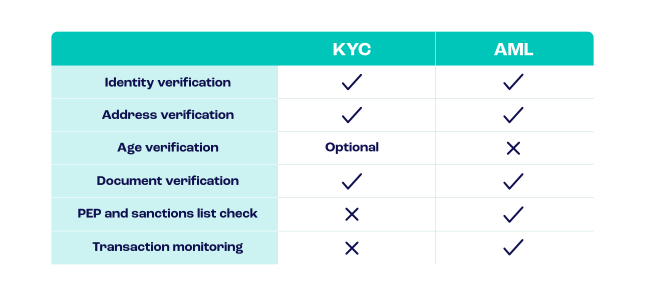
Both KYC onboarding and AML require organizations to verify the identity of individuals to meet their KYC onboarding and AML are closely related, but they aren’t interchangeable. AML is the broader framework for preventing money laundering and terrorist financing. KYC onboarding is one of the first steps within that framework, focused on collecting and verifying customer information at signup and assigning an initial risk level.
The data gathered during KYC onboarding feeds AML controls like screening and ongoing monitoring, so teams can make risk-based decisions and keep an audit trail.
The table below highlights where AML and KYC overlap and how they differ.
How to Improve Your KYC Customer Onboarding Processes
A crucial thing to remember with KYC onboarding and KYC itself is that there must be minimal friction for a prospective customer to enter the signup stage (and, later, the account creation stage). The best way to improve your KYC onboarding process is to minimize, rather than remove, friction.
With this in mind, here’s a list of recommended actions to help reduce friction:
- Deploy pre-KYC checks by ensuring prospective customers provide their basic details at signup.
- Enable dynamic friction by allowing low-risk individuals to be quickly onboarded. Meanwhile, act on the fact that those who are harder to verify will need to provide further information. For example, individuals whose addresses can’t be found on your database may need to provide more documentation than those whose details are found straight away.
- Weigh up your KYC procedures and solutions by determining what will and won’t stand the test of your KYC onboarding demands. For instance, if it’s too time-consuming to have your staff carry out photo ID verification, consider integrating biometric authentication solutions.
- In such a case, you could forgo asking prospective customers to email you a scanned copy of their passport or driving license and instead request they send a video of themselves holding up their documentation and stating their full name and the date of the recording.
- Offer regular feedback throughout the process to manage prospective customers’ expectations. For example, when they complete the initial signup, ensure they receive an automatic welcome email that details how the business will process their information.
- An important message in your welcome email is that while your organization will only ever ask for necessary documentation, it may require further information if any complications arise during the initial verification stage.
The best ways to improve KYC customer onboarding are to ensure prospective customers are well-informed and encounter as few delays and as little admin and repetition as possible.
How Can SEON Help in Your KYC Customer Onboarding Process?
SEON supports KYC onboarding by helping teams assess customer risk earlier and more efficiently, without adding unnecessary friction to the signup experience.
As customer data is submitted, SEON can screen individuals against sanctions, PEPs, and watchlists, while also enriching onboarding decisions with digital identity signals. This added context helps validate customer information, reduce false positives, and keep manual reviews focused on the cases that genuinely need extra checks.
SEON can run these checks automatically in the background, or teams can trigger them manually when needed. With configurable rules and APIs, organizations can approve low-risk customers faster, route higher-risk cases for review, and maintain a clear audit trail for compliance.
The result is a smoother, faster KYC onboarding process that balances compliance, risk management, and customer experience.
Frequently Asked Questions
No. KYC can only occur after KYC onboarding is completed. Just as someone cannot become a gym member without being onboarded onto the gym’s system, a prospective customer cannot progress to the KYC process until they’ve passed the KYC onboarding phase.
The prospective customer provides a valid and adequate amount of personally identifiable information (PII) so that the organization can approve the individual’s account creation process.
KYC onboarding requires due diligence and AML compliance through the organization receiving, validating, and (when permitted) storing its prospective customers’ PII. Many KYC onboarding processes also require background checks, from social media assessments to PEP screening.