Anti-money laundering (AML) case management is the centralized process of collecting, investigating and reporting suspicious financial activity to regulatory authorities. Modern AML case management systems unify transaction monitoring, customer screening and fraud intelligence into a single operational interface.
This structured approach helps compliance teams eliminate manual spreadsheet tracking, reduce false positive alerts and accelerate mandatory filings such as Suspicious Activity Reports (SARs) and Currency Transaction Reports (CTRs).
AML CASE MANAGEMENT AT A GLANCE
What is AML Case Management?
AML case management provides regulated institutions with a structured environment to review, investigate and resolve alerts generated by compliance monitoring systems. When automated systems flag transactions or customer profiles for potential money laundering, sanction breaches or terrorist financing, those alerts escalate into investigative cases.
Legacy compliance operations frequently rely on disconnected spreadsheets, manual data aggregation and fragmented communication channels. This fragmentation creates severe operational drag, leaving analysts to spend hours gathering context across separate tools.
Modern AML case management platforms solve this by aggregating digital footprint data, transaction history, Know Your Customer (KYC) details and screening matches into a unified dashboard. Centralizing this context enables compliance analysts to evaluate risk rapidly and maintain complete audit trails for regulatory bodies such as FinCEN, FinTRAC and the NCA.
How Modern AML Case Management Systems Work
An effective AML case management system operates as an intelligence hub, turning raw transactional alerts into structured, actionable investigations.
Centralizing Customer Data and Risk Profiles
Modern case management platforms connect directly to core banking systems, payment processors and external databases through lightweight Application Programming Interfaces (APIs). When an alert fires, the platform automatically compiles the customer’s full profile, including historical transaction volumes, verified identity documentation, associated card hashes and ongoing watchlist screening results.
Centralizing customer context eliminates manual data searching across disparate systems. Analysts immediately see whether a flagged event represents an isolated anomaly or a broader pattern of suspicious behavior across multiple accounts.
Unifying Fraud Signals with Compliance Data
Traditional compliance tools evaluate transaction values, volumes and velocity in isolation. However, financial crime rarely occurs without preceding digital indicators. Fraud and AML (FRAML) convergence integrates real-time digital biometrics, IP geolocation context and device intelligence directly into the compliance workflow.
By capturing server-side signals such as active remote access software, residential proxy usage, or mismatched hardware configurations, compliance engines gain critical behavioral context. Combining deep technical indicators with financial transaction logs enables analysts to distinguish legitimate high-value users from compromised accounts or money mule networks.
“Bringing fraud signals like device intelligence and IP context into transaction monitoring allows compliance teams to move away from static rules and reduce false positives through behavioral context.”
Nauman Abuzar, VP of AML Compliance and Risk
Automating SAR Narratives and Regulatory Filings
When an investigation confirms suspicious activity, compliance teams must file formal regulatory reports. Manual completion of SARs, CTRs or regional equivalents requires significant time to format transaction logs and write detailed narrative summaries.
Advanced case management platforms streamline regulatory reporting by auto-populating mandatory data fields directly from the case record. Embedded generative AI tools assist analysts by drafting structured narrative summaries that follow regulatory guidelines, outlining who was involved, what occurred, when it happened and why the behavior raised suspicion. Analysts retain full editorial control to review, edit and finalize the narrative before submitting reports directly to regulatory portals.
Legacy Tracking vs. Modern AML Case Management
| Operational Feature | Legacy Manual Process | Modern AML Case Management |
| Data Aggregation | Manual extraction across separate databases | Automatic centralization via real-time APIs |
| Risk Context | Basic transaction amounts and static user details | Combined fraud biometrics, IP and hardware signals |
| Alert Allocation | Manual triage via email or spreadsheet assignment | Automated workload balancing and skill-based routing |
| Reporting Workflow | Manual narrative drafting and form completion | Generative AI narrative generation and auto-filled forms |
| Audit Trail | Dispersed notes and unstandardized logs | Immutable, timestamped activity records and checklists |
Resolving Common AML Workflow Challenges
Compliance departments face mounting regulatory scrutiny while managing high alert volumes. Modern AML case management frameworks resolve core workflow bottlenecks to maintain strict operational integrity.
Detect Structuring and Smurfing Typologies
Bad actors frequently split large sums of illicit cash into smaller, consecutive transactions to bypass mandatory currency reporting thresholds. This practice, known as structuring or smurfing, often evades basic transaction monitoring rules set to static dollar cutoffs.
Advanced case management engines apply velocity rules and historical lookback windows to catch structured payments. By tracking cumulative transfer volumes across short timeframes, the platform automatically aggregates related micro-transactions into a single case, alerting analysts to hidden patterns before funds leave the institution.
Eliminate Alert Fatigue with Search Profiles
High rates of false positive alerts overwhelm compliance teams, leading to delayed reviews and analyst burnout. False matches often stem from blanket search parameters that treat all customer segments identically.
Configurable search profiles allow institutions to adjust fuzzy logic matching thresholds based on specific risk tiers, product lines, or geographic regions. High-risk accounts or Politically Exposed Persons (PEPs) can be screened against strict string-matching parameters, while lower-risk cohorts utilize calibrated thresholds. Customizing search parameters reduces unnecessary noise without exposing the institution to unmitigated risk.
Standardize Multi-Tiered Investigation Checklists
In complex institutions, investigations often pass through multiple lines of defense before reaching resolution. A first-line analyst may perform initial screening, while a second-line compliance manager executes final SAR approval.
Integrated investigation checklists enforce standardized review procedures across every tier. Analysts must complete mandatory verification steps, log investigative notes and confirm document reviews before escalating or closing a file. This structured workflow ensures every decision meets internal risk policies and provides regulators with a complete, timestamped audit log.
Maintain Auditability for Regulatory Examinations
AML case management transforms how regulated entities conduct financial investigations, streamlining the entire lifecycle from initial alert to final resolution. By centralizing data and automating manual aggregation, these systems eliminate workflow fragmentation, enabling compliance teams to respond to suspicious behavior with greater speed and accuracy.
Unifying fraud and AML intelligence within a single platform fosters cross-team collaboration while maintaining immutable, timestamped records of every decision. This automated end-to-end transparency minimizes human error and ensures complete auditability during regulatory examinations, allowing institutions to swiftly adapt to new compliance standards without sacrificing operational momentum.
How SEON Supports AML Case Management
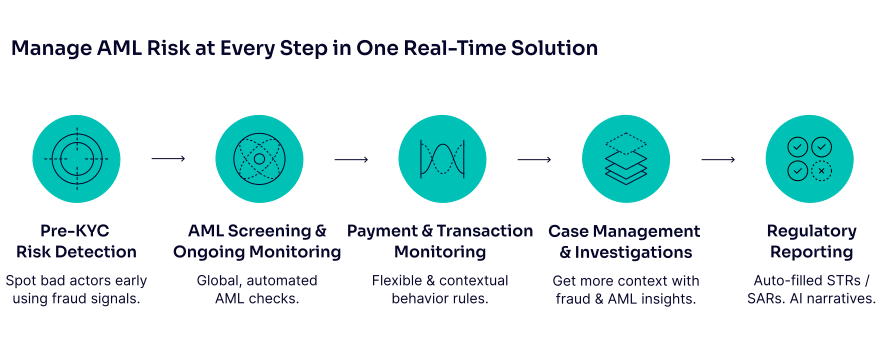
SEON offers a flexible risk platform that unifies real-time fraud detection with AML compliance workflows. By evaluating over 1,100 proprietary data signals, SEON enables compliance teams to investigate alerts and report financial crime efficiently.
- Unified FRAML intelligence. Combine device fingerprinting, IP proxy detection and digital footprint analysis with transaction monitoring to reduce false positives.
- Automated watchlist screening. Screen individuals and corporate entities against global sanctions, PEP lists, watchlists and adverse media, complete with ongoing background monitoring.
- Customizable workflow checklists. Build tailored review checklists and automated routing rules to maintain consistent investigation standards.
- AI-assisted regulatory reporting. Automatically populate report fields and draft structured narrative summaries to streamline SAR and CTR submissions.
FAQ
How do you measure the effectiveness of AML case management?
Effectiveness is measured through key performance metrics including average investigation time, alert-to-case conversion rates and false positive reduction. Modern systems track team performance, audit trails and regulatory turnaround times to ensure operational compliance.
How does AML case management software support compliance?
AML case management software supports compliance by centralizing risk data, maintaining immutable audit trails and automating regulatory reports. It ensures institutions meet regulatory requirements from authorities like FinCEN, FinTRAC and the NCA without manual data entry.
What is the difference between AML screening and transaction monitoring?
AML screening verifies customer identities against sanctions, PEPs and watchlists during onboarding or periodic reviews. Transaction monitoring continuously analyzes live transaction velocity, volume and behavioral patterns to detect active money laundering schemes.
Can generative AI assist with SAR filings?
Yes. Generative AI assists compliance teams by automatically drafting SAR narratives based on transaction history and alert context. Analysts review and edit the structured draft before submitting the final report to regulatory agencies.
Does AML case management support ongoing monitoring?
Yes. Modern AML case management engines perform continuous background rescreening against updated sanctions and watchlists. When risk statuses change, the system automatically generates an escalated alert for immediate analyst review.