Most digital onboarding journeys follow a familiar script. A new user signs up. A government-issued ID is requested. A selfie is taken. Boxes are checked. And somewhere along the way, identity is assumed to be verified.
It’s a process that looks secure and is designed to satisfy auditors and meet compliance requirements. But fraud doesn’t play by those rules. Sophisticated attackers test your systems from the first click, exploiting the moments before verification begins.
This is the blind spot of document-first identity verification. It offers a flat, two-dimensional view of identity, reacting to fraud only after it’s already in the door. Real verification starts not with a scan but with context, aka the subtle signals in how someone connects, moves and interacts online that reveal whether they’re genuine long before their photo or picture of their ID appears on screen.
Why Traditional IDV Flows Are Built Backwards
Despite the evolving threat landscape, most identity verification programs still rely on this linear, outdated logic: collect credentials first, assess risk later. However, in today’s environment, that sequence doesn’t verify identity; it simply grants access.
Fraudsters exploit this order with ease. Armed with stolen documents, synthetic identities, deepfake tools and AI-crafted personas, they clear the first hurdles without raising suspicion. The ID looks authentic, the face matches, but none of it truly confirms that they are the person they claim to be.
Identity verification still plays a vital role in modern verification, but it cannot stand alone. Relying solely on documents and selfies leaves a critical gap at the beginning of the user journey, where fraud signals often emerge first. To close that gap, the process needs to be reimagined. Verification should start not with a scan but with signals, including email and phone history, including digital footprints and associated online profiles, device signals, IP intelligence and behavioral patterns. These early indicators help determine whether a user is genuine, suspicious or something in between before any document is submitted.
Why Documents Alone Can’t Prove True Identity
Documents can confirm what someone claims, but not who they truly are. The distinction matters more than ever in an era where synthetic identities and stolen credentials are easily weaponized.
Bad actors can now easily assemble identities that pass surface-level checks. They can source a valid ID, pair it with a matching deepfake and even clear database queries using real but misused personal data. What’s much harder to fabricate is continuity — the rich, multi-dimensional footprint of a real person who has existed and interacted naturally online over time. That’s where digital history becomes invaluable.
Signals such as the age and usage patterns of an email address or signs of organic online activity, including social media presence, prior logins from the same device or inclusion in historical breach data, all help construct a narrative. These signals can’t be fabricated or faked with ease, and together, they reveal whether you’re dealing with a real person or just a well-constructed illusion.
Catching Risk Before It Puts on a Face
By the time a document is uploaded, much of the story has already been written. Long before a user submits a selfie or an ID, they’re revealing key signals — if you know where to look. An email address created just minutes before signing up. A phone number tied to dozens of other accounts. A device that appears across multiple users. An IP routed through a VPN, paired with behavior that moves too quickly to be human.
These are all real-time indicators of intent, legitimacy or deception. The platforms that treat them as primary inputs instead of secondary checks gain a critical advantage: they’re able to assess intent at the outset, flag risk before it escalates and allocate resources more intelligently. This is a smarter, more proactive way to manage trust from the very first interaction.
Rethinking Your Identity Verification Stack
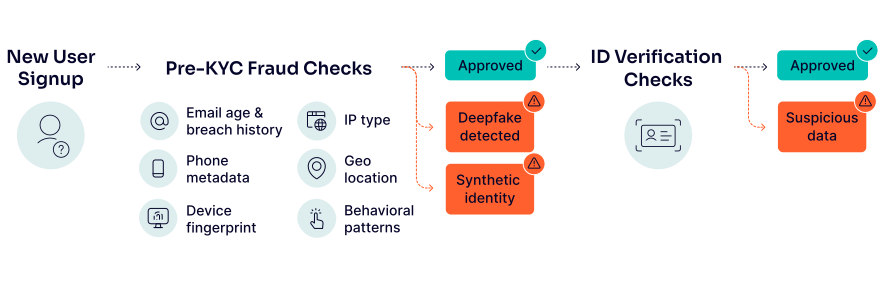
In a fraud-first model, the process starts with early screening: signals like email age, phone number reputation, device fingerprinting, IP patterns and behavioral consistency. This pre-KYC layer filters out synthetic identities that might otherwise sail through traditional document checks. No digital footprint? No need to proceed.
ID verification still plays a key role, but only after this initial context is established. At that point, risk scoring determines the next steps: low-risk users move through quickly, while higher-risk ones undergo additional checks. Fraud context remains active throughout the entire process, helping to spot mismatches between a user’s appearance and their underlying data.
Solutions like SEON make this strategy practical, surfacing over 900 real-time signals across identity, device, network and behavior. The goal isn’t to stack more tools but to sequence smarter decisions. By embedding this intelligence throughout the flow, verification becomes contextual, dynamic and far harder to game.
The Payoff of Flipping the Funnel
Smarter orchestration also reshapes how teams operate. When risk intelligence is embedded from the start, verification becomes more targeted, efficient and less wasteful across the board.
Fewer fraudulent sessions make it to the ID check, cutting down KYC spend and saving on verification credits. Low-risk users experience faster onboarding with fewer manual touchpoints. Review queues shrink, analysts get to focus on meaningful edge cases and pass rates climb for legitimate users who might otherwise have been caught in unnecessary friction.
Every layer downstream becomes sharper. Instead of treating each step as a siloed task, the process draws strength from earlier context, letting fraud signals shape how documents are assessed, how compliance actions are triggered and how teams intervene. The result is a system that’s not just faster or cheaper but fundamentally smarter in how it detects and responds to risk.
The Future of Identity Verification Is Multi-Dimensional
As fraud tactics evolve and regulators demand more nuanced, risk-based approaches, the most advanced systems are moving toward context-first identity verification, where behavior, signals and intent are assessed before the first credential is submitted.
In this model, identity verification doesn’t disappear — it just gets smarter and becomes one layer in a broader strategy, powered by intelligence that’s already in motion. In the age of AI-generated identities and synthetic fraud, trust doesn’t begin when an ID is uploaded. It starts long before the camera turns on.